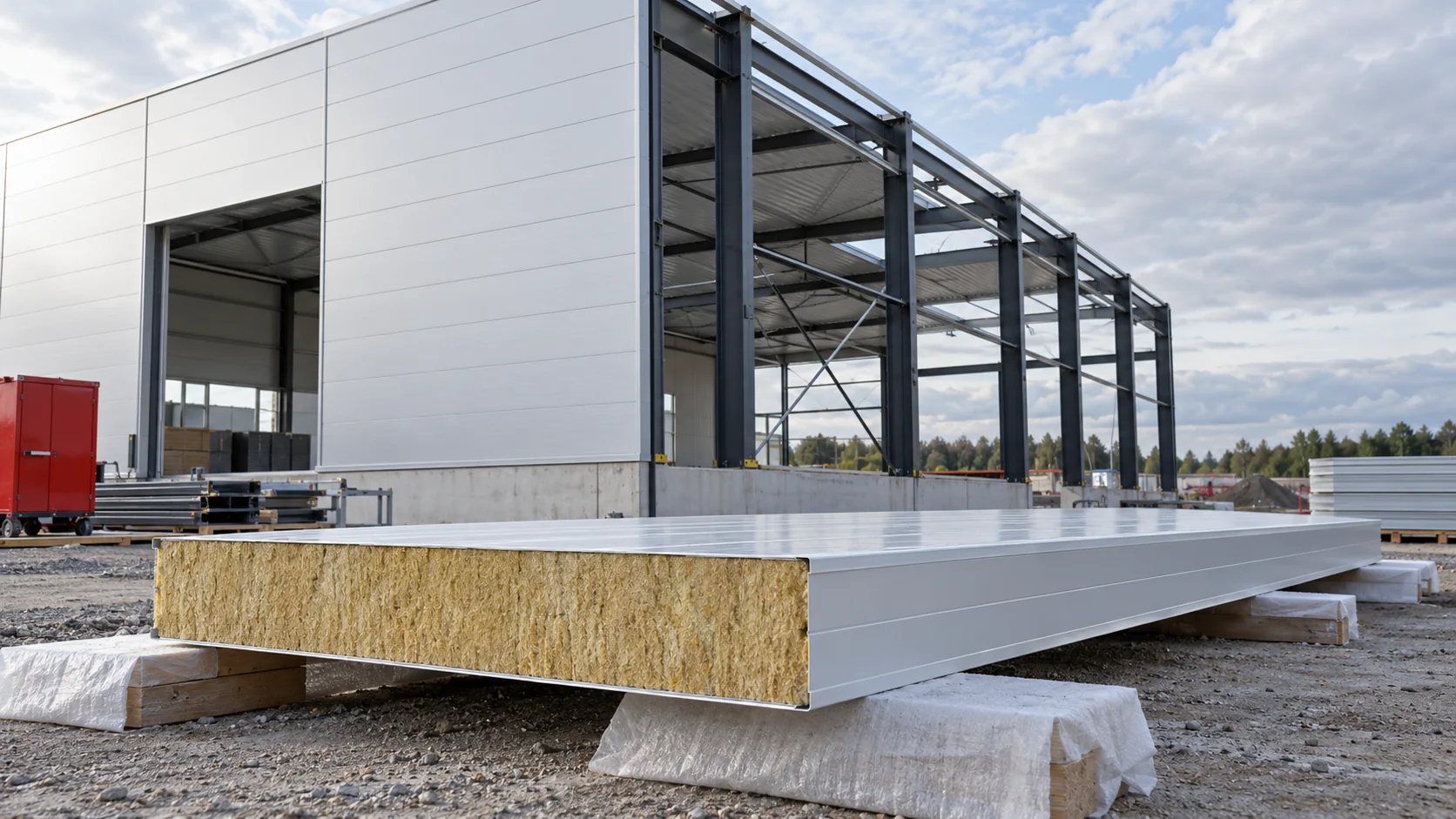
What is a 60 mm mineral wool panel suitable for, and can 40 mm be ordered?

The 60 mm thickness appears in selected wall panel families with mineral wool, but it is not a universal minimum for all systems. A 40 mm version should not be assumed simply because that dimension exists with a different core. First establish the function of the wall, then check the actual range of the product offered. An insulation panel with mineral wool and a sandwich panel with two metal facings are different products. A thin layer of insulation may appear in many systems, but that does not prove the availability of a self-supporting panel of the same thickness. In your enquiry, state the type of element explicitly.
By |2026-11-14T10:37:51+01:002024-09-13|Knowledge base|Comments Off on What is a 60 mm mineral wool panel suitable for, and can 40 mm be ordered?

How panel length affects the weight and handling of mineral wool wall panels

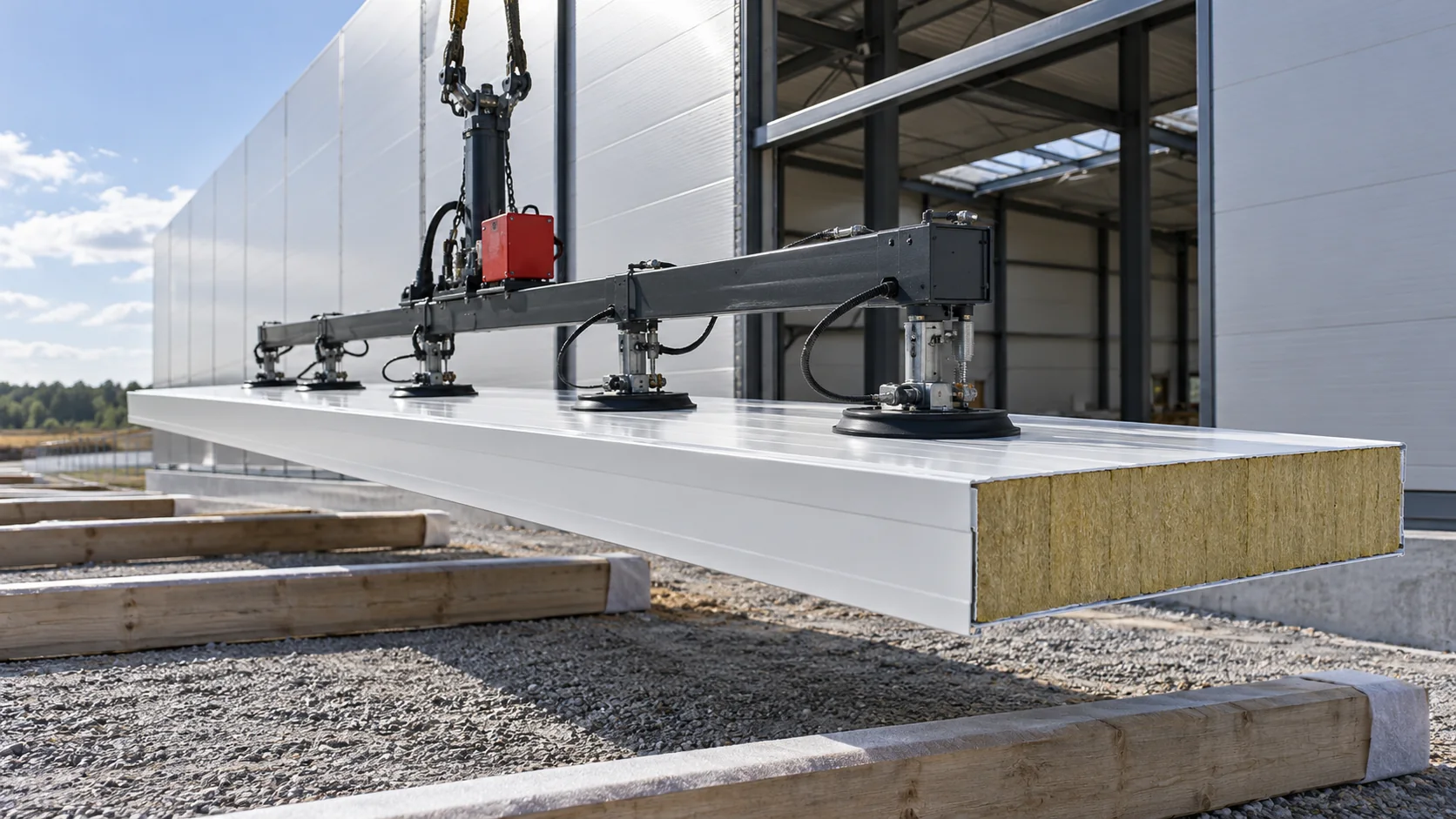
The mass per square metre helps compare panels, but on site a specific piece is lifted. A long panel can weigh considerably more than a small sample suggests. In a new building, the weight calculation must be combined with the support design, the choice of equipment and access to the installation location. The configuration of both facings is also important. The mass may be given in kg/m² or in kg/linear metre for a specific module. In the second case, a linear metre does not mean a square metre unless the cover width is exactly one metre. This difference is worth checking before compiling loads and ordering transport.

By |2026-11-14T10:37:46+01:002024-08-15|Knowledge base|Comments Off on How panel length affects the weight and handling of mineral wool wall panels

What determines the service life of an insulated wall panel with a mineral wool core?

There is no single number of years that describes every mineral wool panel. A wall facing a busy road, a sheltered rear wall and a damp interior all perform under different conditions. The durability of a new enclosure should be planned as the interaction of coatings, tight joints and structure, with consideration for later access to important details. Outside, precipitation, solar radiation, pollutants and proximity to sources of salt matter. Inside, humidity, process operations, cleaning agents and temperature must be described. The same building may require different protection for the sheet steel in a dry storage area and in a room that will be regularly washed.

By |2026-11-14T10:37:15+01:002024-03-01|Knowledge base|Comments Off on What determines the service life of an insulated wall panel with a mineral wool core?

What are the advantages and limitations of mineral wool panels in a new hall?

The mineral wool in a sandwich panel is part of a composite element with metal facings. Its advantages must be assessed together with the weight, the joint and the coating. In a new hall, the choice affects the purlins, the lifting equipment, the openings and the sequence of works. It is therefore worth comparing at the level of the finished envelope, not solely the cores. Panels with a mineral core are often chosen where reaction to fire and the fire resistance of the wall are important. These are, however, two separate parameters. The classification of the whole panel also covers the facings and the bonding layers, and fire resistance refers to a specific partition.

By |2026-11-14T10:37:30+01:002024-01-14|Knowledge base|Comments Off on What are the advantages and limitations of mineral wool panels in a new hall?

Reading thermal conductivity, R-values and U-values for mineral wool sandwich panels

Lambda characterises the material, R-value describes a layer of a given thickness, and U-value describes heat transfer through a building element or a specified component. These values should not be used interchangeably. When choosing a wall made of mineral wool boards, it is also important whether the stated figure includes joints and how it relates to the whole building. The thermal conductivity λ is given in W/(m·K). The lower it is, the greater the thermal resistance that can be achieved from the same thickness of homogeneous material. Within mineral wool board families there are different values, depending on the core used and its declaration.

By |2026-11-14T10:37:33+01:002023-11-30|Knowledge base|Comments Off on Reading thermal conductivity, R-values and U-values for mineral wool sandwich panels

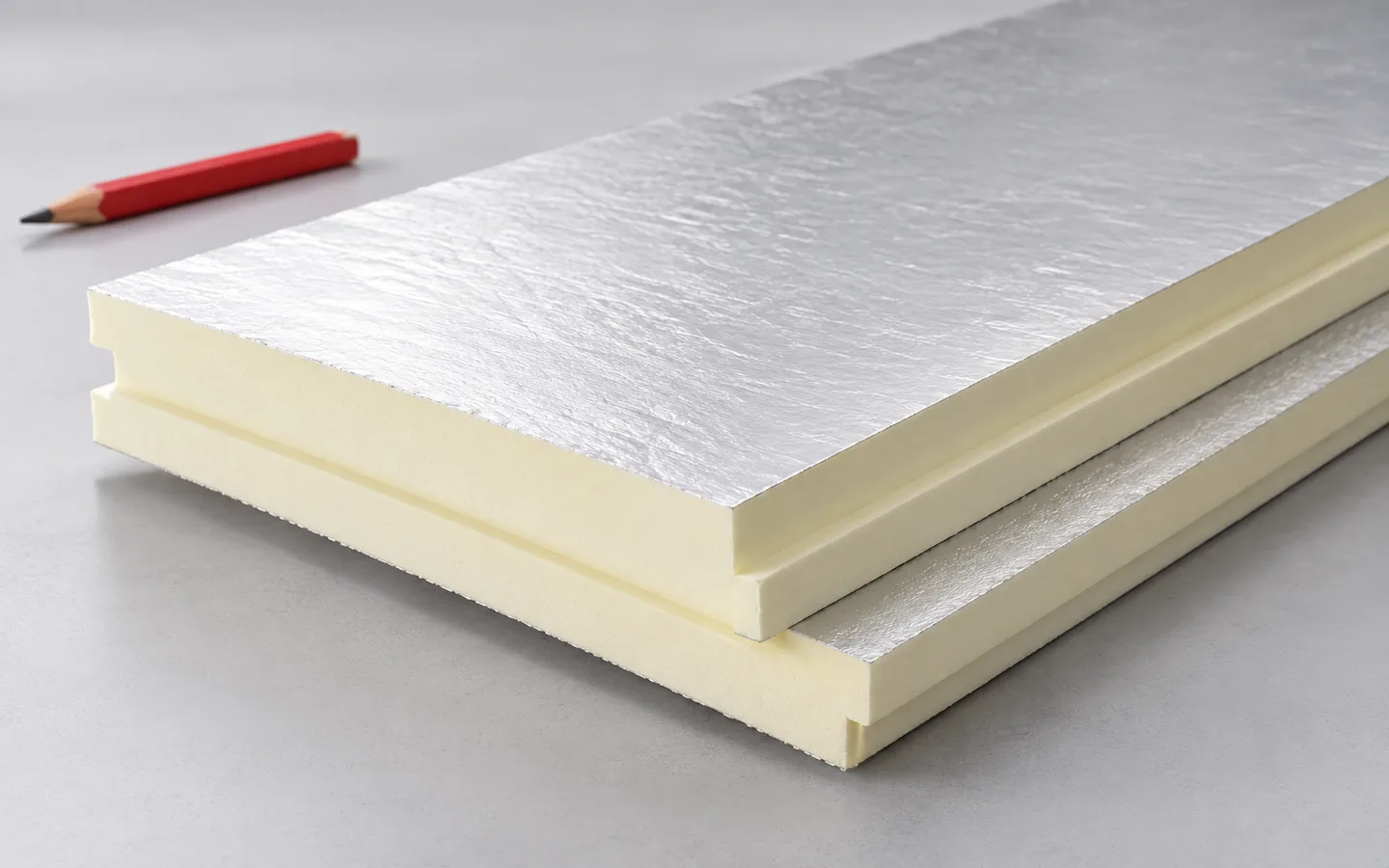
PIR, EPS, XPS or mineral wool: choosing insulation for the roof build-up

Start by establishing where the heated part of the building ends, not by comparing material coefficients. If the loft is unheated, insulate the partition above the rooms; if it is used, insulate the roof slope together with its wall junctions. Only then compare PIR, EPS, XPS and mineral wool at the required thermal resistance and permitted layer arrangement, taking account of support, moisture, fire and loads. PIR delivers high resistance at low thickness, wool suits fire and acoustic requirements, EPS can be economical, and XPS is chosen where resistance to moisture and compression is needed. No material replaces airtightness, waterproofing and correct details.

By |2026-11-14T23:58:35+01:002023-09-22|Knowledge base|Comments Off on PIR, EPS, XPS or mineral wool: choosing insulation for the roof build-up

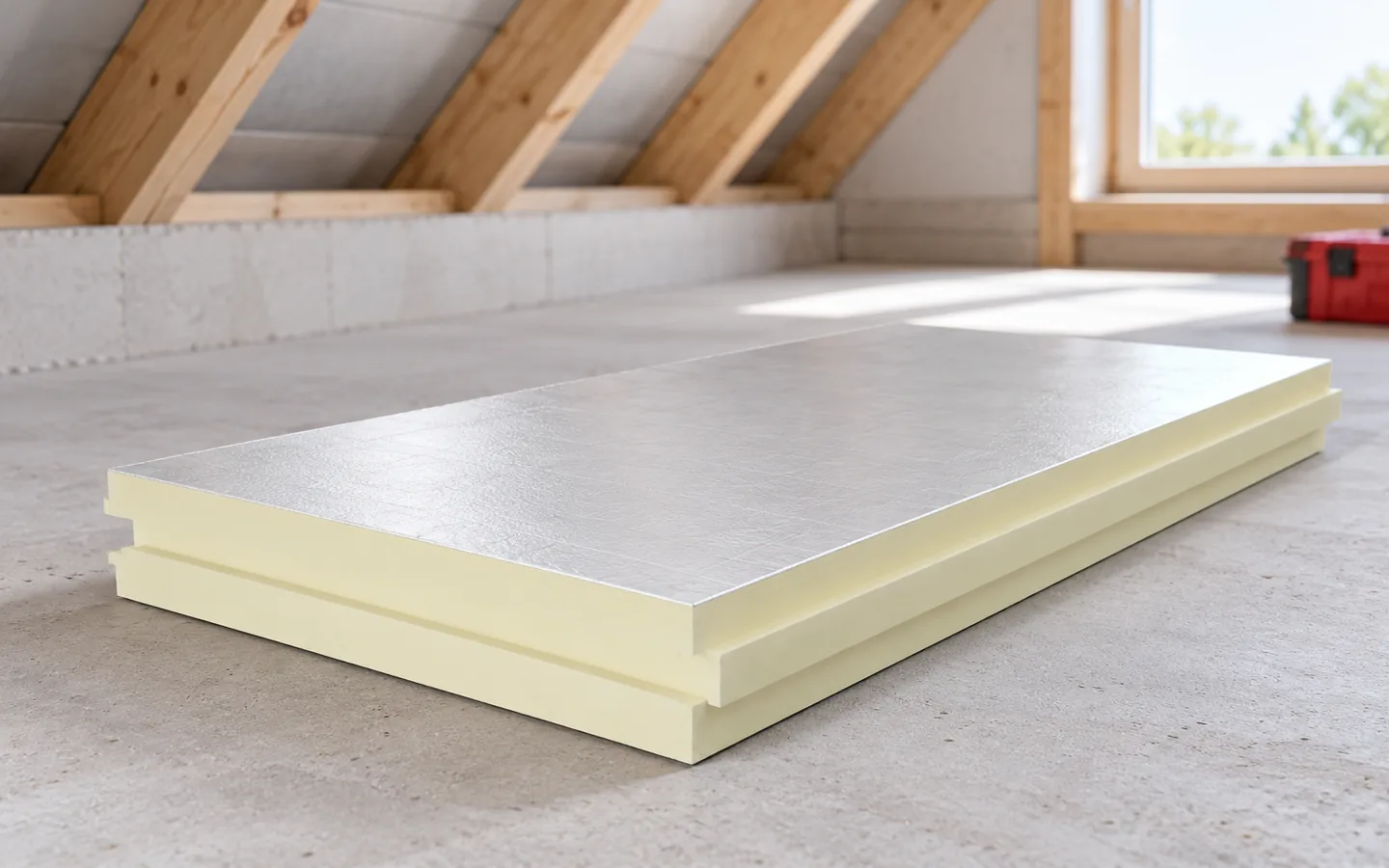
Keeping loft insulation continuous at walls, windows and service penetrations

The most demanding parts of a loft insulation job are the roof-to-wall junctions, window frames and service penetrations. At each one, the insulation needs to continue without a gap and the layer on the room side needs an airtight seal. Before choosing a material, check the condition of the roof, how moisture can escape and how much headroom you can spare. Mineral wool between the rafters and PIR boards above them occupy different positions in the roof. Draw the junctions to see where a further layer is needed. Inspect them with the installer while they are still accessible, before the lining goes on.

By |2026-11-15T03:58:14+01:002023-08-19|Knowledge base|Comments Off on Keeping loft insulation continuous at walls, windows and service penetrations

How do you choose the wool panel thickness for the warm and cold zones of a building?

The thickness of a wall wool panel should be matched to the building zones, not to a single nominal value for the whole project. A warm office and a cool warehouse may require a different approach. Fire, wind and the geometry of openings come on top of thermal performance. The 60–200 mm range is a point of comparison for specific variants, not a ready-made recipe. Determine which rooms will be permanently heated, periodically heated or cooled. Note the expected humidity and how often the gates are opened. For each zone, the designer sets the thermal requirements in line with the function and the regulations applicable to the project.

By |2026-11-14T10:38:01+01:002023-07-10|Knowledge base|Comments Off on How do you choose the wool panel thickness for the warm and cold zones of a building?

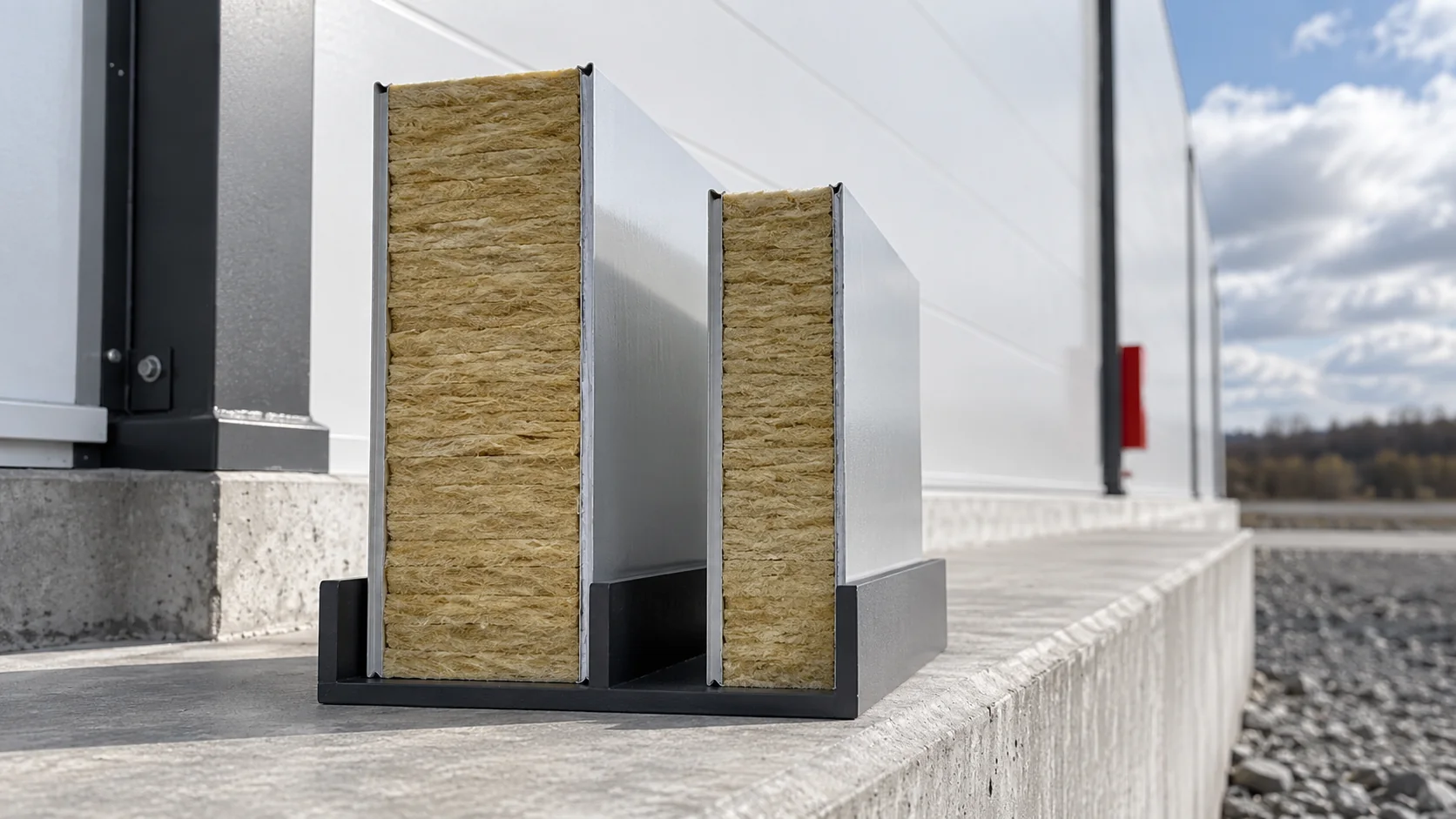
What changes when you choose 150 or 200 mm mineral wool panels in a wall design?

Moving from 150 to 200 mm increases the core thickness, but also changes the weight, the reveal depth and the length of the joints. The benefits must be related to the specific panel family and the function of the wall. In a new building it is easier to use a thicker panel when its impact on the fenestration, structure and flashings is planned before these elements are installed. For an example wall panel with concealed fixing and 0.5/0.5 mm facings, the 150 mm variant has Uc 0.27 W/(m²·K) and a weight of 23.4 kg/m². In the same family the 200 mm variant has Uc 0.20 W/(m²·K) and a weight of 28.4 kg/m². The change in weight is therefore 5 kg/m².

By |2026-11-14T10:37:49+01:002023-05-13|Knowledge base|Comments Off on What changes when you choose 150 or 200 mm mineral wool panels in a wall design?

When do outlet mineral wool wall panels save money on a new build?

A second-grade mineral wool panel may suit a new build if its limitations are known before the elevation is drawn. The saving depends on the area that can actually be installed. Joints, claddings and documents must also be checked, because a visual defect and a loss of tightness have entirely different consequences. In a new hall, the outlet is best assessed against a specific wall drawing. Mark the gates, windows, corners and plinth height. Only then compare the lengths of the available panels with the sections between supports. A short panel may fill the strip above a window well while being unsuitable for the entire adjacent field.

By |2026-11-14T10:37:13+01:002022-10-27|Knowledge base|Comments Off on When do outlet mineral wool wall panels save money on a new build?
Back to top