Mineral wool panels
What is a 60 mm mineral wool panel suitable for, and can 40 mm be ordered?
The 60 mm thickness appears in selected wall panel families with mineral wool, but it is not a universal minimum for all systems. A 40 mm version should not be assumed simply because that dimension exists with a different core. First establish the function of the wall, then check the actual range of the product offered. An insulation panel with mineral wool and a sandwich panel with two metal facings are different products. A thin layer of insulation may appear in many systems, but that does not prove the availability of a self-supporting panel of the same thickness. In your enquiry, state the type of element explicitly.
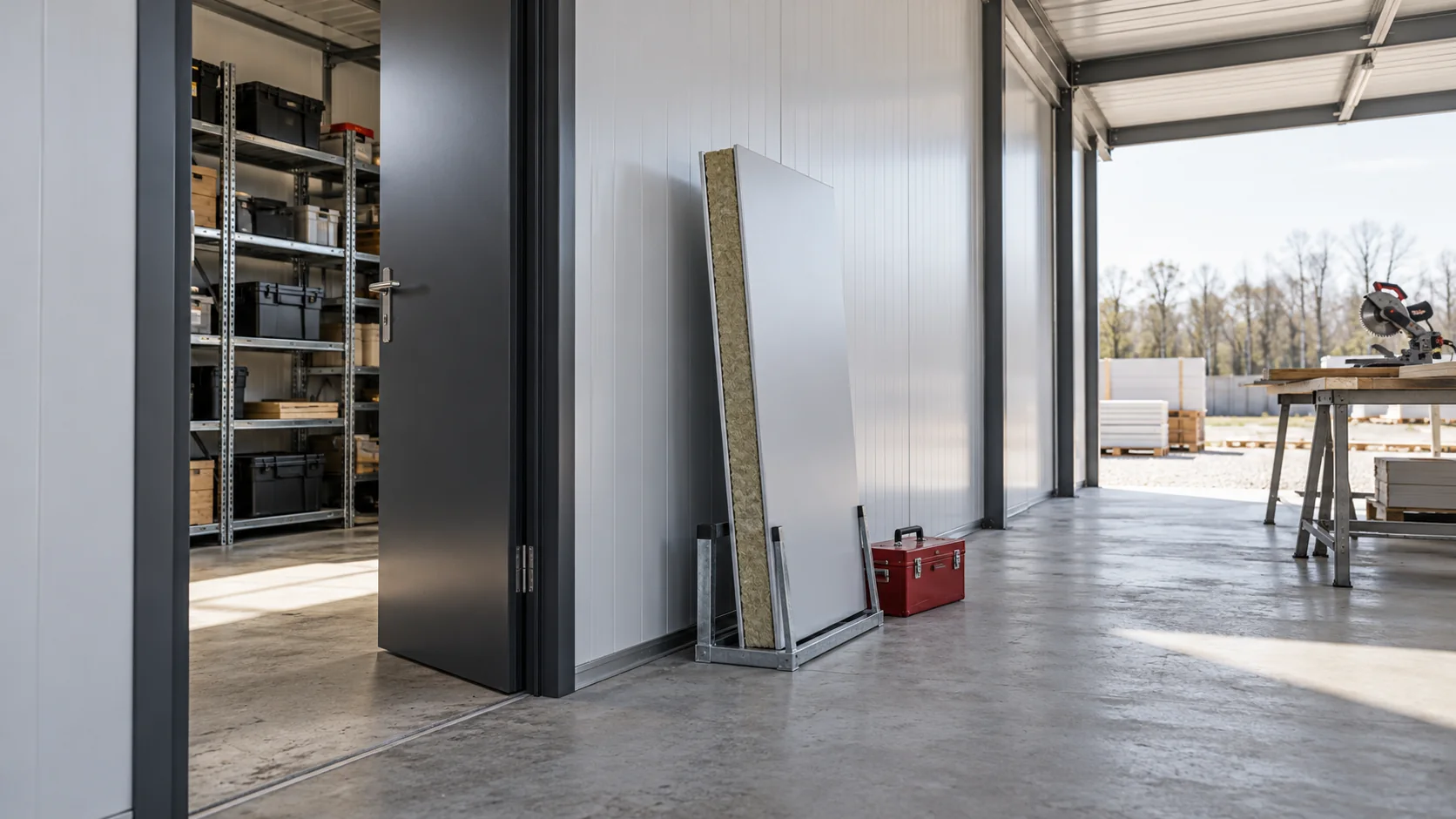
Check which panel is meant
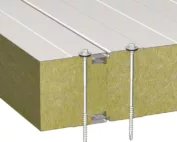
The production range also depends on the joint. One family with visible fixing may start at 60 mm, while the concealed-fixing version starts at a different thickness. Length, module and performance data should be sought for exactly that variant.
What the example of a 60 mm panel shows
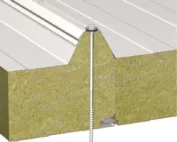
For a specific mineral wool panel with a core density of 100 kg/m³, visible fixing and 0.5/0.5 mm facings, a weight of 14.1 kg/m² and Uc 0.66 W/(m²·K) is given. These data clearly show that a thin panel does not provide the same insulation performance as thicker versions in this family.
These are not the parameters of all 60 mm panels. When selecting, load-bearing capacity, permissible lengths and fire properties must also be checked. Low surface weight may facilitate logistics, but the large area of a single piece still requires appropriate handling.
Consider partitions in unheated zones
A thin panel may be considered as cladding or space division where high thermal protection is not expected. An example is a new covered ancillary space, a dry storage area or a partition separating areas of similar temperature. Suitability must be confirmed for the actual conditions.
The absence of heating does not remove all requirements. Wind, moisture and temperature differences caused by the sun still apply. If the interior is to be heated periodically, the risk of condensation on cold details should be considered straight away. A later change of use may require a different solution.
Assess fire and noise independently of thickness
In the selected thin configuration, a particular fire property may not be declared. A missing result should not be replaced by the statement that the mineral wool alone is non-combustible. Reaction to fire and fire resistance of the partition describe different characteristics.
Likewise, it must not be assumed that any wall with mineral wool will soundproof a workshop or plant room. Data for the complete panel are needed, along with an assessment of doors, gaps and flanking transmission. A thin solution chosen for a lightweight warehouse partition may not meet the new acoustic requirement.

Plan for a lightweight ancillary space as a future option
For a new unheated back room, a thin panel may suit the current purpose. However, if the client plans a workplace in that area, the target conditions must be assessed straight away. The change does not concern the heating bill alone; it also affects ventilation, reveal temperature and the potential for moisture.
Compare the cost of the final solution with the cost of later rebuilding of the layers. Additional insulation from the inside may change the thermal and moisture regime, so it should not be treated as an automatic reserve. A clear usage plan allows a thin panel to be chosen deliberately, without assuming that every future problem can be solved by simply adding insulation.
Confirm the 40 mm version before changing the design
The absence of 40 mm in the datasheet checked means that the availability of this variant in the given family cannot be assumed. It is not proof that such a product does not exist anywhere on the market. If the offer includes a thin panel with mineral wool, full identification and documentation specific to that configuration are required.
Do not transfer the tables for the 60 mm panel or the data for the 40 mm PIR panel to it. Differences in core construction and the joint may change insulation performance, mechanical behaviour and application. The designer should receive information on the actual product before approving the supports.
Compare the benefit against the whole wall cost
A thinner panel may require shallower reveals and shorter fasteners, but it does not always reduce the cost of the complete partition. If it needs a denser substructure or an additional finishing layer, the initial saving may disappear. The comparison must cover the same scope of function.
In a new building, the planned use in subsequent years should also be taken into account. If the unheated area is soon to become a work room, the decision on a thin wall should be considered together with that change. Well-defined requirements are more valuable than choosing the lowest available thickness.
Questions and answers
Is 60 mm enough for a heated office?
This should not be assumed. The designer should check the thermal requirements of the whole building envelope, the operating conditions and the details. The availability of a thickness alone does not confirm suitability for a specific room.
Does a 40 mm panel with a different core replace 60 mm mineral wool?
Only after a new selection. All required properties must be compared, including fire, thermal performance, load-bearing capacity, joint and coatings. Different materials are not interchangeable on the basis of a single dimension.
7 branches. Materials closer to your project.