Roof and energy
Comparing three photovoltaic roof quotations without guesswork
Three final amounts are not enough to choose if each offer describes a different scope. First they must be brought to a common scope, and only then can price, energy and service be compared. With an integrated roof, the covering function and the details also matter. A simple table with a few groups of information makes differences visible. It does not require assigning seemingly precise points to things that have not yet been clarified. Every contractor should work from the same geometry, location and description of needs. If one offer was prepared after a measurement and another from an approximate area, this must be noted. It is worth asking for clarification before assessing.
How do you establish a common reference point?
A preliminary figure should not be treated as equivalent to a full cost estimate confirmed by a site survey.
Also establish whether all solutions actually perform the function of a photovoltaic roof covering. Modules added to a finished roof may be a reasonable alternative, but they require a different basis for comparison. If you mix these variants, include the cost of the complete roof in each. Otherwise the table will compare different investments.
What should go in the technical part of the table?
Record the system and component versions, the coverage area, the active–passive split and the output. Add the conditions of use, required layers and important limitations. Where data is unclear, enter ‘no information’ rather than filling it in yourself from another catalogue. The data should relate to what the contractor proposes in the order.
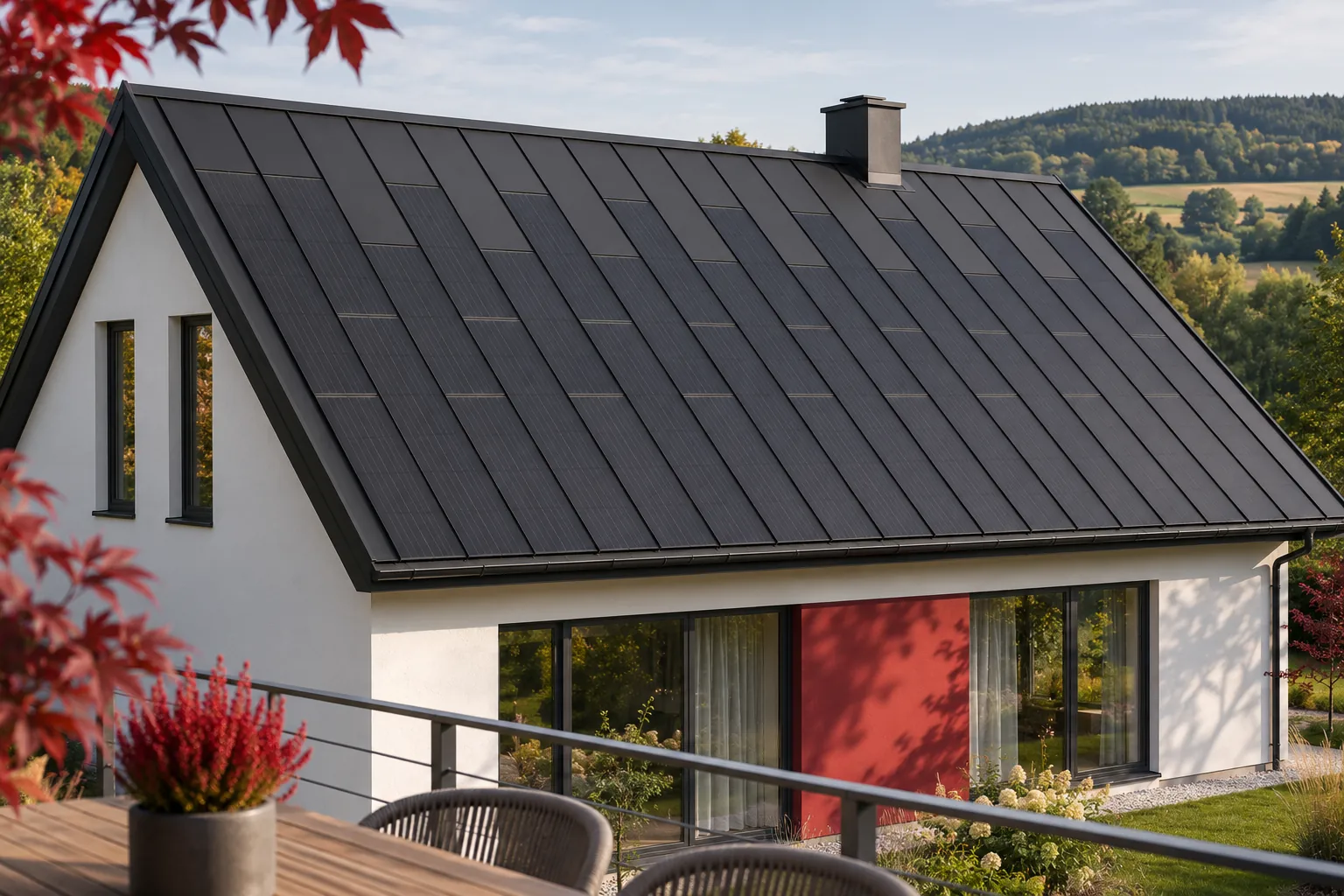
Also check the details of difficult locations. A quote for a simple roof slope may not cover a chimney, windows or a roof valley in the same way. It is precisely such sections that tend to be the source of later cost differences. In an integrated system, consistent aesthetics are an advantage, but they must result from the designed layout, not merely from a photo of a sample house.
How do you compare energy forecasts?
Ask for the monthly yield and the simulation assumptions. Orientation, shading, mounting method and assumed losses should be described. If one forecast omits a known obstacle, its higher result is not proof of a better product. The assumptions must first be harmonised. Otherwise an apparent technical difference may stem solely from optimistic calculations.
Compare monetary savings separately from energy. They should take into account the same consumption profile and the same billing method. A variant with storage is not directly equivalent to one without. They can be assessed together as different packages, but the additional cost and the function that justifies it must be shown.
How do you uncover differences in the price scope?
For each quote, check the design, transport, access, substrate preparation, installation and commissioning. It is worth adding documentation and work excluded from the price. If some items will be settled later, note their uncertainty. The lowest final amount may be only the narrowest estimate, though it does not have to be.
Do not add an arbitrary surcharge without justification. Ask the contractor for the missing price or a range resulting from specified conditions. This keeps the comparison verifiable. If the scope cannot yet be confirmed, the decision can be made conditional on a site inspection. It is better to clarify one major item than to create an elaborate ranking based on incomplete data.
How should warranty and service be compared?
Separate the warranties for the product, output, weathertightness and workmanship. Check the costs of access, dismantling and reinstating the covering. Add the reporting procedure and service availability. The number of years alone is not enough for comparison. Two similar-sounding promises may mean a different scope of services and owner obligations.
It is also worth asking about spare parts and documentation after repair. An integrated roof must function as both covering and installation, so servicing should restore both functions. An offer with clearly described coordination may be easier to use. This benefit can be assessed objectively, without assigning it an invented score or universal monetary value.
How to choose without false precision?
First, eliminate the variants that do not meet the confirmed building requirements. Then compare the remaining ones according to your own priorities: cost, appearance, yield and service. Mark information that is still uncertain. There is no need to declare a winner to the hundredth of a point if a significant installation condition remains unexplained.
A good choice is clear in a few sentences. It can be stated that the variant has a complete scope, fits the roof, ensures a consistent appearance and has a defined service path. A system steel covering is well suited to this approach when correctly designed. The comparison should lead to a justified decision, not just the best-looking table.
Examples of companies and brands in roof-integrated photovoltaics are Autarq, Wienerberger Wevolt, LUMA Solar, SolRoof, SunRoof, MDM NT (MyRoof), SoliTek, Terrán, Electrotile and ML System.
7 branches. Materials closer to your project.

- SEROCK — Dzierżenin 34 E
- BŁONIE — ul. Sochaczewska 138A
- RADOM — ul. Grobickiego 8
- ŁÓDŹ — Natolin 8
- OLSZTYN — Barczewo, ul. Prosta 9
- WROCŁAW — ul. Jerzmanowska 10C
- GORZÓW WLKP. — ul. Zielona 33/34