Mineral wool insulation boards
Reading thermal conductivity, R-values and U-values for mineral wool sandwich panels
Lambda characterises the material, R-value describes a layer of a given thickness, and U-value describes heat transfer through a building element or a specified component. These values should not be used interchangeably. When choosing a wall made of mineral wool boards, it is also important whether the stated figure includes joints and how it relates to the whole building. The thermal conductivity λ is given in W/(m·K). The lower it is, the greater the thermal resistance that can be achieved from the same thickness of homogeneous material. Within mineral wool board families there are different values, depending on the core used and its declaration.
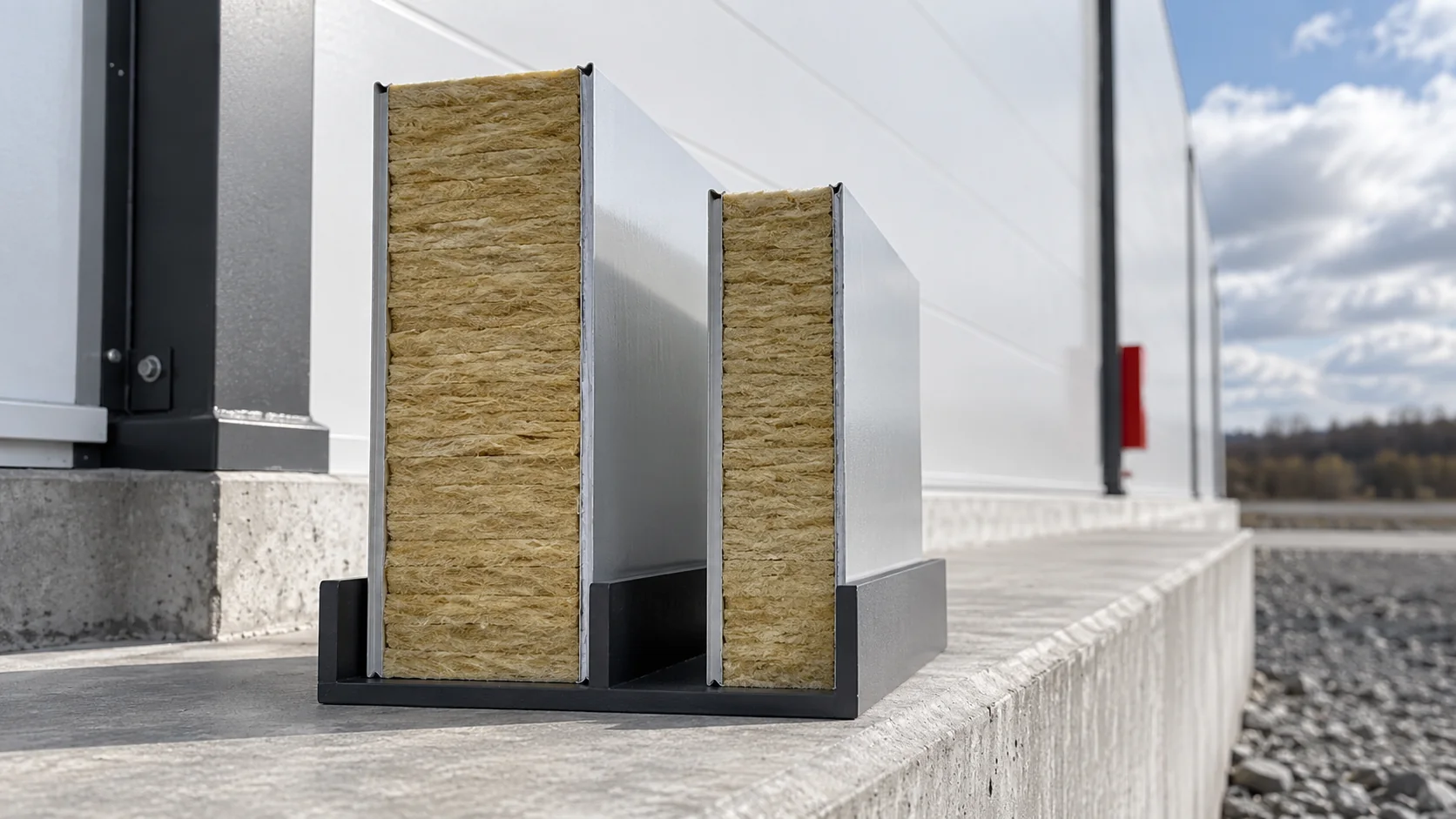
Lambda alone does not yet tell you how warm the wall is
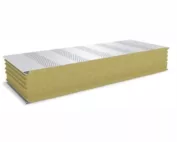
Don’t take a figure found for a loose insulation board and attribute it to a panel with steel facings. Mineral wool lamella working within a composite element is part of a specific product. For comparison you need the correct data sheet and parameters that match the configuration being ordered.
Calculate R only for a specific layer
For a homogeneous layer the relationship R = d/λ applies, with thickness d given in metres. Take a 180 mm core and λ = 0.040 W/(m·K) as an example. We obtain 0.18/0.040 = 4.50 m²·K/W. This is the resistance of the core alone in this simplification.
The result is not yet the declared U of the panel or of the whole wall. It omits the surface heat transfer resistances and the details of the joint. Nor can you multiply the lambda value by the thickness to obtain U. Observing the units quickly reveals similar calculation errors.
Read U together with the product description
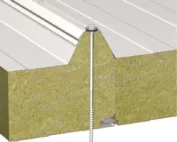
U is given in W/(m²·K). It describes the heat flow per unit area at a temperature difference. For the selected panel with concealed fixing, a 180 mm core and 0.5/0.5 mm facings, Uc 0.23 W/(m²·K) is stated. The 200 mm version of this family has Uc 0.20 W/(m²·K).
These are specific product values, not a universal table for mineral wool. When comparing offers, check the designation of the coefficient and how it was determined. Different families may have different joints, cores and declaration conditions, so thickness alone does not guarantee an identical result.
Calculate the effect of a change on the wall area
Assume a panel area of 240 m² and a temperature difference of 25 K. For U = 0.23 W/(m²·K), the heat flux will be 0.23 × 240 × 25 = 1380 W. At U = 0.20, this will be 1200 W, i.e. 180 W less under the same conditions.
This is an instantaneous comparison for the assumed area. It is not a forecast of the seasonal bill. Such a forecast requires climatic conditions, operating temperature, heating efficiency, heat gains and ventilation. The difference in U should not be converted into annual monetary savings without these data.

Don’t confuse the panel area with the façade area
If you are calculating the heat flux through the full panels, subtract the area of windows and doors from this area, then account for them separately with the appropriate parameters. For ordering material, however, a larger number of square metres may be needed due to cutting. Both areas are correct, but they serve different purposes.
When comparing variants, keep the geometry and temperatures identical. Otherwise, the difference in the result may stem from a change in openings, not from the insulation thickness. It is worth recording all assumptions alongside the calculation so that a later design revision can be traced. This prevents a simple thermal example from accidentally becoming a full energy balance of the building.
Add what a simple product doesn’t describe
The entire façade contains windows, doors, gates and details. Their share can change the balance more than a slight improvement in the U-value of the panels themselves. Linear thermal bridges at the base and reveals, as well as point thermal bridges from certain connections, require separate consideration in the calculations.
Also consider air tightness. Losses associated with uncontrolled air flow are not the same as conduction through the panel area. Careful installation of seals and proper door design can therefore be just as important as increasing the core thickness.
State the thermal objective before choosing a thickness
The designer should determine the requirements for the given function and building conditions in accordance with the regulations applicable to the investment. The product, details and method of connection to the joinery are then selected. A statement about compliance with one old version of the regulations is not sufficient to assess a new building.
For ordering, it is worth carrying over a specific parameter rather than a general promise of a “warm wall”. If the lock, core or configuration changes, check the result again. This helps avoid a situation where a replacement has the same thickness but a different thermal transmittance.
Questions and answers
Can U be calculated as lambda divided by thickness?
This approximation applies to a homogeneous core and omits some of the phenomena. For selecting a ready-made panel, use the value specific to its configuration, and for a building design, use the full balance of the building envelope.
Is a lower U always beneficial?
It limits heat transfer under the same conditions, but the choice must take into account the function of the building, cost and details. Further thickening of the panel will not fix a leaky door.
7 branches. Materials closer to your project.