PIR insulation
PIR or XPS on a flat roof: what does the layer build-up tell you?
Choosing between PIR and XPS on a flat roof starts with establishing where the waterproofing sits and how the roof will be used. Insulation beneath the membrane works under different conditions from a layer above the waterproofing. The differences concern not only heat but also contact with water, loads, fixing and the height of details at the parapet. In a traditional build-up the thermal insulation sits beneath the waterproofing. PIR boards can form the layer in such a solution if their facings and the method of fixing suit the membrane or roofing felt. The vapour control layer and the substrate must also be matched to the whole roof.
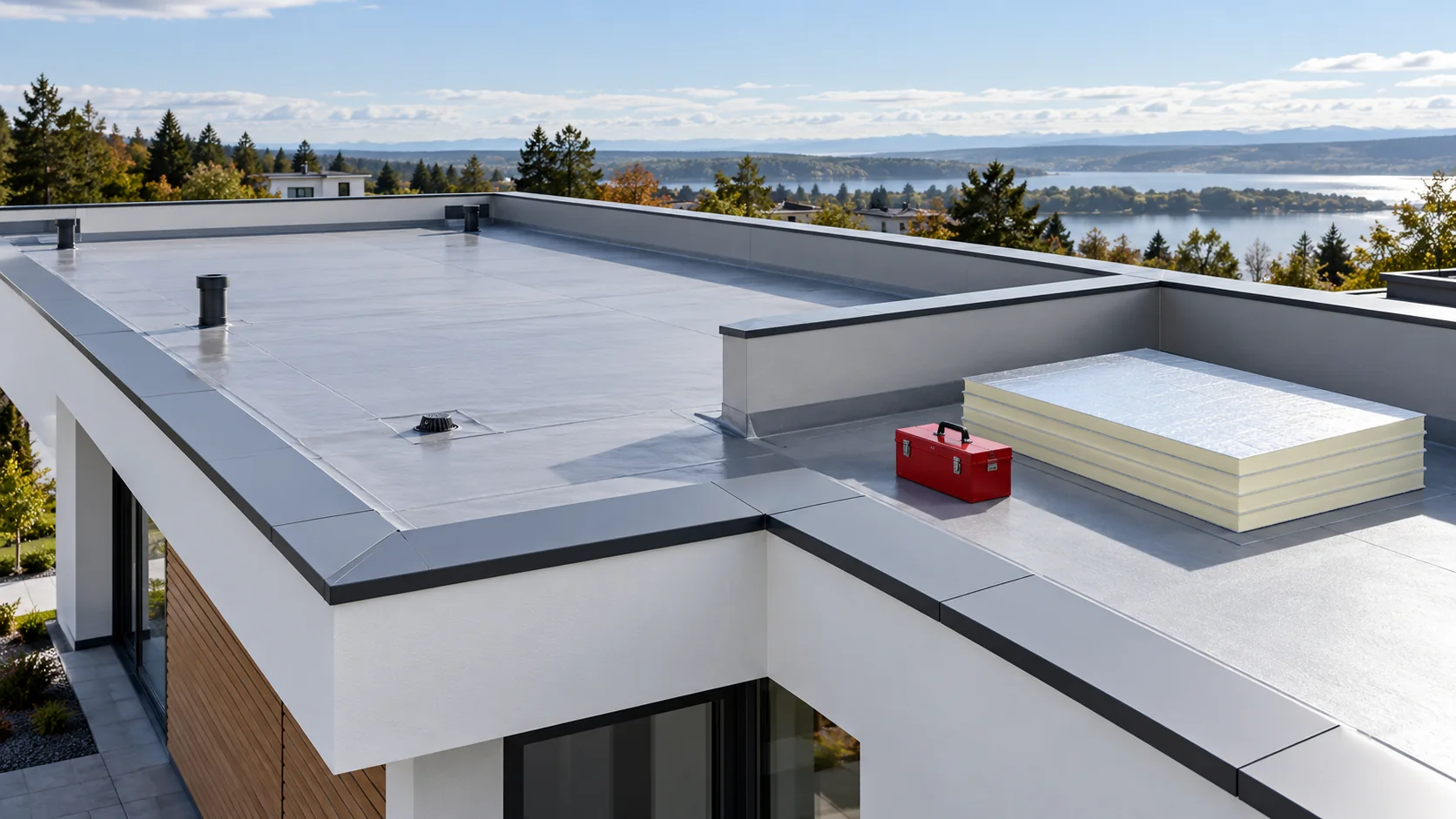
Determine the position of the waterproof layer
In an inverted roof the waterproofing lies below and the thermal insulation works above it. Suitable XPS boards are selected for such applications, among others. This is not a simple replacement in an identical section: requirements relating to water, separating layers and ballast are added. Each assembly must be assessed as a whole.
Compare thickness for the same function
PIR with a favourable lambda value can help to limit the height of the layers at a terrace threshold, parapet or skylight. However, the calculation should use the data for the specific board. The declared value for insulation in foil does not have to correspond to a different facing. For XPS, too, the parameters appropriate to the grade and thickness must be verified.
Do not compare only the nominal resistance of dry boards if their operating conditions differ. An inverted roof requires the relevant calculation rules to be taken into account, including the influence of water in the assembly. The final criterion is the result for the entire building element. A thinner layer does not always mean a lower or simpler roof once all the required materials are added.
Assess loads over the entire service life
On a terrace, green roof or beneath equipment, the insulation carries loads over many years. The CS(10) parameter describes the stress at a defined deformation in a test. It is not the permissible permanent pressure under the base of equipment. Suitable data on long-term behaviour and on the load-distribution arrangement are needed for selection.
Small feet, brackets and places where materials are set down are particularly important. A large weight distributed over the whole roof acts differently from the same weight concentrated at a few points. The structural design and the layer design should take into account both the use and the construction stage. A temporary stack of boards or ballast can also load the substrate.

Check compatibility of membrane, adhesive and facing
The possibility of bonding depends on the surface of the board, the type of waterproofing and the permitted technology. A material with good insulating performance does not have to be a suitable substrate for any adhesive. Solvents may be incompatible with the selected plastics, so the selection of all products requires confirmation.
With mechanical fixing, the substrate, fasteners and wind suction are what matter. The number of fixings is not determined by the name PIR or XPS alone. In a ballasted roof, the weight and distribution of the ballast must be assessed. These are alternative technologies that affect the structure and details, not add-ons written in after the insulation has been chosen.
Plan the falls and two difficult perimeters
Water should reach the designed drainage. The fall pattern must be decided before the heights of the parapets and thresholds are set. Thermal insulation does not replace waterproofing, and a low water absorption value does not mean that water may pond freely. Outlets and overflows require their own details.
The first difficult perimeter is the junction of the roof slope with the parapet, the second is penetrations and equipment bases. Thermal continuity, watertightness and the feasibility of making the connections must be ensured. If the heights are too small, it is better to change the section at the design stage. Cutting the insulation to fit a finished threshold can impair both water protection and heat protection.
Agree the roof use before choosing the board
A roof intended only for technical maintenance requires a different solution from a terrace with foot traffic. Planned planters, greenery, solar installations or ventilation units should be included in the assumptions from the outset. For each item of equipment, the support, access and method of passing through the layers must be established.
The final comparison of PIR and XPS should cover the complete section, the loads, the required height and the cost of execution. If both variants meet the assumptions, the decision can be made on the basis of ease of installation and available space. The material name alone does not determine the fire resistance or the watertightness of the finished roof.
Questions and answers
Can XPS simply be inserted instead of PIR under the membrane?
Only after checking the design of the entire system, the compatibility of the layers, the loads and the fixing. Changing the material is not merely a change of lambda.
Does an inverted roof not need drainage?
It needs a carefully designed drainage path. Insulation above the waterproofing does not remove the requirements for falls, outlets and limiting water ponding.
7 branches. Materials closer to your project.