Costs and formalities
Metal roofing and its alternatives: comparing the whole roof cost
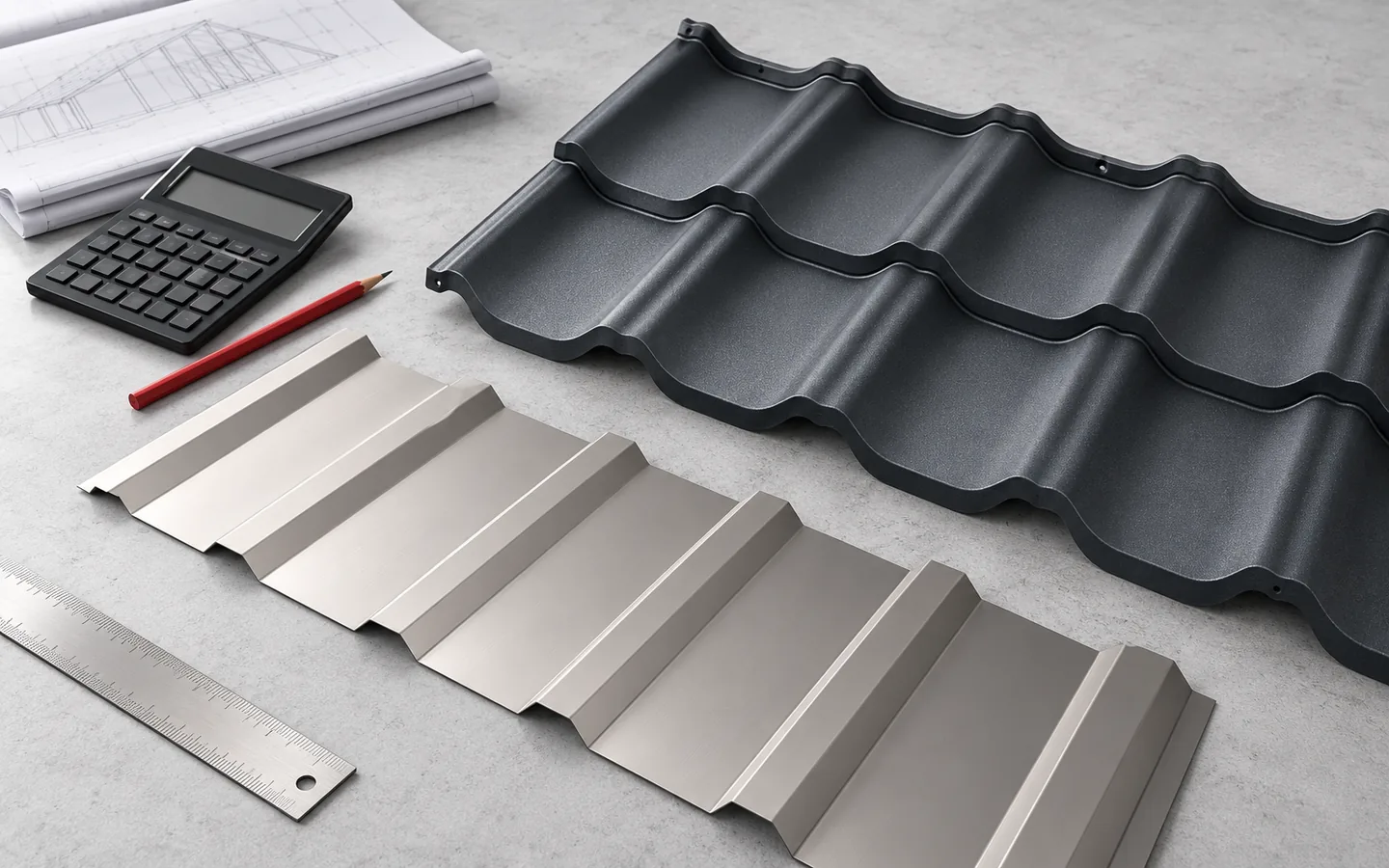
To compare roof cost fairly, set offers against identical geometry and the same scope of work. The price per metre of sheet metal, tile or shingle does not reflect every necessary layer — add the substrate, accessories, waste, transport and installation. For a renovation, check the condition of the roof structure and the removal work. Include the effective area with laps and cuts arising from the roof shape, since cut, modular and T18 metal sheeting perform differently. Also compare a similar quality level and the complete set of system components.
Why are prices per m² not enough?
One quote may give the m² of the entire steel sheet, another the m² of coverage, and a third the price per roof tile. Without converting the units, they cannot be compared. The effective area takes into account the overlaps specific to the material. Then come the cuts resulting from the roof shape. A large rectangle and a slope with several dormers may have a similar area but a different quantity of material to purchase.
The comparison should also cover a similar level of quality. Cheap steel sheet with a basic coating and a more expensive variant intended for a different use are not equivalent offers. With roof tiles, the complete set of required system components matters. With shingles, the required substrate must be taken into account. The lowest number in a shop’s table does not yet determine the cheapest finished roof.
What is included in the cost of the system under the covering?
Coverings may require different preparation. In one variant, suitably selected battens and counter-battens with an underlay membrane are sufficient. In another, full boarding and additional layers are needed. Their material, installation and effect on weight must be compared. The cost of a component should not be subtracted just because it was not listed in an abbreviated quote.
Insulation is a separate item. Tile-effect metal roofing or T18 do not by themselves provide the thermal insulation of a heated building. A roof sandwich panel contains an insulating core but requires a different arrangement of supports and details. That is why its price is not compared directly with the price of a thin sheet. In both cases, the same functional effect of the building envelope must be achieved.
How to calculate the impact of waste and format?
Consider two options for the same roof. Option A needs 168 m² of sheeting at about €12.77 per m², for a total of €2,145.66. Option B needs 157 m² at about €14.40 per m², for a total of €2,260.37. The unit prices differ by about €1.63 per m², but the total cost of the covering differs by €114.71. The euro totals use the unrounded unit prices. This example illustrates the calculation and gives neither a current price nor a typical waste allowance.
In a real quote, the quantities must result from the cutting plan. Cut tile-effect metal roofing is often advantageous on long, straight slopes. A modular system makes material planning easier with numerous edges and obstacles. Roof tiles or smaller elements also require cuts and special components. A single percentage allowance is not applied to every covering and every geometry.

How do construction and installation change the result?
With a heavier covering, it must be checked whether the structure is prepared for it. In a new house, this follows from the design. In a renovation, an assessment and reinforcement of the roof truss may be necessary. Lighter steel sheet often reduces the dead weight of the covering but does not eliminate the problem of damaged timber. Snow, wind and additional equipment on the roof must still be taken into account.
Labour costs depend on the work included and the conditions on site. Roof height and pitch, access and the number of details all matter. A large sheet may cover a simple slope quickly but be harder to transport. Smaller pieces can take more individual operations to fit. Compare rates against the same measured quantities and a clear description of each contractor’s responsibilities. Prices from different regions may cover very different work.
Which expenses are easy to overlook?
Flashings, gutters, ventilation, service penetrations and snow guards can all affect the total. Allow for scaffolding, transport and unloading as well. On a refurbishment, include the cost of stripping the existing covering and dealing with the waste. If the roof covering contains asbestos, allow separately for specialist removal. It cannot be priced as ordinary sheet-metal removal.
Check whether accessories and servicing will be available later. Different materials may need repairs at different intervals, and warranties vary in what they cover and under what conditions. Include inspections, cleaning and minor repairs in the maintenance budget. There is no need to put a figure on every possible repair that might never be needed.
How should you prepare a comparison to make a decision?
Use one set of measurements and the same list of items for every quotation. Record the quantity, unit and price for each item, noting whether it includes VAT. Keep the tax basis consistent when adding up the figures. Specify the steel thickness, coating, accessories and layers beneath the covering, and check whether delivery and installation are included. You can then compare the total cost of two or three realistic options.
The choice may also depend on the appearance and constraints of the building. If the structure, pitch or local plan excludes a material, a low price will change nothing. It is worth leaving a clear item in the cost estimate for work requiring the old roof to be uncovered. The scope of this allowance should result from the inspection. A reliable quote shows both the known amount and the elements that still need to be checked.
7 branches. Materials closer to your project.