Choice of covering
Single- or double-module roofing sheets for your roof layout?
The choice between one and two modules of a metal roofing tile depends primarily on the roof geometry and site organisation, not on the number of modules alone. It is worth checking the cutting plan, the effective covering area, and the number of joints and offcuts for the specific project. A shorter sheet can be handier where access is tight and roof slopes are complex, while a larger one reduces the number of pieces to move. Leave the format decision to the designer, as the price of a single piece does not reflect the cost of the whole covering.
What exactly does the number of modules mean?
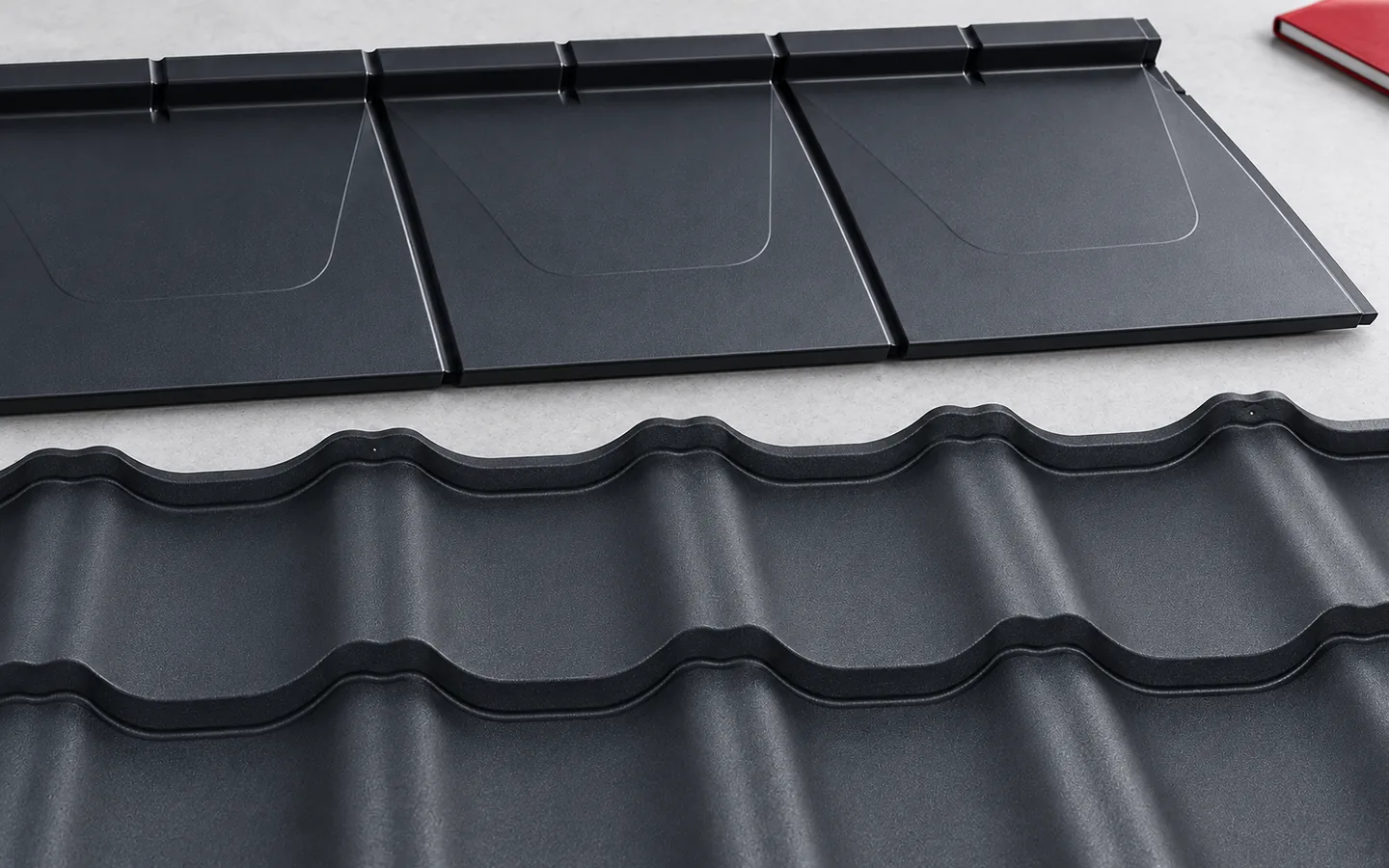
The module describes a repeating section of the pattern along the roof slope. The single-module version contains one row, and the two-module version two. The total sheet length also includes the overlap elements. It therefore does not have to be an exact multiple of the cover length. When ordering, a distinction must be made between overall and effective dimensions.
The sheet width is a separate dimension. It may include several corrugations or flat fields depending on the model. Two products with the same number of modules do not have to have an identical cover area. The price per piece should not be compared without this data. Differences in geometry also affect the substructure and the fit of flashings.
Which format is easier to transport?
A shorter sheet can be more convenient with tight access and limited storage space. It is easier to handle manually and to pass up onto the roof slope. A larger sheet, in turn, means fewer pieces to move for the same area. Convenience therefore depends on site organisation, equipment and the number of people in the team.
Both formats require protection of the coating and correct storage. Wet packs should not be left unchecked. Sheets must not be dragged over one another or leaned in a way that permanently deforms the edge. The size of the element does not change these basic rules. Damage to a small lock can hinder the connection just as effectively as a bend in a large sheet.
How does the format affect the speed of laying?
With the same coverage width and the length of a single module, a two-module sheet covers a larger area in one setting. On a straight section of the roof slope, this can make work easier. The single-module version gives greater freedom on short runs and around obstacles. However, the pace also depends on the geometry of the interlock, the preparation of the battens and the team’s experience with the chosen system.
It is not worth promising a fixed time saving solely on the basis of the format. A large part of the work falls on the eaves, roof valleys, chimneys and terminations. Neither one nor two modules eliminates these tasks. A well-prepared substructure and a complete set of accessories often have a greater influence on the deadline than a small difference in the size of the basic sheet.

Does a small sheet produce less waste?
On a complex roof it can make it easier to use the material, but this must be checked with a cutting plan. The shape and direction of the lock limit the possibility of reusing offcuts. A piece cut at one roof valley does not always fit on the other side. The symmetry of the roof alone does not guarantee the interchangeability of all the remaining pieces.
Ask for two layouts for the same project. They should show the number of sheets, the coverage and the cut locations. Only then can the amount of waste be assessed. On simple roof slopes the difference may be small. With many dormers the result may look different. A single percentage saving should not be taken as a fixed feature of every modular roof.
What about joints and tightness?
More short sheets means more transverse overlaps. A correct interlock and installation allow a tight covering to be made, but they require care. The number of joints cannot be treated as irrelevant to the labour input. The laying sequence, proper support and the method of fixing specified by the system are important.
A different number of modules is no reason to mix sheets from incompatible families. Even a similar profile may have a different end and drip edge. Mixing should be permitted in the documentation. Trying to force contact with screws can lead to stresses and damage to the coating. It is worth checking a sample joint before ordering a larger batch.
How do you decide without paying over the odds?
Compare the price per m² of effective coverage at the same thickness and a similar coating class. Add the actual number of pieces from the cutting plan, fasteners, flashings and transport. Also take into account the contractor’s work organisation. The cheapest sheet may have lower coverage, and a larger number of pieces may change the cost of the whole order.
For many small roof slopes, the single-module format will be convenient. With calm geometry, it is worth considering the two-module format, as well as cut tile-effect metal roofing. None of these variants always wins. The right choice results from the design, logistics and quality of the entire system. This is a better basis than the belief that a smaller element by definition means a more modern roof.
Keep the order data and establish whether sheets can be purchased later. For repairs, the compatibility of the interlock and the coating matters, not just the number of modules. A small reserve can help, but it should be stored according to the material’s recommendations.
7 branches. Materials closer to your project.