Polystyrene and thermal insulation
Is yellowed EPS still suitable for installation?
A yellow film on white polystyrene may indicate exposure to UV radiation. The change in colour alone does not determine whether the whole board is suitable for use. The surface, flatness, cohesion and storage conditions must be assessed. Removing the loose layer is sometimes necessary, but it will not repair deep damage or deformation caused by temperature. White EPS left without protection may change colour at the surface over time. Sunlight affects the exposed layer of polystyrene. With continued exposure, dusting and loss of cohesion may occur. This is particularly important where mortar is to be adhered to the board or a reinforced layer is to be applied. The rate of change depends on the actual conditions.
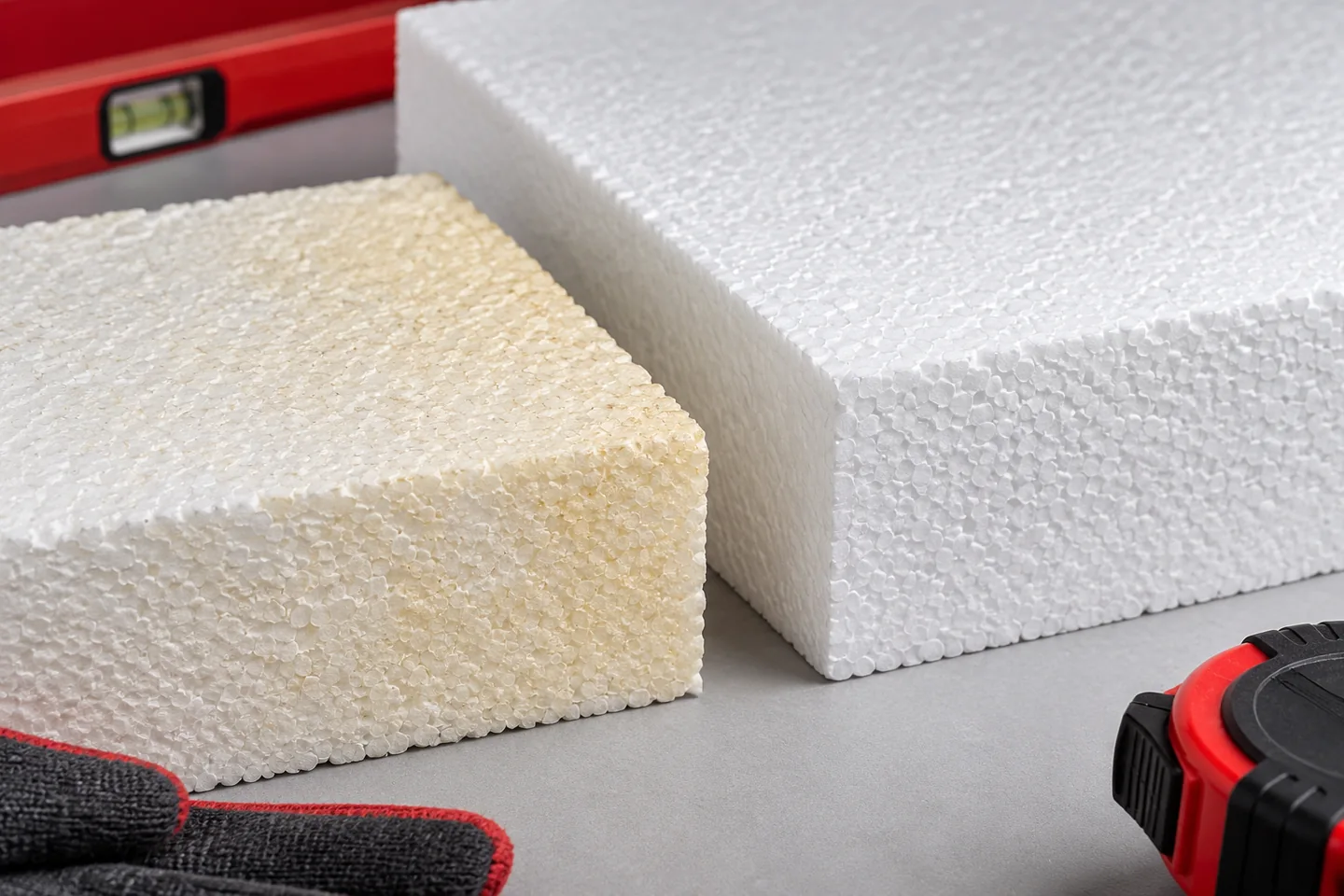
Where does the colour change come from?
It is impossible to assess every board solely on the basis of the number of days since delivery. Sun exposure, cover and the way the boards are laid matter. Conversely, not every stain on EPS is the result of UV. Dirt, mortar residues or contact with a chemical substance require different treatment.
What should be checked besides the colour?
Examine both faces of the board and its edges. Look out for dusting, crumbling, cracks and visible defects. Also check whether the board has retained its flatness. Deformation will make tight butt-jointing and correct support difficult. The surface may look relatively good, yet the geometry may no longer be suitable for the planned installation.
Determine whether the material has been lying in water or near solvents and heat sources. Traces of dissolution, deep dents or permanent bowing are not ordinary surface bloom. They cannot be removed by a light wipe. Set questionable boards aside separately so that they are not used accidentally during the work.
When can the surface layer be removed?
Manufacturers’ instructions provide for removing weathered surface bloom before applying subsequent layers. This applies where the problem is limited to the surface and the rest of the board has retained the required condition. The method of preparation should correspond to the instructions for the product and the system in which it is to be used.
After removing the weak layer, the surface must not remain dusty. Loose particles impair the adhesion conditions. At the same time, the geometry and the remaining thickness of the board must be checked. Deep sanding is not a way of saving the material at all costs. If the damage extends further, a separate assessment is needed.
Do not try to wash off the bloom with an arbitrary solvent or to scorch the surface. Such treatment can damage the polystyrene. Priming is also not a universal substitute for removing the loose layer. Any additional preparation would have to be provided for in the system solution and compatible with the material.
Does the situation change after the boards have been bonded?
On the façade, the fixing and the joints must also be assessed. A long break after bonding the EPS could have meant exposure of the entire unfinished assembly to sun, wind and precipitation. It must be checked whether the boards have debonded, warped or left open gaps. Sanding down the yellow surface alone does not answer these questions.
Before the reinforcing layer, the contractor should assess the substrate in accordance with the system instructions. If the condition is in doubt, the scope of the inspection is agreed with a technical adviser or the person responsible for acceptance. It is not worth covering up the problem with mesh and mortar in the hope that the subsequent layers will even out all the damage.
Does grey EPS require the same assessment?
On graphite, a change in colour may be less discernible. The absence of a yellow film therefore does not prove that the board was not exposed to unfavourable conditions. Checking for deformation after heating is particularly important. Graphite EPS must be protected from intense sunlight both in the packs and during installation.
Do not judge quality by comparing the shade of two boards. The composition and surface finish may differ. What counts in the assessment is the identification of the product, its condition and its conformity with the requirements of the application. A permanently deformed board will not be repaired by pressing it against the wall or loading it in a stack before laying.
How can the problem be prevented from recurring?
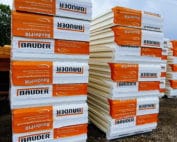
Deliver the material at a time corresponding to the progress of the works. Provide a shaded storage location and the necessary covers during work. Plan the stage of bonding the thermal insulation together with the subsequent layers of the system. EPS should not deliberately be left exposed for a long time as a finished protection for the wall.
Keep the labels and photographs of the condition of the material if it was necessary to clarify its suitability. The agreed method of preparing the surface should be recorded. The final decision does not come down to colour: what matters is a board that has retained the required properties and enables the entire insulation to be installed correctly.
EPS is produced, among others, by Austrotherm, Termo Organika, Knauf Therm and Ekobud. Recommendations for surface preparation must be related to the specific board and system.
7 branches. Materials closer to your project.