Roof and energy
Is it worth buying a battery storage system together with a photovoltaic roof?
Buying them together can make it easier to select the equipment and prepare the installation, but it is not always the best financial decision. The storage system must be matched to the surplus and to later consumption. In a new house these figures are often still uncertain. You can therefore consider buying it straight away or consciously preparing for later expansion. It is important that both options have a defined scope rather than relying on a general promise of future compatibility. If you know the building’s needs and the expected mode of operation, it is easier to select the whole package in one go. You can plan the space for the equipment, the cable routes, the metering and any backup circuits. This avoids some of the later modifications.
When does buying together have a practical advantage?
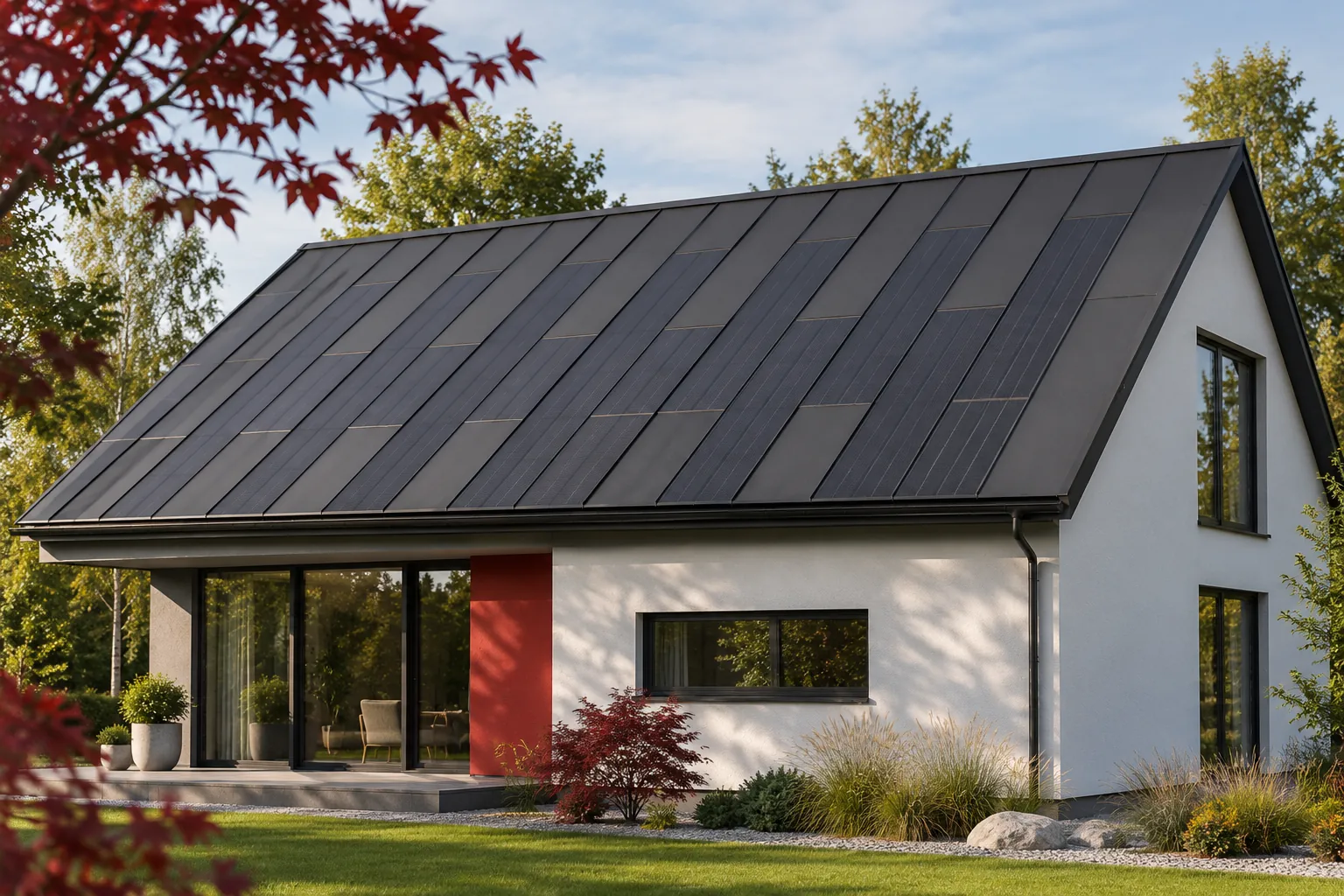
In an integrated roof this works well with the idea of planning the covering and the installation together.
An organisational benefit does not, however, automatically mean a lower cost over the whole period of use. The price of the package must be compared with the actual value of the function. It is not worth buying a large battery simply because installation takes place on the same date. Its capacity and output should match the energy flows and a clearly defined purpose.
When is it worth finding out the house’s consumption first?
In a new building the actual profile may differ from the initial assumptions. The number of occupants, the hours of presence and the way appliances are used all matter. Data from operation shows how much energy remains after current consumption and when demand occurs. An annual total does not show these relationships accurately enough.
Postponing the purchase can therefore provide a better basis for sizing. It does, however, have its own consequences: the future cost, the availability of compatible parts and possible additional work. Waiting should not be presented as a solution without any drawbacks. It is worth comparing two specific scenarios, not merely the slogans ‘everything at once’ and ‘we’ll buy it later’.
What does preparing for battery storage mean?
It should mean specific solutions, not just a label in the offer. You need to know which device is planned, where it is to be placed and what type of connection will be possible. The permitted combinations, metering and space for the equipment all matter. The preparation may cover the structural part, the electrical part or both.
Ask for the limitations to be put in writing. Does future expansion require replacing the inverter, activating a function or adding another device? Will it be possible while keeping the current system? The answers need not guarantee any battery whatsoever many years from now. They should, however, explain exactly what you are buying as part of today’s preparation.
How can backup power be assessed separately?
If the storage system is to help during a grid failure, the backed-up loads and the operating time must be specified. Not every battery or every inverter provides this function to the expected extent. A switching arrangement and dedicated circuits may be needed. Capacity in kilowatt-hours alone does not answer the question of what will start up after a power failure.
It is worth setting a priority between daily energy use and keeping a reserve. The more energy you use in the evening, the less may remain for an unforeseen outage. The settings should follow the needs of the occupants. The offer should show this relationship instead of promising maximum savings and a full reserve without limits at the same time.
How can the two options be compared financially?
A full set: the cost of the storage unit with installation, the expected utilisation and losses. Include the warranty conditions and possible servicing. For the later option, add the preparation cost and the likely scope of the second stage. Do not assume fixed equipment prices or certain availability of future financial support. Such elements should be a separate scenario.
It is worth checking whether the investment remains justified with fewer surpluses. If the result depends on an ideal day throughout the year, the assumptions are too optimistic. Storage does not increase the roof’s production. It can improve how that production is used, but the value of that change must be compared with the additional expense.
How can a decision be made without closing off future possibilities?
First sort out the objective, then choose the scope for today. With uncertain consumption, you can prepare a sensible location and route while keeping the conformity documentation. With well-known needs, a joint purchase can simplify implementation. In both cases, a specific design and clear responsibility for commissioning are important.
Integrated steel roofing allows you to create an attractive roof whose energy function is planned from the outset. Storage is another element of this system, not a mandatory condition for its sense. The best decision results from actual flows and the user’s objective. Not from the mere fact that a battery appeared in a promotional package.
Among the manufacturers and brands of photovoltaic roofs are Dyaqua, ML System, SolRoof, SunRoof, MDM NT (MyRoof), 3S Swiss Solar Solutions, Electrotile, Wienerberger Wevolt, Nelskamp and SoliTek.
7 branches. Materials closer to your project.

- SEROCK — Dzierżenin 34 E
- BŁONIE — ul. Sochaczewska 138A
- RADOM — ul. Grobickiego 8
- ŁÓDŹ — Natolin 8
- OLSZTYN — Barczewo, ul. Prosta 9
- WROCŁAW — ul. Jerzmanowska 10C
- GORZÓW WLKP. — ul. Zielona 33/34