Costs and formalities
How much do tile-effect roofing sheets cost, and how do you budget for the whole roof?
To estimate the cost of a tile-effect metal roof, start with a cutting plan and work out how much sheet metal to order. Two quotations for the same roofing can look different if one supplier includes the overlaps in the sheet area and another charges for the area actually covered. For modular sheets, work out the number of whole panels as well. Compare coating options on the same price basis and check whether VAT is included. Add separate amounts for flashings, fixings, delivery and labour to arrive at the cost of the finished roof.
What does the example from the current price list show?
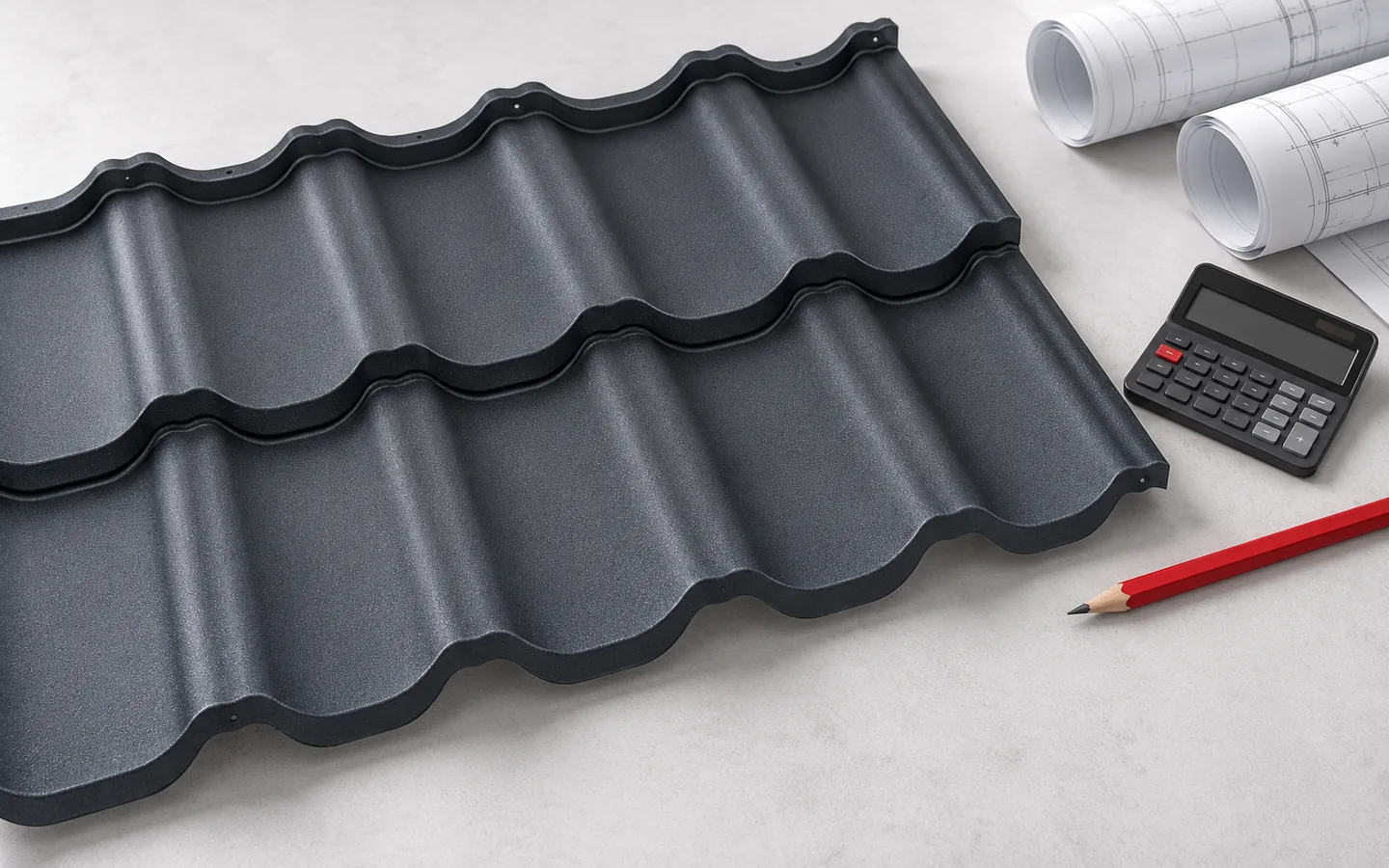
For one tile-effect roofing sheet made of 0.50 mm steel, the price list effective from 28 October 2026 gave three prices per square metre of effective cover. Converted to euros, these were €9.11, €10.34 and €13.79 excluding VAT, or €11.20, €12.72 and €16.96 including 23% VAT. The three prices corresponded to different protective coatings.
This is not a market average nor a promise of a price available at every point of sale. The catalogue does not take into account all the conditions of a specific order. A quote may depend on quantity, colour, availability and delivery. The example does, however, show why the appearance of the profile alone is not enough to assess the price. Two similar sheets may have different surface protection.
Why does m² of sheet metal not always mean m² of roof?
Total sheet area includes the parts concealed by overlaps. Effective cover counts only the area the installed sheet covers. The lowest-priced finish in this example cost €10.53 including VAT per square metre of total area, or €11.20 per square metre of effective cover. Both figures describe the same material. The lower number reflects the way the area is measured.
For modular roofing, check whether the seller quotes per panel. A panel covering 0.80 m² at an illustrative price of €11.11 would cost €13.89 per square metre of cover. When ordering, allow for cuts and round up to whole panels. Multiplying the roof area by the lowest price in an advertisement can give a misleading total.
Is modular more expensive than cut?
A comparison makes sense with the same material class and a similar coating. Cut tile-effect metal roofing can reduce the number of joints on a simple roof slope. The format is ordered to a specific length, which is why measurement is very important. Changing the dimension after production can increase waste. Long elements also require appropriate unloading and space for safe handling.
Modules make it easier to manage material at dormers and numerous breaks. Some unused elements can be allocated to another roof slope if the profile and layout allow it. This does not mean that waste will always be smaller. A cutting plan is needed. The difference in sheet price must be set against transport, labour and the actual quantity of purchased covering.

How do you calculate just the material using a specific example?
Suppose the measurements and cutting plan call for 165 m² of effective cover. At the converted catalogue price of €12.72 per square metre including VAT, the sheets would cost €2098.80. Multiply the quantity ordered by a unit price based on the same area measure. The 165 m² is specific to this example and does not establish a standard waste allowance.
In the cost estimate, it is worth showing the geometric area of the roof slopes and the quantity to order separately. This makes the cost of overlaps, offcuts and full modules visible. Some sheets have specified ranges of produced lengths. The required number of full packs may also be relevant. Such constraints should be taken into account before comparing two offers, not only when issuing the invoice.
Which items must not be missing from a quote?
In addition to the covering, flashings for the eaves, gables, ridge, roof valleys and chimneys are needed. Fasteners, sealants, ventilation and roof penetration elements are also required. Gutters, roof access and snow guards are usually priced separately. The number of these elements is determined by the roof layout. It cannot be reliably calculated with a single fixed surcharge per m² of sheet metal.
The works budget may include substrate preparation, replacement of battens, membrane and roof truss repairs. For a renovation, removal of the old covering and waste disposal are added. Check the cost of scaffolding, a lift, transport and unloading. Two quotes with an identical price per m² of tile-effect metal roofing can result in a completely different final amount if they cover a different scope of works.
What should you ask before approving an order?
Ask for the profile name in the order documentation, the steel thickness, the type of coating and the colour. Establish whether the amounts are net or gross and what the unit of area means. The offer should specify the validity period, delivery date and the method of settling additional elements. It is also worth knowing who is responsible for the measurement and whether the quote includes a list of sheet lengths.
When comparing material with a service, do not automatically assume the same VAT rate. The rules depend on the nature of the transaction and the property. The clearest comparison covers the full amount payable for the same scope. Only then can you assess whether a higher coating price or the choice of modules actually increases the roof cost or merely changes the breakdown of expenses.
7 branches. Materials closer to your project.