Choosing a covering
What role do steel, zinc and paint play in tile-effect metal roofing?
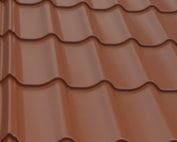
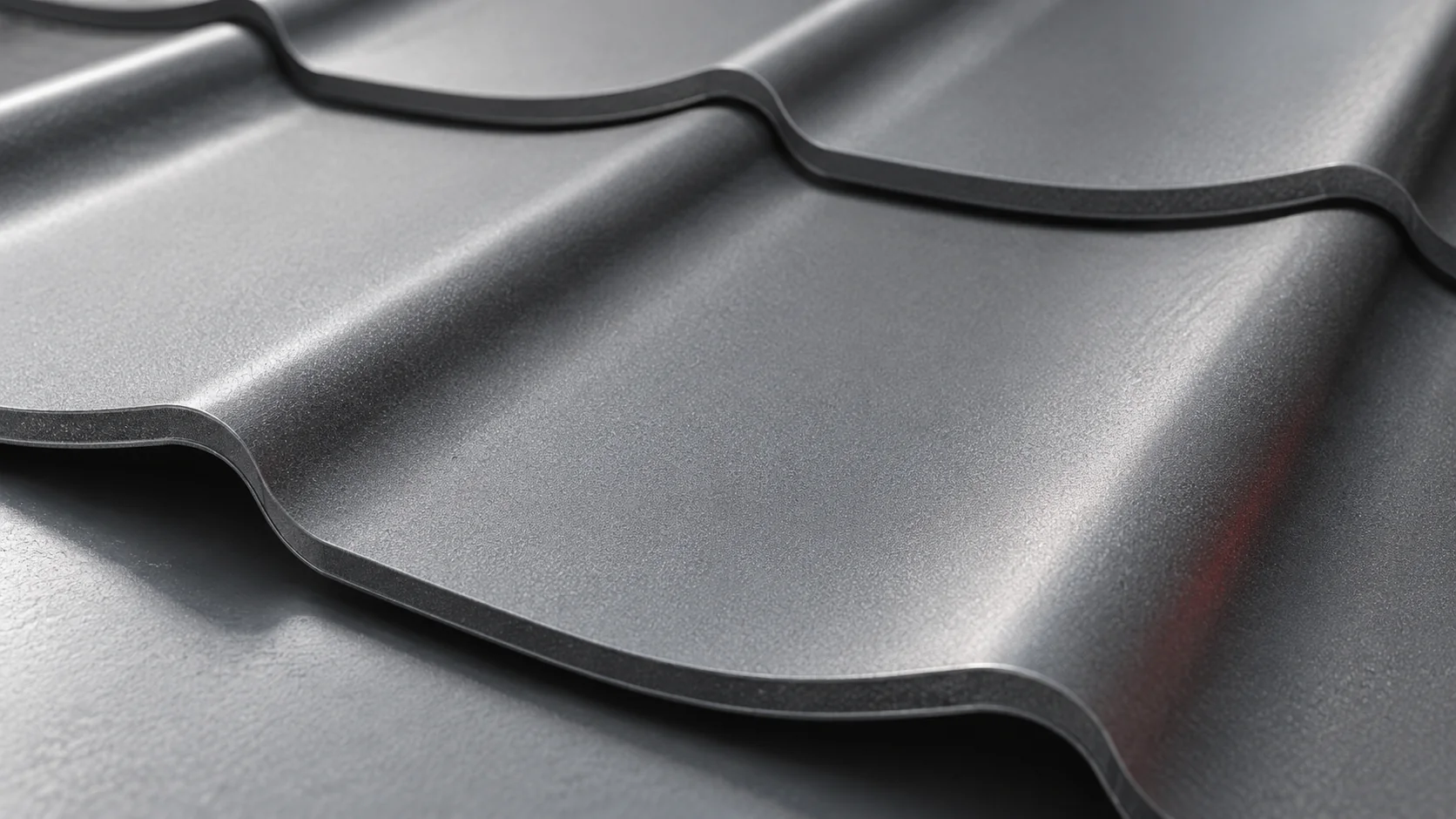
Tile-effect metal roofing is a thin metal covering with a formed profile. In the steel version, its durability relies on the interaction of the core, metallic protection and coatings. Each layer has a different task. The profiling helps give the sheet its shape and rigidity, but does not replace insulation, an underlay or a correctly designed structure. Beneath the outer coating is a thin steel core protected metallically, for example with a zinc layer. There are also surface preparation layers and a primer. On the underside, protection suited to the intended use is applied. The exact build-up depends on the product and should not be guessed from the colour alone.
What lies beneath the visible colour?
These are several different functions. Steel is responsible for the mechanical properties, while the protective layers limit environmental effects. The paint also provides colour and texture. Each micrometre of paint should not be treated as additional structural thickness of the steel sheet. In the order, the parameters of the steel substrate must be distinguished from the thickness and type of coating.
Why does thin sheet form a rigid covering?
Profiling changes the geometry of the cross-section. Longitudinal and transverse corrugations limit the flexibility of the flat sheet and create the characteristic roof pattern. However, this does not mean that the panel can be installed on battens at any spacing. The support must match the positions intended for the given profile.
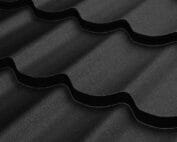
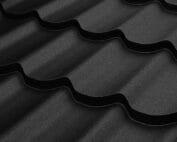
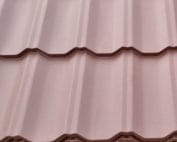
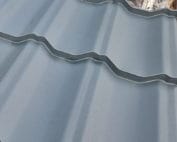
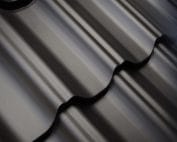
In the example flat tile-effect metal roofing, the module is 320 mm long and the step is 35 mm high. These dimensions affect the rhythm of the roof slope and the preparation of the substructure. Another model may require a different spacing. The choice of appearance and the choice of battening are therefore linked. A change of covering after the framework has been built should be checked before laying begins.
How do metallic protection and the organic coating work?
The metallic layer protects the steel against corrosion. Its type and quantity are material parameters. The external organic coating forms an additional barrier and is responsible for the appearance. In practice, resistance to radiation, damage and environmental conditions also matter. The colour name alone does not describe any of these properties.
Polyester and polyurethane coatings are available in various grades. It is not enough to compare two words or the paint thickness alone. The declared properties and the range of application must be compared. A material suitable for an ordinary residential roof does not have to be suitable for an interior with an aggressive environment. The underside is also assessed, particularly when it will be permanently exposed to moisture.
Why do cutting and swarf matter so much?
After the sheet has been formed, its protection must survive transport and installation. Overheating during cutting can damage the coating. Steel coated coverings are therefore cut with tools intended for this purpose, usually without generating high temperature. An angle grinder is not the right substitute for shears in such work.
After cutting and drilling, metal filings must be removed. Left on the paint, they can corrode and soil the surface. Scratches are assessed according to depth and location. A spot touch-up should not turn into random painting of large areas. The colour and method of repair are matched to the covering, and damage requiring replacement of a sheet does not disappear under a layer of paint.

What does tile-effect metal roofing not provide on its own?
The covering is primarily intended to protect the roof from the weather and to work with the drainage details. It is not complete thermal insulation. Heat is limited by other layers, whose continuity must be maintained at the eaves, walls and openings. The metal alone also does not replace a airtight layer on the side of the heated interior.
Condensation can occur beneath the covering. Its control requires a suitable layer arrangement and, in the intended solutions, also ventilation. The preliminary covering takes over its tasks only when it has correct laps and drainage. The quality of a roof cannot be assessed solely by whether the external paint looks even and has a long warranty.
How do you choose the material for the whole project?
Record the requirements for profile, steel thickness, protection and coating. Link them to the roof pitch, support and environment. Check the compatibility of flashings and accessories with the chosen finish. Two surfaces with the same colour designation may differ in gloss or texture. A larger sample will show this better than a screen.
Next, establish the rules for installation and inspections. In new construction, it is worth planning access to the chimney and equipment before the roof is closed. The weight of additional installations is not transferred arbitrarily to thin sheets. The covering works correctly as part of a well-thought-out building envelope. Knowledge of its layers helps to choose material according to needs, not just the promise in the description.
Questions and answers
Is tile-effect metal roofing a type of clay roof tile?
No. It has a metal core and is profiled into sheets or modules. A similar pattern on the finished roof surface does not mean the same construction or installation rules.
Can all protective layers be measured with an ordinary vernier caliper?
Not in a way that allows them to be assessed separately. The result of a total thickness measurement does not separate the steel, metallic protection and individual coatings.
7 branches. Materials closer to your project.