Roofs and details
Why does the watertightness of a standing seam roof depend on the entire roof slope?
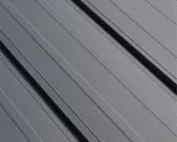
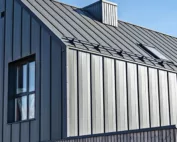
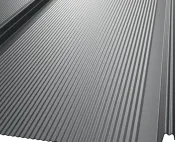
The standing seam moves the joint between adjacent strips away from the main plane of water runoff. This is an important advantage, but it does not justify calling every such roof the most watertight. Water can enter at the chimney, a transverse junction or an incorrect eaves detail. The effectiveness of the covering is determined by the entire system: from the substrate to the final flashing. The longitudinal edges are raised above the surface between them. Water flowing down the roof slope moves mainly along the flat strip. In many solutions the fixings remain concealed within the joint. This limits the number of holes in the visible surface, but does not remove the requirements for their correct execution.

What does the standing seam change in the path of water?
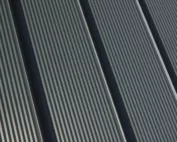
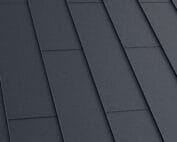
Under the term standing seam there is both traditional folding and a factory snap-lock. Each solution has a defined scope of application. Two roofs of similar appearance may differ in seam geometry, strip width and sealing principles. Therefore the specific system is assessed, not the characteristic vertical pattern of the roof surface alone.
How do pitch and roof slope length affect watertightness?
The pitch must correspond to the selected covering and its details. For an example steel snap-lock panel, a minimum of 8° is specified provided the other system requirements are met. This is not an approval for every standing seam. Traditional solutions and other panels have their own limitations.
As the length of the roof surface increases, the path and quantity of flowing water change. If a single strip cannot be used, a transverse joint is created. Its execution requires a separate detail. The additional overlap must not simply be a copy of a joint from another material. On a low-pitch roof, every local step and water retention point deserves particular attention.
Which penetrations interrupt the straight drainage path?
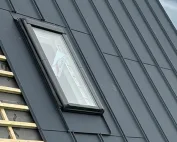
A chimney, window, vent and dormer wall divide the covering plane. Water above the obstacle must be directed to the sides. At these points, corners, flashing connections and junctions with other materials arise. It is precisely the details that often determine the outcome, even though they occupy a small part of the roof area.
Plan the penetrations before cutting the panels. Sometimes moving an installation by a small distance avoids a collision with the standing seam. However, such a change must be agreed with the installation design. The seam must not be cut out simply because it interferes with positioning the base. The penetration element should match the profile and maintain continuity of protection beneath the covering.
How do fixing and substrate affect the joints?
An even substrate facilitates laying the panels and closing the seams. An uneven plane can force deformation and make it difficult to align subsequent strips. Construction errors should not be compensated for by strongly tightening the sheet metal. First, what the covering rests on must be corrected.
The fixing must transfer loads and allow for the anticipated thermal movement. Binding the panel too rigidly can impose stress on the flashings and the ends of the sheets. The extreme zones of the roof are also important, where wind action can be greater. The concealed screw remains a structural element. The absence of a visible head on the roof surface does not mean that the way it is seated is arbitrary.

What happens beneath the covering?
Water vapour can condense under the cool metal sheet. Depending on the roof construction, the correct layers for vapour control, airtightness and moisture drainage are needed. If the design provides for ventilation beneath the covering, the air path from inlet to outlet must remain clear. A single opening in a random location is not enough.
The underlay has its own joints and terminations. At the eaves it should discharge water in the planned manner, and at openings it must remain continuous. Felt adhered to the underside of the panel can reduce dripping from condensation, but it does not replace these functions. A wet attic does not always prove that the standing seam is leaking. It is necessary to identify whether the water comes from precipitation or from inside.
How to assess a roof before handover?
With the contractor, check the closing of joints, the terminations of the sheets and the areas at chimneys and roof valleys. Compare the details with the agreed solution. It is worth having photographs of the fixings and layers taken before they are covered. They make later assessment easier without dismantling a large part of the covering.
Ensure a clean surface and clear drainage. Remove swarf and debris left by other crews. Establish the inspection regime and access to equipment on the roof. A tight standing seam roof is the result of matching material, design and workmanship. An attractive profile alone is not proof of quality. A correctly detailed chimney and a dry layer beneath the covering say far more.
Questions and answers
Is standing seam suitable for standing water?
A typical standing seam covering should not be treated as arbitrary waterproofing for a flat roof. The permissible pitch and operating conditions must be checked for the specific system.
Does the absence of visible screws mean there is no risk of leaks?
No. Joints, flashings and service penetrations remain. Concealed fixing is a feature of the system, not a guarantee of the tightness of the entire roof.
7 branches. Materials closer to your project.