Choosing a roof covering
How to assess the quality of tile-effect roofing sheets
The quality of a metal roofing tile depends on its steel core, corrosion protection, coating and the precision of its pressings. Check the nominal steel thickness, the material and the product documentation, bearing in mind that a measurement of the coating is not the same as the core thickness. Match the sheet’s properties to the conditions on your plot. Remember transport, storage and installation too, because an attractive pattern cannot replace damaged protection.
What does the thickness of the steel core tell you?
The core determines the mechanical properties of the sheet. In the offer, look for its nominal thickness, the type of material and a reference to the product documentation. Measuring the entire coated sheet is not the same as the thickness of the steel itself. Protective layers are added to it, and the result also depends on the measurement location.
Do not choose material solely by the principle of “the thicker, the better”. The profile geometry, sheet length and support arrangement matter. The stiffness of a short module and a long sheet is assessed under different installation conditions. If offers differ in price, first establish whether they describe the same base material and the same scope of delivery.
How do you recognise suitable corrosion protection?
Steel roofing is protected by a metallic coating and organic layers. Their tasks are related but not identical. The coloured layer is also responsible for the surface appearance. The colour name alone says nothing about resistance in a damp or polluted environment. A description of the specific protection system is needed.
Check the intended use of the coating, the environmental category and the conditions of its application. Different loads occur near a forest, others near the sea or an industrial plant. Do not assume that every thicker coating is suitable for every environment. In a demanding location, the suitability of the application should be confirmed before purchase, not only when a claim is made.
Are the profile and cutting done precisely?
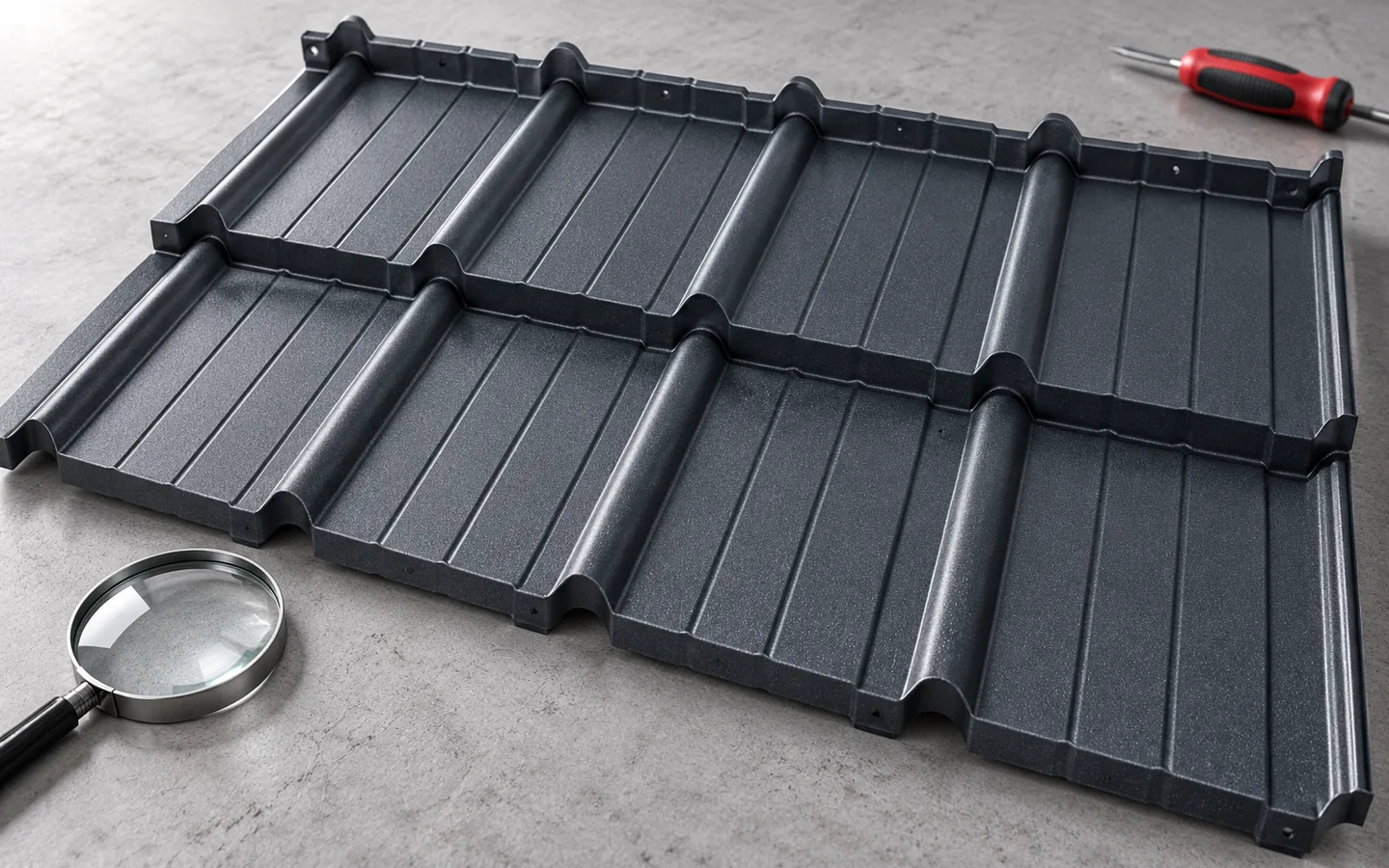
Join sample sheets on a level surface. The pressings should meet in the correct places, and the joint should lie without forcing the shape. Pay attention to the condition of the edges, corners and mounting holes, if the given model has them. Dents and surface cracks require clarification before the material is taken onto the roof.
Subtle light reflections do not necessarily indicate a defect. Thin sheet reacts to lighting and stress. However, permanent damage or poor fit must not be excused by this. On acceptance, compare the sheets with the documentation, not with an idealised visualisation. Photos of the entire batch and close-ups of questionable areas are helpful.
Also assess colour consistency within the delivery. Before installation, separate clearly damaged elements and clarify their condition with the seller. Once the sheet is screwed down, it is harder to determine whether a dent occurred in transport or during work. Material acceptance should take place before its use.

How should you read the parameters and the warranty?
The documents should allow you to establish what product you are buying and where it can be used. Check the coverage width, minimum pitch, fixing method and substrate requirements. With modular tile-effect metal roofing, the intended arrangement of laps is also important. Data from a similarly looking profile does not replace the instructions for the selected model.
The warranty may cover perforation, colour retention and other coating characteristics separately. Different periods are not directly comparable. Read the maintenance conditions, environmental restrictions and the claims procedure. A long number on the brochure does not yet tell you whether the protection will cover a specific problem. Keep the invoice and the material markings.
What can damage good material before installation?
Sheets should be carried in a way that limits deflection and surface rubbing. Long sections require a suitable number of people or equipment. Sliding one sheet over another leaves scratches. A pack placed in a damp location can trap water between the sheets, even when its outer film appears tight.
Observe the storage instructions and the deadlines for removing the protective film. When cutting, use tools approved for the given product. Hot swarf and abrasive cutting can damage the surface protection. After the work, remove drilling and cutting residues. This is a small step that limits later rusty deposits.
How to compare two quotes fairly
Place the core, coating and coverage width parameters side by side. Then compare the cost of the entire roof. Include waste, flashings, screws and accessories. A cheaper square metre of sheet may require purchasing a larger area. The difference may also result from omitting components needed for correct installation.
Ask about the availability of matching accessories and the possibility of receiving samples. Assess whether the offer description is unambiguous and consistent with the instructions. Good tile-effect metal roofing does not need a promise that it will “work everywhere”. It should have a clearly defined application, repeatable geometry and documents that allow the installer to select the right solutions.
7 branches. Materials closer to your project.