Costs and planning
When does a simple structure give a cheaper roof than the cheapest steel sheet?
The cheapest sheet does not always give the cheapest finished roof. Costs rise through numerous bends, short cuts, flashings and difficult access to the roof slopes. Savings are worth seeking in the design of the building form itself. A simple roof with a well-chosen material can make execution easier and reduce waste. However, the required layers, load-bearing capacity and airtightness must be maintained. First establish what is to be created under the roof. An open canopy needs a different arrangement from a heated workshop. In the first case, the profiled sheet alone can be the external covering without a thermal layer. In the second, insulation, airtightness and a method of limiting moisture must also be planned. Comparing these buildings solely by the price of the steel sheet makes no sense.
What comparison should you start with?
Within a single build, compare variants that fulfil the same task. If one cost estimate includes the structure and insulation, and another only the covering, the difference is apparent. Record the common scope before choosing the material. Also include the planned equipment, access to it and requirements for the interior. Only then can savings be sought.
Why does geometry change the bill?
On a simple roof slope, long strips of sheet metal are easier to plan. Roof valleys, dormers and numerous corners require additional cuts and details. They also increase the number of places where water must be conducted through a change in roof shape. Two slopes with the same total area can therefore require completely different amounts of work.
At the design stage, it is worth checking whether the complex shape is necessary. Sometimes a small change in the chimney position or simplifying the connection of two volumes makes execution easier. It is not about removing every detail. It is about the conscious cost of building it. If the layout is already approved, the quote must be based on its actual shape, not on the price of a simple roof from an advertisement.
Does trapezoidal steel sheet always win on price?
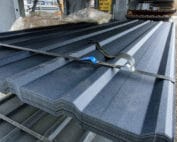
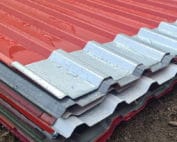
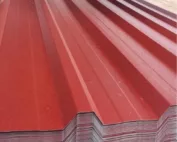
Simple trapezoidal steel sheet is often an economical choice for agricultural buildings and canopies. However, the final result depends on the profile, thickness, coating and support. The low price of a thin sheet may require a different substructure than a more expensive variant. Without checking both structures, it is impossible to know which roof will be cheaper to execute.
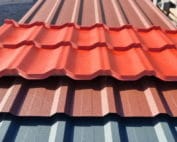
Other types of covering must also be calculated as a complete system. Tile-effect metal roofing requires cutting in line with the pressings. A snap-lock panel has its own requirements for the substrate and installation. Bituminous materials or roof tiles work in yet other systems. There is no fair, fixed order from cheapest to most expensive material without specifying the particular roof slope and scope of work.
How can a lower price per metre give a higher cost?
Let us consider two agreed variants of the same covering with an area of 120 m². In the first, the material including cutting to size costs €1,411.84 net, and the matching substructure costs €1,134.10. In the second, the material costs €1,666.44, but the intended support arrangement costs €763.78. These two items give €2,545.94 and €2,430.22 net respectively.
In this example, the cheaper material does not produce a lower total. The difference is €115.72 in favour of the second option before the other items are added. The figures are assumed solely for the calculation. They do not prove that a particular profile will allow the supports to be spaced further apart. Such a change must be permitted by the structural check. In both cost estimates, the same scope of finishing, transport and installation must still be included.

What is not worth skimping on?
Necessary flashings should not be removed, nor should a correct detail be replaced with a random sealant. Saving on fixings can change how the covering behaves in wind. Omitting a required layer under the steel sheet can in turn expose the interior to water or moisture. Each of these decisions affects how the roof performs, not just how it looks.
It is also worth matching the surface protection to the environment. Steel sheet over an ordinary shelter and steel sheet exposed to aggressive vapours do not work under the same conditions. The coating is not chosen by colour alone. If a limited budget forces a change of solution, it is better to re-agree the whole system than to buy a random cheaper version with unknown properties.
How to cut costs without guessing?
Collect measurements, the cutting plan and the list of details before ordering. Agree sheet lengths with the possibility of delivery and of getting them onto the roof. Check whether the contractor knows the selected type of covering. Material prepared to size will be of little help if the structure has different dimensions or is not ready for the agreed date.
A cost estimate with quantities, units and scope of work gives the most control. It makes it possible to notice a missing element before work begins. Compare the final totals and note which items remain on your side. A cheap roof should be correctly designed, feasible to build and suited to the building. The lowest price of a single sheet alone does not ensure this.
Questions and answers
Will the simplest roof always be the cheapest?
Simple geometry usually makes cutting and execution easier. However, the result is also determined by spans, loads, layers and working conditions on site.
Can insulation be omitted to reduce cost?
Only if this suits the building’s purpose and design. A heated space should not be compared with an open shelter as if they needed the same roof.
7 branches. Materials closer to your project.