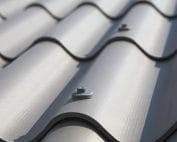
Fibre cement coverings
Small or large corrugated sheets: how panel divisions affect a building’s appearance
The sheet format affects the appearance of the roof slope, the number of joints and how installation is organised. Fibre cement sheets are best compared in relation to a specific building form. Asbestos-free fibre cement in shorter sheets can produce a finer division, while a large format can emphasise the continuity of the roof. Neither of these effects exempts you from structural requirements. On a small gazebo a large sheet may occupy a considerable part of the visible roof slope. On a vast hall the same format will be just one of many repetitive elements. It is worth assessing how often horizontal laps are to appear. Their rhythm influences the perception of the roof’s proportions. There is, however, no rule that a small building always needs a small sheet.
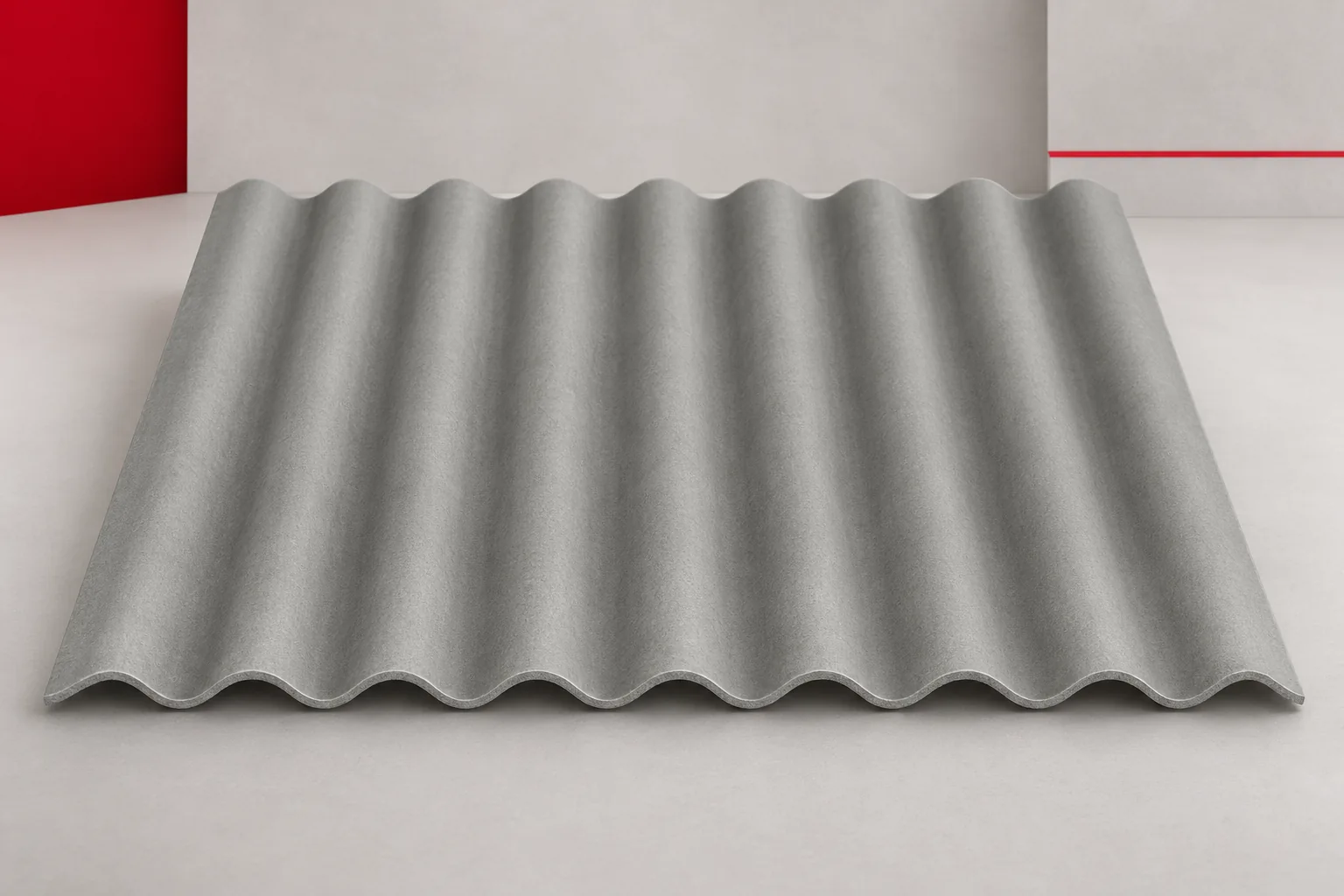
The scale of the building helps in choosing the division
A calm building form can look good with a limited number of divisions. What matters is planning the result deliberately. It is best to draw the actual sheets on the elevation or roof slope section rather than relying on a general visualisation.
The working length differs from the total length
Fibre cement sheets overlap according to the system. The visible part in a row depends on the overlap. Therefore the nominal length does not directly determine the rhythm of the horizontal lines. For planning, the effective dimensions specific to the given solution are used.
If the last row at the ridge turns out very short, it is worth checking the whole layout. Perhaps a different set of lengths will give a better division. However, the required overlaps must not be reduced arbitrarily. Aesthetics are adjusted within the limits of correct installation, not by weakening the joint.
The covering width organises the edges
The number of full modules and the way the gable end is finished affect the appearance of the side zones. Fibre cement sheets have a defined overlap edge geometry. It is not enough to multiply the number of corrugations by their pitch. The profile drawing and the cover width help to determine the layout correctly.
It is worth drawing asbestos-free fibre cement around windows, chimneys and other penetrations as well. An accidentally left narrow fragment can be difficult to fix and look inconsistent. A suitable plan limits such situations. It also allows determining in advance where additional flashings will be needed.
A large sheet can reduce the number of joints
On a simple roof slope, a larger format can be organisationally advantageous. Fewer joints are created between successive rows. However, this should not be regarded as an automatic guarantee of weathertightness. Every remaining lap and every fixing must still be carried out in accordance with the system.
Large-format corrugated fibre cement sheets require appropriate transport and lifting. The weight of an individual sheet and the ability to control it during work are what matter. Narrow access or difficult site geometry can limit the benefit. The format is selected to suit the project and the real conditions of execution.
A shorter sheet can make cutting easier
On a complex roof slope, with roof valleys and many penetrations, shorter elements can offer greater freedom in planning. This does not mean there is no waste. The actual cutting layout and the required laps must be calculated. Some small fragments are unsuitable for use owing to their support and the position of the holes.
Asbestos-free fibre cement in a small format should not be equated with just any roof tile. It is still an element of a specific corrugated system. Corrugated fibre cement sheets may require proper preparation of the corners and a specific laying sequence. More rows also mean more places that must be carefully executed and inspected.
Support spacing does not follow from appearance
The division visible on the roof must be agreed with the structure. The number and arrangement of supports depend on the format, the loads and the documentation. A longer sheet does not always mean a greater permissible span. Purlins should not be designed solely to match an aesthetic drawing of the rows.
In an existing building, it must be checked whether the intended format suits the old arrangement. Any change to the supports requires a structural assessment. The covering should not be forced to fit an arbitrary substrate. A well-chosen format combines proper support with the planned appearance.
Calculate the cost per area of the finished roof
The price per piece does not describe the cost of the covering. Laps, cuts, accessories and transport organisation must be taken into account. A larger sheet may have an advantageous price per area, but with a complex cutting layout it may produce more waste. A shorter one may require more fixings and joints.
Corrugated fibre cement sheets are worth comparing in two complete variants of the schedule. For each, there should be a roof slope drawing and a list of elements. This allows the cost to be assessed without guesswork. The price difference becomes understandable once it is clear which arrangement and which labour input it results from.
Check whether future repair is possible
The selected format should be recorded in the documentation together with the profile and the preparation variant. When replacing, a sheet of similar length is not sufficient. It must match the geometry and the connections. It is also worth establishing how to access the place that may require servicing.
Asbestos-free fibre cement is not a walking surface, so handling requires proper safeguards. The format also affects the ability to safely remove a single sheet. A good choice takes the entire service life into account. Appearance, installation and subsequent repair should form one coherent plan.
Compare two sheet layouts on the same roof slope using the cover dimensions. Only then compare appearance, number of joints, waste and installation cost.
7 branches. Materials closer to your project.