Maintenance and durability
How to locate and repair a leak in a metal roof
A leak in a metal roof is repaired by removing its cause, not by covering the sheet with sealant. Readers should first establish whether the water comes from rainfall or condensation and check where moisture enters the roof layers. The problem often lies in flashings, laps or fixings. The type of repair is matched to the covering and the condition of its coating, and extensive corrosion or a poor detail may require replacing the element. Vapour from inside can condense on cold components, producing widespread damp even without rain.
Is it a leak or condensation?
Water under the covering does not always come from a leak on the outside. Vapour from inside can condense on cold components. In that case the damp surface is often extensive, and the problem appears even without rain. A damp patch after heavy rain from a particular direction, on the other hand, suggests looking elsewhere. It helps to record the conditions under which the moisture appears.
A stain on the ceiling does not pinpoint the hole in the roof. Water can travel along the membrane, the timber or the insulation. You need to trace the path it flows along, not just the section of sheet metal above the stain. The inspection of the interior and of the roof slope should complement each other. You should not start by taking apart random areas.
If the cause is condensation, the repair may concern ventilation, the continuity of the insulation or the airtightness of the vapour control layer. Sealing the sheet overlaps will not solve such a problem. It may even restrict the intended airflow if it is carried out without understanding the system.
Which places should be inspected first?
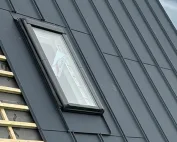
Check the flashings at chimneys, windows and the walls of higher parts of the building. Assess the roof valleys and the joints between sheets. Water can get in through an incorrect lap or reach under the sheet from an overflowing valley. Leaves and accumulated dirt can change its path even though the material itself is not damaged.
Next, inspect the fixings. A cracked, under-tightened or excessively crushed seal needs to be assessed. You should not automatically tighten all the screws. A damaged thread in the substrate will not regain its load-bearing capacity through greater force. Sometimes the specified method of repairing the hole and the selection of a suitable fastener are needed.
Pay attention to cut edges and signs of corrosion. A hole in the steel core is a different problem from a soiled surface. With a sandwich panel, the locks and the condition of the core must also be assessed. Water penetration into the interior of the panel should not be overlooked just because the dripping has been stopped.

When can sealant be used?
Sealant is used in the places specified in the given system and on a compatible substrate. The material must match the coating, the operating temperature and the expected deformation. Not every construction sealant is suitable for a metal roof. Adhesion to a cleaned surface is particularly important.
The application conditions, substrate preparation and curing time are set out in the product documentation. Applying the material over dirt, water or a coating that is coming loose gives an uncertain result. Nor may openings that serve to drain water or provide ventilation be covered. More material does not mean a better-made joint.
Local repair makes sense when the geometry of the detail is correct. If the flashing directs water under the covering, it must be rebuilt. Simply sealing the joint will then be a short-term solution. The same applies where the pitch is too low or the sheet lap has been incorrectly planned.
When is it better to replace the flashing or the sheet?
A deformed edge, extensive corrosion and numerous accidental holes may indicate that the component should be replaced. It is worth comparing the cost of repeated repairs with producing one correct detail. When ordering new sheet metal, the actual profile must be matched. A similar name and colour do not guarantee compatible seams and pressings.
Replacing part of the covering requires planning the sequence of dismantling. A sheet should not be torn out of the laps and deform adjacent sheets. Once exposed, the substrate and the moisture of the layers are checked. Wet insulation or a damaged membrane may need separate repair. Stopping the leak does not conclude the assessment of its effects.
For a sandwich panel, the solutions approved for the specific product must be observed. Not every damaged facing can be cut out and replaced at will. The panel acts as a composite element. The extent of intervention may affect its load-bearing capacity, airtightness and fire performance.
How can you check that the repair has worked?
Document the identified cause and the scope of work carried out. After repair, the area is checked from the roof side and from inside. A water test should be planned so that water is not directed in a way that does not correspond to normal service conditions. An accidental strong jet under the lap can create a new problem.
Observation during subsequent rainfall helps confirm the result. It must be remembered that previously damp layers do not always dry immediately. A persistent stain does not have to mean an active inflow, but it requires checking. Where the cause is unclear, it is worth using a moisture measurement and a contractor’s inspection.
Finally, remove debris from the outlets and gutters and establish an inspection plan. A well-executed repair has an explained cause and a specific scope. A series of successive sealant stains across the entire roof slope usually indicates that the diagnosis has still not been completed.
7 branches. Materials closer to your project.