Polystyrene and thermal insulation
Does EPS need a stabilisation period after purchase?
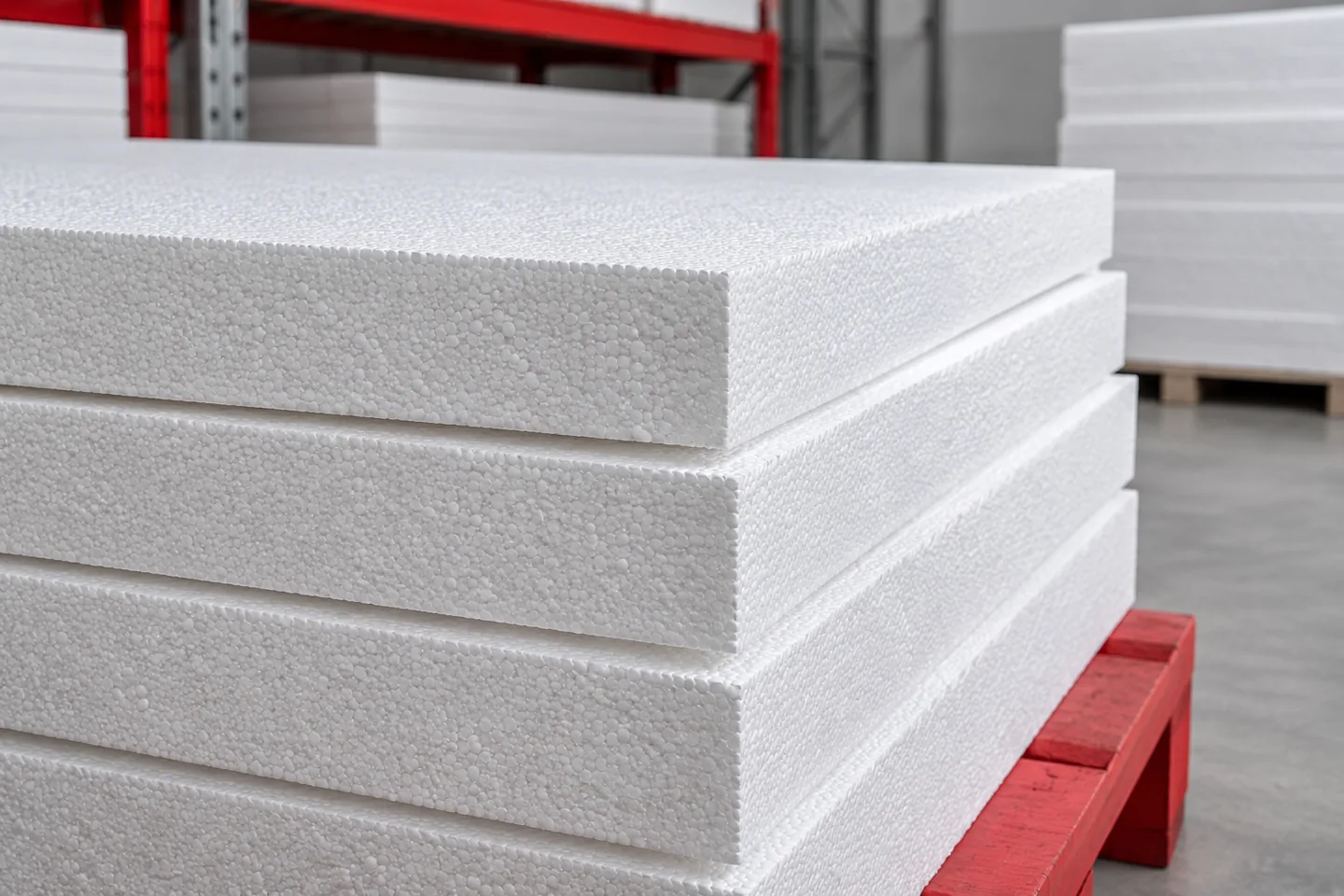
Seasoning is part of preparing EPS at the production plant. Finished boards should meet the declared requirements, including those relating to dimensional stability. There is no single number of weeks of waiting on site that is appropriate for every product. Before installation, follow the manufacturer’s documentation, the condition of the boards and the working conditions, not just the date on the label. During the manufacture of EPS, the material goes through the expansion and stabilisation stages. Depending on the technology, the granulate, the formed blocks or the finished components are stabilised. In the case of boards cut from blocks, the time before cutting is part of the production process. It is not simply storing packaged goods on site.
What does stabilisation mean in the production of polystyrene?
The course of the process depends on the raw material, the grade and the manufacturer’s equipment. Different plants may therefore use different times and conditions. Information about one process should not be turned into a universal recommendation for all boards. For the buyer, the most important thing is whether the delivered product meets its declared properties.
Do you have to wait after every delivery?
You should not automatically add several weeks of waiting time to every order. You need to check the instructions for the specific product and any recommendations regarding preparation before installation. The phrase “fresh polystyrene” alone does not define the condition of the board. The production date does not provide information about all earlier stabilisation stages.
If the manufacturer specifies particular conditions before installation, these must be observed. In case of doubt, it is worth obtaining clarification for the marked batch. The material’s readiness for use also does not mean that it can be installed on an unsuitable substrate or in unacceptable weather. These are separate conditions for carrying out the work.
What does dimensional stability mean?
In the EPS designation you can find the symbol DS(N), which refers to stability under specified laboratory conditions. This is not information about the number of curing days. For example, level DS(N)2 corresponds to a dimensional change of up to 0.2% under the conditions of the proper test. It should be read together with the documentation for the given product.
This value should not be treated as a guarantee that the board will behave identically under any heating by the sun. Other symbols relate to different temperature or load conditions. Dimensional stability and thickness tolerance also describe different things. The first concerns changes, the second concerns conformity of the dimension with the declared range.
When taking delivery, compare the actual boards with the requirements of the documentation. Visible bowing, rocking on a level substrate or large dimensional differences require assessment. It should not be assumed that the problem will disappear on its own after waiting. If the material was damaged during storage, the passage of time may not restore it to its proper shape.
Does long storage always improve the material?
Further dimensional stabilisation may occur over time, but its course depends on the conditions and the product. This does not mean that every extended period of storage brings a benefit. On site, the material may simultaneously be damaged by UV, heating, incorrect support or contact with chemicals. The entire balance of conditions must be taken into account.
Leaving packs on an open yard is not a controlled technological process. Nor should one attempt to accelerate stabilisation by heating the boards. Such a procedure can lead to deformation. If the construction schedule slips, ensure proper storage instead of treating every pause as an additional improvement in quality.
What should be done when the boards change shape?
Set the material aside and record when and under what conditions the problem was noticed. Take photographs of the boards and labels. Check whether the packs stood in full sun, near a heat source or on an uneven substrate. With graphite EPS it is particularly important to identify exposure to heating during storage and work.
An explanation must be obtained before concealing the boards in the building element. Do not straighten them by applying strong pressure, and do not level out large deformations with excess adhesive. Depending on the scale of the problem, an assessment by the manufacturer or an investigation may be required. Waiting another week on its own does not replace a decision on the suitability of the material.
How should purchasing and installation be planned?
Coordinate the delivery date with the stage of the works and the preparation of the storage location. The boards should arrive on a prepared substrate under the conditions permitted by the system instructions. A delivery much earlier makes sense only if the material can be properly protected. It is not worth creating a large stock solely out of fear of an unspecified “lack of stabilisation”.
Keep the documents and batch markings. Before starting installation, inspect the surfaces, edges and flatness. When the condition and documentation comply with the requirements, the decision is based on specific data. If they do not, ask for an explanation. This is more reliable than assessing quality by the age of the pack alone.
Polystyrene is produced by, among others, Styropmin, Austrotherm, Knauf Therm and Sonarol. Information on the readiness of the product for installation should be referred to the documentation of the specific manufacturer.
7 branches. Materials closer to your project.