Roof and energy
Does a larger photovoltaic roof capacity always mean a better investment?
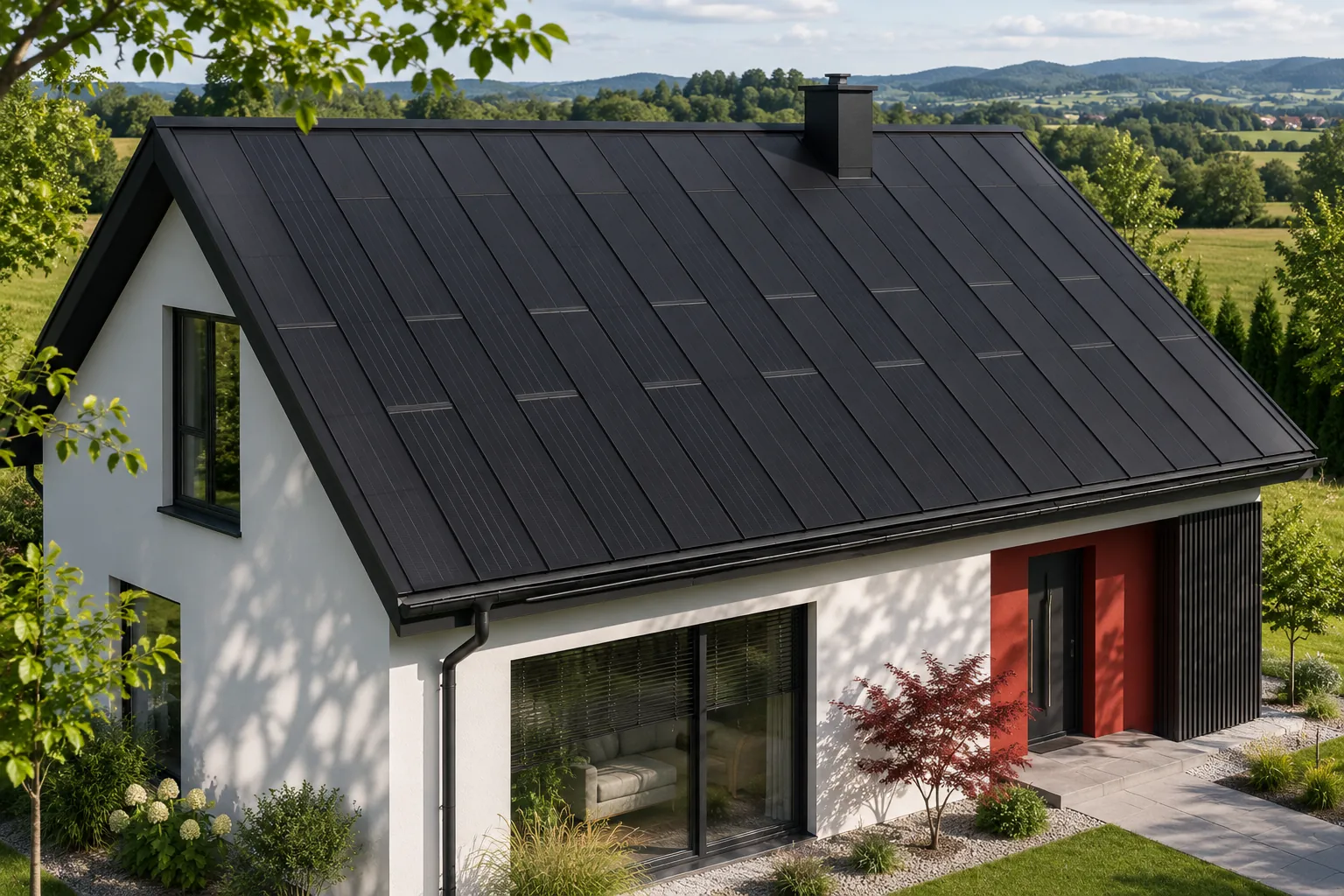
A larger active area can increase production, but it does not necessarily increase the benefits proportionally. An additional roof section is often less well lit or supplies energy at a time when there are already large surpluses. The additional cost must be compared with the additional value of the energy. In an integrated system, a consistent covering can be maintained with passive elements. There is therefore no obligation to use every square metre of the roof surface to the maximum. At the outset, areas with good conditions and a simple layout are usually considered. As capacity is increased, zones with shading, a less favourable orientation or a more difficult detail may be added. Their production per unit of capacity does not have to be the same as on the first part of the roof.
What does an additional active section change?
That is why the result of the best area should not be multiplied linearly.
The designer should show what the next variant delivers. A comparison of the additional power, the expected energy and the installation cost is useful. This shows whether the extension comes from the needs of the house or only from the available space. The mere possibility of fitting an active element is not yet a justification for buying it.
Will the house use the additional energy?
The distribution of consumption over time is most important. If a large surplus is already being generated during sunny hours, additional cells may mainly increase the amount of energy fed into the grid. Its value should be assessed according to the applicable billing rules. The entire additional production cannot automatically be counted at the price of the avoided purchase of energy.
It is also worth checking the realistic possibilities for changing consumption. Shifting the operation of appliances can help, but not every appliance can be run when the sun is shining. An investment should not be planned on the basis of habits that the household does not want to maintain. The model should cover current needs and justified changes, not an ideal day without constraints.
How should future consumers be taken into account?
A planned heat pump, car or house extension can increase demand. However, both the amount of energy and the hours and season of its consumption must be estimated. Heating has a different profile from summer cooling or weekend car charging. Information about a new appliance alone does not automatically determine the right roof capacity.
Two variants can be prepared: for the current building and for a specific extension. It is worth checking whether a later increase of the active area is technically permitted and how much work it requires. Not every replacement of a passive element with an active one will be a simple operation. Matching parts, cables and suitable devices are needed.
What limitations does the rest of the installation have?
A larger array capacity may require a different inverter, a different circuit layout or other components. The connection conditions and grid operation must also be checked. The cost of the extension does not always end with the additional section of roof. The comparison should therefore cover the complete set that will be able to operate in accordance with the design.
You should not determine the power ratios of the devices yourself on the basis of a single rule from the internet. Different systems may have different permissible ranges. A good installer should explain why they propose a particular solution and what the effects of the alternatives are. Such information is more important than the mere assurance that the larger option will “provide a margin”.
Does a smaller active area make the appearance worse?
In a well-planned system it does not have to. Active and passive elements can form an orderly roofing composition. This allows the power to be matched to needs without attaching random panels on top of the roof slope. It is worth looking at samples and real installations, however, because different surfaces may reflect light differently.
The design should show the boundaries of the arrays and the details at the edges. Sometimes a simple, clear layout looks better than maximum filling of every free fragment. This is one of the important advantages of an integrated steel roof. It allows energy decisions to be made without giving up a consistent building form.
How do you choose a sensible variant?
Compare several sizes on the same basis. For each, record the full cost, the energy forecast, the share used in the home and the required installation changes. Pay particular attention to the benefit of the last increase. If the cost rises faster than the value of the additional energy, the smaller option may better suit the investment goal.
There is no single power that is right for all homes. An integrated roof makes it possible to plan the covering as a whole, and the active area should be chosen deliberately. The largest system may be justified, but it should result from analysis. A sensible margin is something different from buying energy that you do not know how to use later.
Examples of companies and brands in roof-integrated photovoltaics are Electrotile, Wienerberger Wevolt, Nelskamp, SolRoof, SoliTek, EDILIANS, Solartag, SunRoof, ML System and MDM NT (MyRoof).
7 branches. Materials closer to your project.

- SEROCK — Dzierżenin 34 E
- BŁONIE — ul. Sochaczewska 138A
- RADOM — ul. Grobickiego 8
- ŁÓDŹ — Natolin 8
- OLSZTYN — Barczewo, ul. Prosta 9
- WROCŁAW — ul. Jerzmanowska 10C
- GORZÓW WLKP. — ul. Zielona 33/34