Insulation and ventilation
Choosing a roofing membrane to suit the roof build-up and loft use
First decide which side of the roof build-up the membrane will serve, rather than relying on a trade name. Check its diffusion resistance, watertightness, strength and the permitted substrate and gaps. Grammage alone does not confirm suitability. For a habitable loft, pay attention to the airtightness of the inner layer; for metal cladding, to drainage and ventilation. Compare the requirements with the cladding instructions and the build-up design. Only then ask about accessories and the compatibility of the whole system.
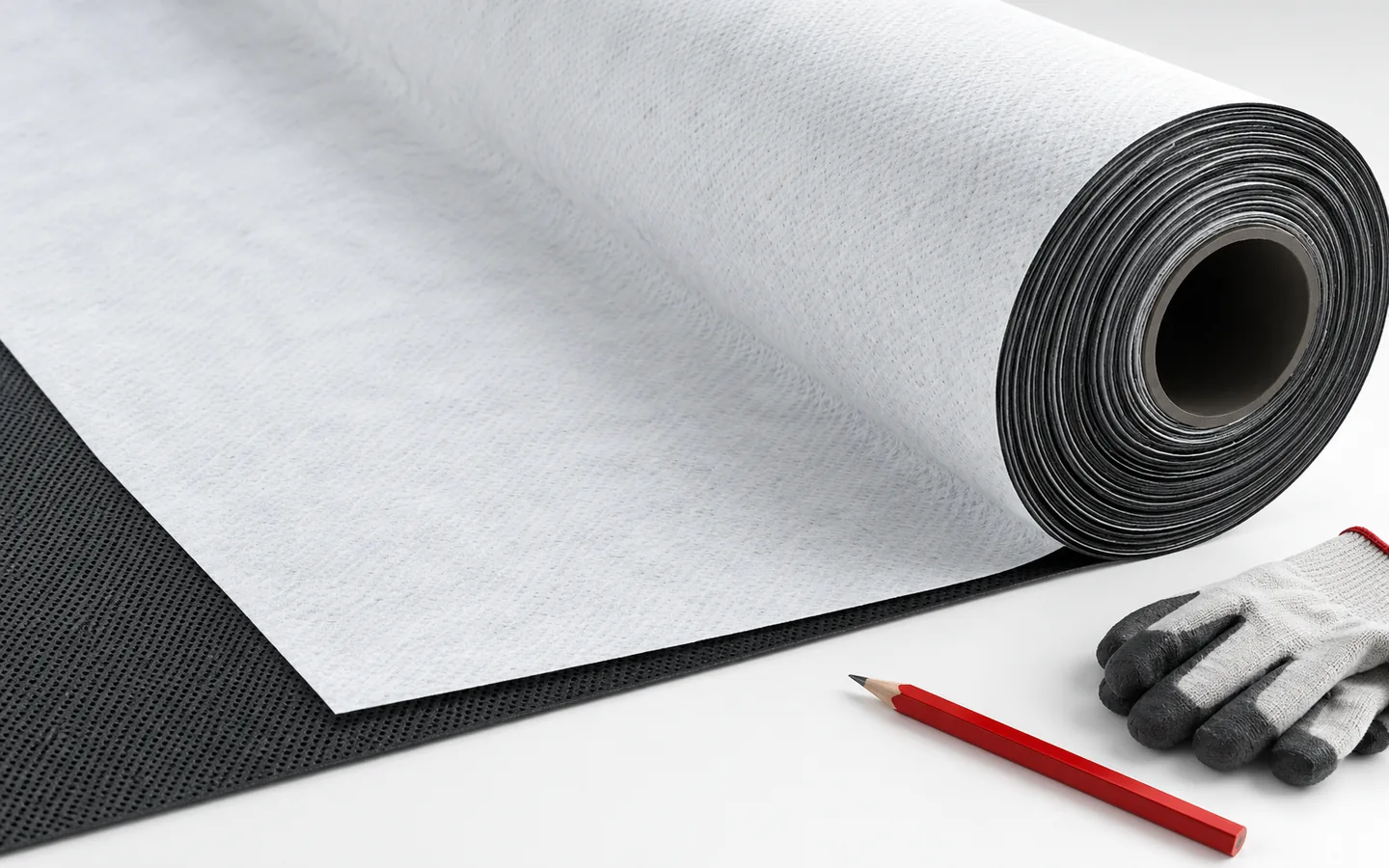
What function does the membrane have in a given place?
The name roof membrane covers materials with different applications. In the underlay layer, the aim is to intercept water that gets under the covering and to protect against draughts. On the room side, a suitably designed layer is needed to limit vapour transport and air flow. Swapping these materials can disrupt the performance of the whole roof.
First establish the cross-section of the assembly. Full boarding, ventilation gaps, the type of insulation and the use of the attic are important. A high vapour-permeability membrane is not automatically suitable under every steel sheet on full boarding. A separating layer or another solution may be needed. Selection should take into account the covering manufacturer’s instructions and a moisture assessment of the assembly.
What does the Sd value say, and what does grammage not say?
Sd describes the resistance to water vapour diffusion as an equivalent air layer thickness. A low value facilitates diffusion through the material. A high value restricts it. The desired value depends on the function and position of the membrane. Not all layers should be chosen according to the principle that the more permeable, the better. A roof needs the right assembly, not one record-breaking property.
Grammage is the mass per unit area. It may be linked to construction and mechanical resistance, but on its own it does not determine tightness or durability. Two membranes of similar mass can differ in functional layer and parameters. The data sheet should also be checked for tensile and tear strength. These are important properties during installation and in service at the fasteners.
Why are water and temperature resistance important?
A membrane under steel sheet may be exposed to water driven under the covering or originating from condensation. It should retain the required properties under the intended conditions. The declared watertightness and, where given, data after ageing should be read. Good vapour permeability is not proof of resistance to liquid water. These parameters describe different phenomena.
Under metal covering there are temperature changes. The selected material must be suitable for this application. Also check the permitted exposure time to sunlight before covering. UV resistance does not mean consent to leaving the membrane without a roof indefinitely. The declared period of temporary protection may depend on the execution of the joints and on weather conditions.

How do the substrate and gaps change the requirements?
Some membranes can be laid directly on insulation or full boarding, others have restrictions. Suitability must not be inferred from the appearance of the roll alone. The support affects the method of fixing and the stresses. Older roofs may also contain materials with high diffusion resistance. Adding a new membrane without identifying the old assembly can trap moisture.
Ventilation beneath the covering requires an unobstructed inlet and outlet as well as a continuous gap. The membrane will not replace this flow. If the design provides for an additional gap beneath the underlay, it must not be filled with insulation. Conversely, incidental void spaces do not create effective ventilation. They must have a designed flow direction and contact with external air.
What does a tight execution of connections involve?
Laps, penetrations and terminations require tapes and accessories compatible with the material. The lap width and the need for additional sealing follow from the instructions and the pitch. At the eaves, drainage of intercepted water must be ensured. At a roof window or chimney, it is not enough to cut the membrane and fold back the loose edges. A continuous connection of the detail is required.
On the interior side, airtightness is particularly important. An unsealed duct, a junction with the wall or a tear can carry moist air into the depth of the roof. The tape should perform on a clean and suitably prepared substrate. An incidental packing tape is not a durable solution. The quality of joint execution matters comparably to the selection of the membrane itself.
How do you prepare a sensible purchase enquiry?
Describe the covering, the roof pitch, the full boarding and the planned insulation. State whether the attic will be heated. Ask about the membrane’s compatibility with the specific build-up and about the required accessories. Compare the cost of the entire layer including tapes and sealings. A saving on the roll can disappear when one quote omits the materials needed for correct execution.
Before closing the slopes, it is worth inspecting the continuity of the inner layer and documenting the joints. Beneath the covering, the water drainage and the patency of the gaps should be checked. A well-chosen membrane works within the whole roof. It will not repair poorly executed flashing and will not dry out permanently wet insulation. Doubts concerning moisture must be resolved before the structure is covered.
7 branches. Materials closer to your project.