Polystyrene and thermal insulation
Can EPS boards from different manufacturers be combined?
EPS boards from different manufacturers are not automatically interchangeable. Whether they can be combined depends on the parameters, geometry and requirements of the overall solution. The ETICS façade and floors with several insulation layers require particular scrutiny. A matching lambda value or thickness alone is not enough. Any change should be checked before opening a new batch. It may be a matter of topping up a few missing packs, replacing the material across an entire wall, or laying different boards in successive floor layers. Each of these situations requires a different check. Approval for one building element must not be carried over to the whole building. The location and the way the insulation works are important. First establish why the change is being considered.
What does combining materials actually mean?
If a few boards are missing, it is usually easier to maintain continuity of the specification than to assess a new product in the middle of the works. When the entire batch changes, a full comparison can be prepared. In both cases, the material must be identified from the documents, not from its appearance.
What is the significance of the ETICS documentation?
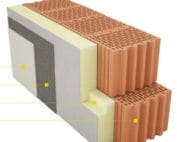
The ETICS system is a defined set of products and rules of execution. Its documentation describes the requirements for the insulation and the other layers. A replacement EPS must fall within this scope. Depending on the solution, the specified properties, variants or other restrictions may be relevant. Full freedom of choice must not be assumed from the name EPS alone.
Equal lambda does not confirm conformity of tensile strength, stability or fixing conditions. The scope of the fire assessment of the entire system must also be taken into account. The reaction-to-fire class of a single board does not replace the classification of the complete façade. In case of doubt, the change is clarified with the designer and the system supplier.
Can white and graphite EPS be combined?
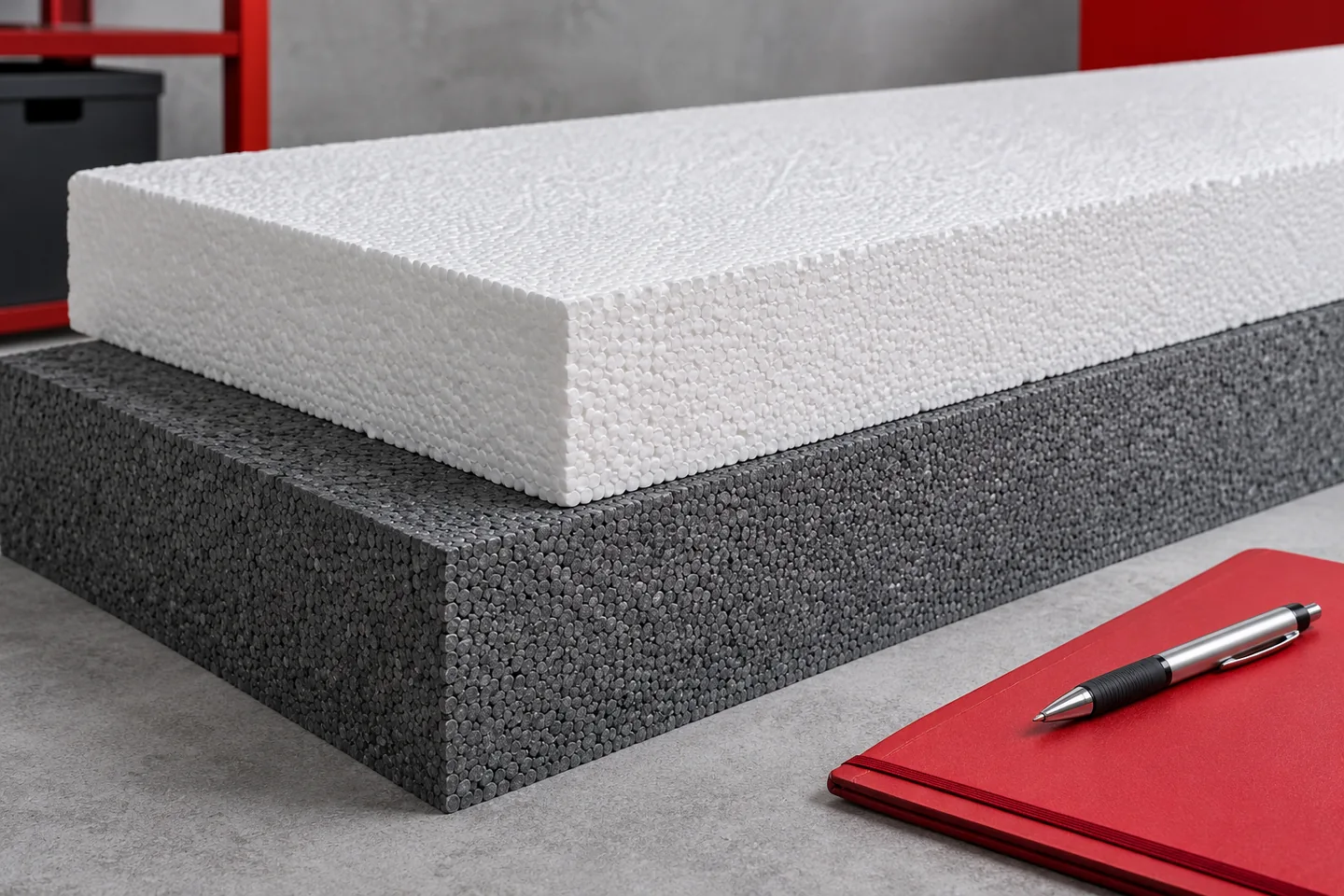
Colour is not a criterion for approval in its own right. The properties and thicknesses must be compared and the thermal solution checked. If boards with different lambdas appear in one plane, the better of these values cannot be assigned to the insulation everywhere. The calculations should correspond to the actual arrangement of materials.
At the same thickness, the thermal resistance of the layer depends on the lambda. Reducing the thickness only in some places in order to use up leftovers also changes the arrangement. The geometry of the surface and the execution of the subsequent layers are added to this. The assessment must be based on the entire detail, not on the assumption that a grey board will always compensate for any difference.
Different materials may require different protection during work. Graphite EPS is particularly sensitive to heating by the sun. With a mixed delivery, the crew should know the recommendations for each variant. This is another reason not to separate the labels from the boards before determining their installation location.
What should be checked in a floor with two layers?
In a floor, the mechanical parameters of all layers matter. Stronger EPS on top does not remove the susceptibility of the weaker layer underneath. The deformation of the entire system depends on thickness, loads and long-term behaviour. Even support and the way the joints are distributed must also be checked.
If one layer is to be acoustic, do not replace it with ordinary EPS just because the height fits. Dynamic stiffness and compressibility affect the performance of the floating floor. With dry screed, the documentation may additionally restrict the variant and the total insulation thickness. A similar CS(10) alone does not confirm the compatibility of the assembly.
Why do the dimensions and edges need to be checked?
Two nominally similar boards may have a different format, edge profile or tolerances. When placed together, steps and gaps may occur. With edge profiling, do not assume the profile matches without comparing it. The covering dimension and the way the elements fit at corners, openings and adjacent layers are also important.
A dry fit shows the geometry but does not replace checking the properties. The boards may fit together perfectly and still not perform the same task. Do not compensate for different thicknesses with a randomly increased amount of mortar. The solution should preserve the required position of the surface as well as the conditions for support and fixing.
How should an approved change be documented?
Record which material was replaced, where the new product was laid and on what basis the change was accepted. Keep the declarations, data sheets and labels. When dividing into zones, mark their boundaries on the plan or in photographs. This way, a later assessment of the building will not be based on a single label kept from a random pack.
Reject solutions whose conformity cannot be demonstrated with the available data. This does not necessarily mean replacing the entire order. Sometimes it is enough to return to the original specification in a given place. The most important thing is that saving a few packs or shortening a delivery does not lead to an uncontrolled change of the building envelope.
Well-known EPS manufacturers include Termo Organika, Austrotherm, Ekobud and Justyr. The possibility of combining specific boards depends on their properties and the requirements of the system used.
7 branches. Materials closer to your project.