Roof and energy
Why parts availability matters when choosing a photovoltaic roof
A roof is chosen with long-term use in mind, and some devices and components may need to be replaced over time. That is why, before buying, you should ask about how parts are identified, the service procedure and possible replacements. In an integrated system, compatibility concerns both the electrics and the roof covering. Merely ensuring that a product is popular does not explain how a specific section of the roof will be repaired in a few years’ time. The active element must fit the geometry and joints of the adjacent covering. At the same time, it should work with the existing electrical system. Similar dimensions and colour are not enough. A change in voltage, profile or method of fixing may require different measures than a simple replacement of one unit.
Why is interchangeability not obvious?
This needs to be checked for the specific system.
This does not mean that the integration is inherently unrepairable. It means a systematic approach to servicing is needed. The supplier should be able to describe how the component is identified and the conditions for using a spare part. Such information is more useful than a general promise that something similar will always be found in the future.
What markings should be kept?
The documentation should identify the versions of active and passive components, the devices and the connection layout. The delivery date and any subsequent changes are also important. A roof plan helps link the part to the installation location. Without it, servicing may require additional identification before the correct product can even be ordered.
At handover, check whether the designations in the documents match what was delivered. If an alternative variant was used, this should be recorded. It is not worth keeping only a catalogue of the entire series. After a few years it may contain many versions, and no information will unambiguously indicate the one installed on your roof.
What should you ask the supplier before purchase?
Ask about the current availability of service parts, the ordering process and the procedure in the event of a variant being discontinued. Establish who assesses the compatibility of a replacement and how the change is documented. Not every future situation can be guaranteed, but the supplier should have a clear service model. The absence of a specific answer is significant information when comparing offers.
It is also worth asking about less visible elements: accessories, electronics and parts needed to recreate connections. The availability of the active surface alone is not enough if the repair requires an unavailable detail. A well-described system allows you to look at the complete scope, not just the largest element shown in the catalogue.
Is it worth buying a spare upfront?
A spare may make sense for selected parts, but it should not be an automatic recommendation. You need to know the storage conditions, the service life and the actual need. Some devices or materials may require proper storage, and a future repair may concern a completely different element. The cost of the spare should be compared with a confirmed service model.
It is best to discuss this decision with the supplier of the specific system. They should indicate what is worth keeping and under what conditions. The owner should not accumulate random replacements just because they are available at a discount. Without mechanical and electrical compatibility, such a purchase may not help in any subsequent repair.
How does roof access affect the cost of parts?
A small component may require considerable effort if it is in a hard-to-reach location. Work protection, dismantling and reinstating the covering must be taken into account. Therefore, parts availability and access to the repair location should be assessed together. A low price for a replacement does not always mean a low cost for the entire intervention.
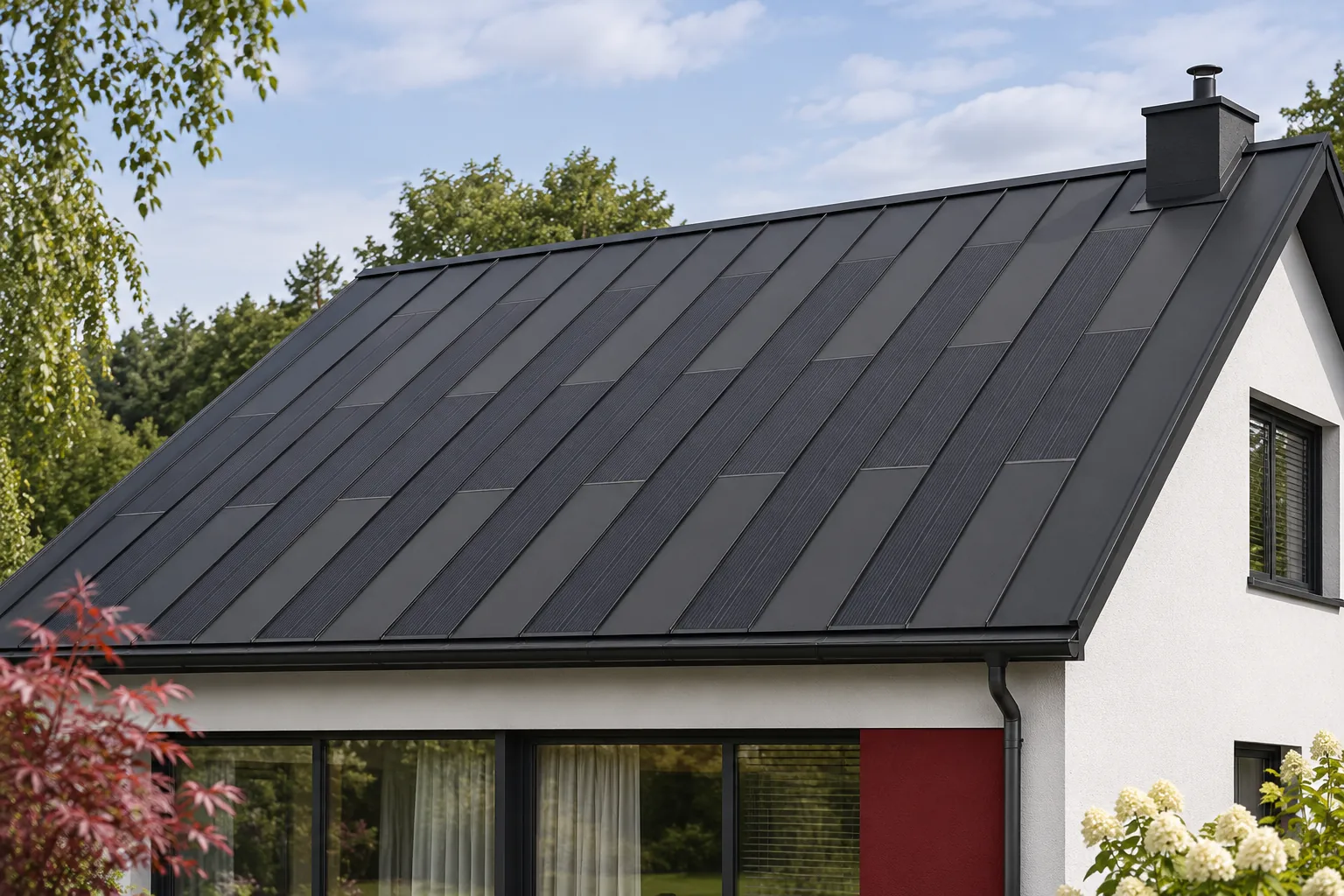
An integrated roof can be designed so that servicing is planned from the outset. An orderly layout of arrays, documentation and appropriate access zones help. This does not mean walking at will on an active surface. It means consciously planning a procedure so that repair does not require improvisation on a finished building.
How should this be factored into the final choice?
Compare not only the length of the warranty but also how it is implemented and the service after it ends. Ask whether the repair covers coordination of the roof and electrical parts. It is worth knowing the local contact and the required notification documents. Good service organisation can be a significant benefit of a system, even if it is not in the power table.
An aesthetically pleasing integrated steel roof is an investment in the building’s appearance and function. Parts availability helps preserve these qualities over time. It is impossible to promise an unchanging market offering for decades. However, you can choose a solution with clear identification, documented repair and a sensible plan for what to do if the product variant changes.
Among manufacturers and brands of photovoltaic roofs are SunRoof, Wienerberger Wevolt, Electrotile, Terrán, ML System, SolRoof, MDM NT (MyRoof), Tesla, Ennogie and Megasol Energie.
7 branches. Materials closer to your project.

- SEROCK — Dzierżenin 34 E
- BŁONIE — ul. Sochaczewska 138A
- RADOM — ul. Grobickiego 8
- ŁÓDŹ — Natolin 8
- OLSZTYN — Barczewo, ul. Prosta 9
- WROCŁAW — ul. Jerzmanowska 10C
- GORZÓW WLKP. — ul. Zielona 33/34