Choice of covering
What determines the weight of T18 and T35 trapezoidal sheets?
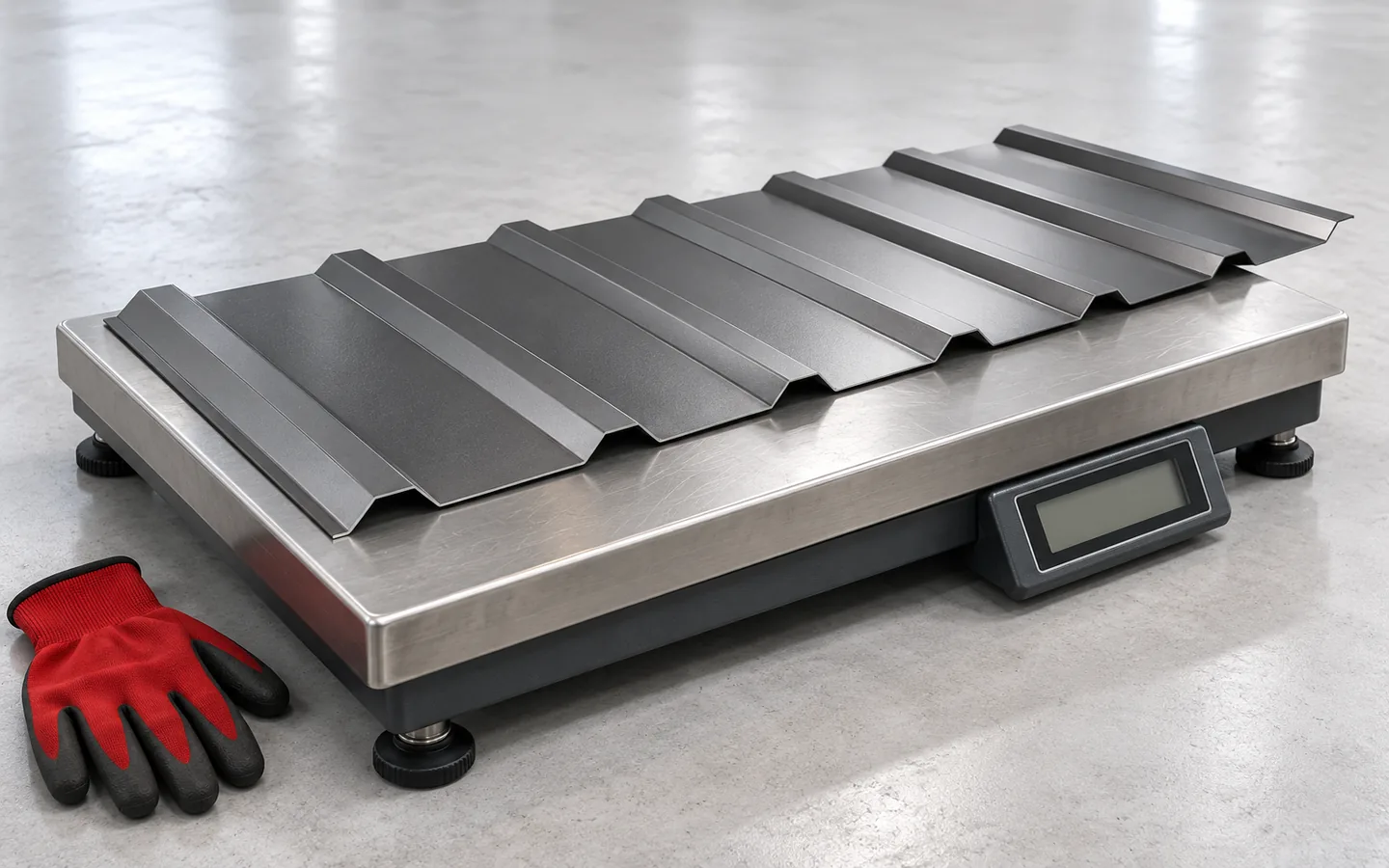
The weight of T18 and T35 trapezoidal sheets depends primarily on the steel thickness and on which surface area the stated mass refers to. There is no single fixed value for these profiles, because the same shape can be available in different material variants. When planning transport and performing structural calculations, check whether the data relate to the total area, the coverage area or a single sheet. It is also worth establishing whether protective coatings are included. Only the technical data sheet for the specific product provides a reliable mass.
Why is the profile designation not enough?
The number in the profile name refers to its geometry, but does not specify the sheet thickness. The same type of trapezoidal profile can be available in several material variants. A sheet made of thicker steel will be heavier, even if it looks similar from above. The question of weight must therefore always be supplemented with the exact specification.
The cross-section also matters. Forming the ribs requires material whose developed length is greater than the width visible on the finished sheet. Profiles of different shapes may have different steel consumption per m² of coverage. It must therefore not be assumed that T35 weighs exactly the same as T18 of equal thickness.
Protective coatings are also included in the weight of the finished product. In a simple calculation they are often omitted for clarity, but this should be noted. For ordering transport or checking the structure, the data declared for the actual sheet is used, not solely the result of a simplified formula.
How does the basic calculation work?
For flat steel, thickness can be multiplied by density and area. At an example density of 7850 kg/m³, a sheet 0.5 mm thick weighs approximately 3.93 kg per square metre of developed steel surface. This calculation does not include coatings or the correction resulting from profiling and overlaps.
If, in a purely calculational example, a steel strip 1.25 m wide gives 1.10 m of coverage, the weight per m² of coverage increases in the ratio of 1.25 to 1.10. This gives approximately 4.46 kg/m² before adding coatings. The widths given serve to show the method. They are not universal dimensions of T18 or T35.
The calculation explains why the price and weight related to the usable area differ from the values for flat material. For a specific profile, the data sheet and the way the weight is stated must be checked. This avoids confusion arising from the use of two different definitions of a square metre.

How do you calculate the weight of a single sheet?
If the data sheet states the weight per square metre of coverage, it is multiplied by the effective width and the length of the sheet. Unit consistency must be maintained. If the weight is described for the total area, the total width must be used. Converting these quantities without checking will overstate or understate the result.
For example, a sheet with a coverage area of 6 m² and a unit weight of 4.5 kg/m² weighs 27 kg in this simplified calculation. This illustrates the method of calculation, not a parameter of any given sheet. The actual result depends on the specification and tolerances. For a large delivery, the schedule should be based on the manufacturer’s data.
The weight of a pack includes the packaging, interleaving and any pallet. Transport should also take account of the length of the elements. A light sheet with large dimensions can be difficult to move safely. Weight does not describe susceptibility to deflection or the effects of wind gusts.
What does the weight mean for the roof structure?
The weight of the covering is a permanent load. In addition to it, there are other layers, snow, wind and equipment. The low weight of the sheet is often advantageous for renovation, but it does not exempt you from assessing the roof structure. A weak connection or a damaged purlin may still need repair, even though the new covering is lighter than the previous one.
A greater sheet weight must not be equated with sufficient load-bearing capacity of the entire system. A table is needed for the profile, thickness, span arrangement and support width. Likewise, lightness does not replace fastening against wind suction. Particular attention is required at edges, corners and open canopies.
Structural sheets used as a roof substrate have separate geometries and parameters. They can work together with PIR insulation and waterproofing, but the weight of each layer is calculated separately. The weight of the trapezoidal sheet alone should not be taken as the weight of the entire layered roof.
How can the data be used when placing an order?
In the material list, record the profile, thickness, coating, lengths and number of sheets. Ask for information on what area the unit weight refers to. This will facilitate transport and unloading planning. When two different values appear, first check the units and widths before considering one of them incorrect.
When comparing T18 and T35, also consider the load-bearing capacity and the cost of the substructure. A heavier profile may allow a different support solution, but this requires confirmation in calculations. A saving of just a few kilograms of material should not be decisive in the choice of roof.
Pass on the dimensions of the longest elements and the weight of the packs to the team. This will help in choosing the lifting method and the storage location. Ultimately, the correct answer to the question about weight is: for a specific profile, thickness and unit. Only such a figure is useful on site.
7 branches. Materials closer to your project.