Roof and energy
Who is responsible for the photovoltaic roof where the roofer’s and electrician’s work meet?
An integrated roof combines two trades in a single construction product. The roofer is responsible for the proper execution of the covering, while the electrical part requires appropriate competences and checks. Most ambiguities arise between these scopes: at penetrations, cable routes and repairs. That is why the coordinator, the acceptance points and the procedure for handling reports must be established before ordering. The name ‘complete system’ alone does not yet guarantee this. The cable must leave the active field, follow the designated route and reach the devices. Along the way it must not impair the tightness, ventilation or protection of the roof layers. The flashings and fixings, in turn, must not damage the insulation or the electrical connection.
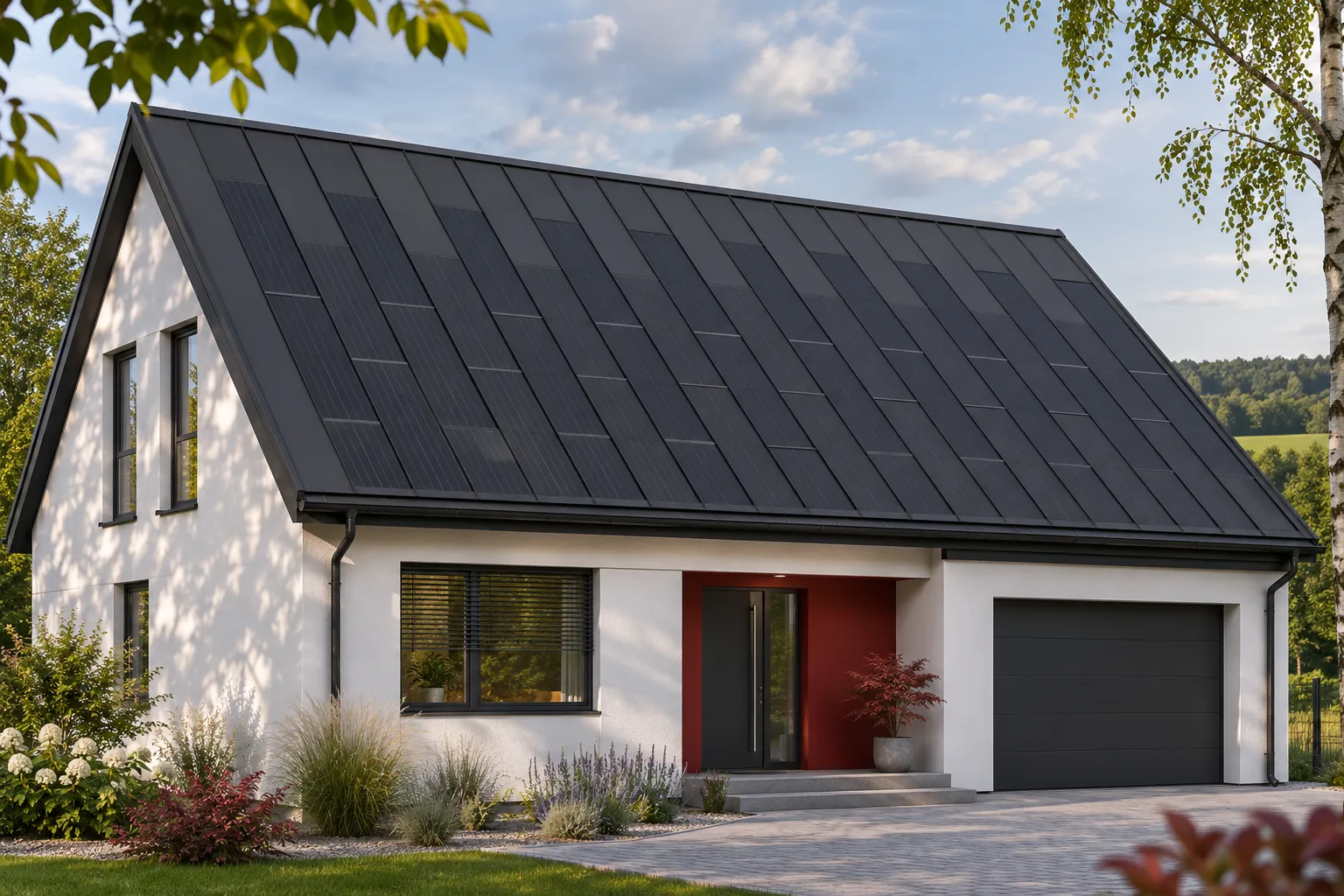
Where do the two trades meet?
These are shared details that cannot be properly planned in two independent conversations.
In a steel integrated system, they can be established before the entire roof slope is installed. This is one of the important advantages of such an approach. However, responsibility for the specific drawing and execution must be assigned. If both teams assume the other will refine the detail, the problem may only emerge after the area is covered.
Does a single contractor solve the problem?
A single contract can facilitate coordination, but it does not replace a clear scope. A general contractor may use subcontractors, and the system supplier does not always carry out all the works. The client should know who makes the technical decisions and who is responsible for contact after acceptance. What matters is the actual organisation, not just the number of logos on the offer.
If the contracts are separate, a shared plan is all the more necessary. The sequence of works, required documents and acceptance rules for areas to be covered must be established. This does not have to mean a complicated procedure. A short, specific division of responsibilities is usually more useful than a general statement that each team is responsible for its own work.
Which stages should be accepted before covering?
Cable routes, connections, penetrations and layers that will be difficult to access later are particularly important. The scope of inspection should follow from the design and the system instructions. Photos help document the execution but do not replace the required checks. It is important to know who confirmed readiness to close a given area.
Stage-by-stage acceptance reduces the risk that a finished roof will have to be opened because of a detail overlooked earlier. It also allows discrepancies between the design and the construction conditions to be resolved. Every agreed change should go into the documentation. Otherwise, the final diagram may describe an assumption rather than the actual installation.
How to establish responsibility for commissioning?
Before work begins, it must be specified who carries out the checks of the electrical part and hands the installation over to the user. The condition of the roofing and flashings must be confirmed separately. A working inverter does not prove that the entire roof has been executed correctly, just as the absence of leaks on a dry day does not confirm that the circuits are functioning.
The final documents should form a coherent set. A current roof layout, a schematic, equipment labels and operating instructions are needed. The owner should receive a service contact and know how to report a symptom with an unclear cause. They should not have to decide themselves whether water at a cable penetration is one trade’s problem or the other’s.
Who handles repairs after years?
It is worth agreeing the reporting and repair coordination process straight away. If an active element has to be removed, the work may require both an electrical procedure and reinstatement of the covering. The scope should cover protecting the building, access and a final check. Repairing the device without confirming that the roof covering has been closed is not a complete solution.
Ask what happens when the contractor changes or cooperation with the original team ends. The documentation and labels should enable service by the appropriate provider. It is not always possible to guarantee the same person throughout the service life. What can be ensured is that knowledge of the system does not remain only in their memory.
What should be included in the agreements?
Record the coordinator, the scope of each trade, the checkpoints and the list of documents to be handed over. Add how changes are approved and how reports are handled after acceptance. The arrangements should match the actual delivery model. If anything is unclear, it is worth clarifying before ordering, while changing the organisation is still simple.
An integrated roof makes it possible to treat the covering and the energy as a single investment. This benefit is greatest when a shared design also has shared management. An aesthetically pleasing roof surface should be the result of coordinated work, not a chance meeting of two teams. Clear responsibility helps maintain that effect during later servicing too.
Players in the photovoltaic roofing market include Solarstone, Ennogie, SunRoof, MDM NT (MyRoof), Electrotile, ML System, SolRoof, GAF Energy, Wienerberger Wevolt and Dyaqua.
7 branches. Materials closer to your project.

- SEROCK — Dzierżenin 34 E
- BŁONIE — ul. Sochaczewska 138A
- RADOM — ul. Grobickiego 8
- ŁÓDŹ — Natolin 8
- OLSZTYN — Barczewo, ul. Prosta 9
- WROCŁAW — ul. Jerzmanowska 10C
- GORZÓW WLKP. — ul. Zielona 33/34