Choosing a covering
What distinguishes modern modular tile-effect roofing sheets?
Modern modular metal roof tiles stand out for their repeatable sheet format and refined joining method, not for the label ‘new’ alone. Before choosing, check the effective dimensions—the coverage area rather than the overall size—as well as the profile geometry and the type of lock. View several joined sheets in natural light, because a single sample does not show the rhythm of the whole roof slope. Also ask about the permissible roof pitch and the details at the eaves. A flat profile does not remove the need for an even substructure, and a deeper pressing is not automatically better.
How has the form of tile-effect metal roofing changed?
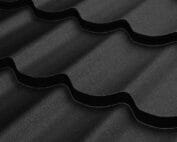
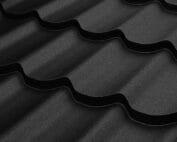
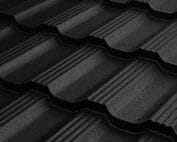
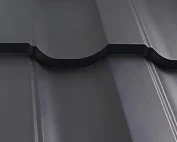
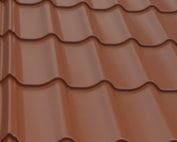
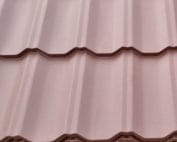
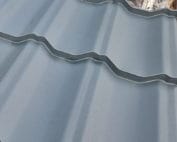
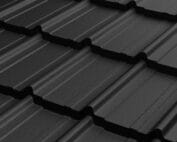
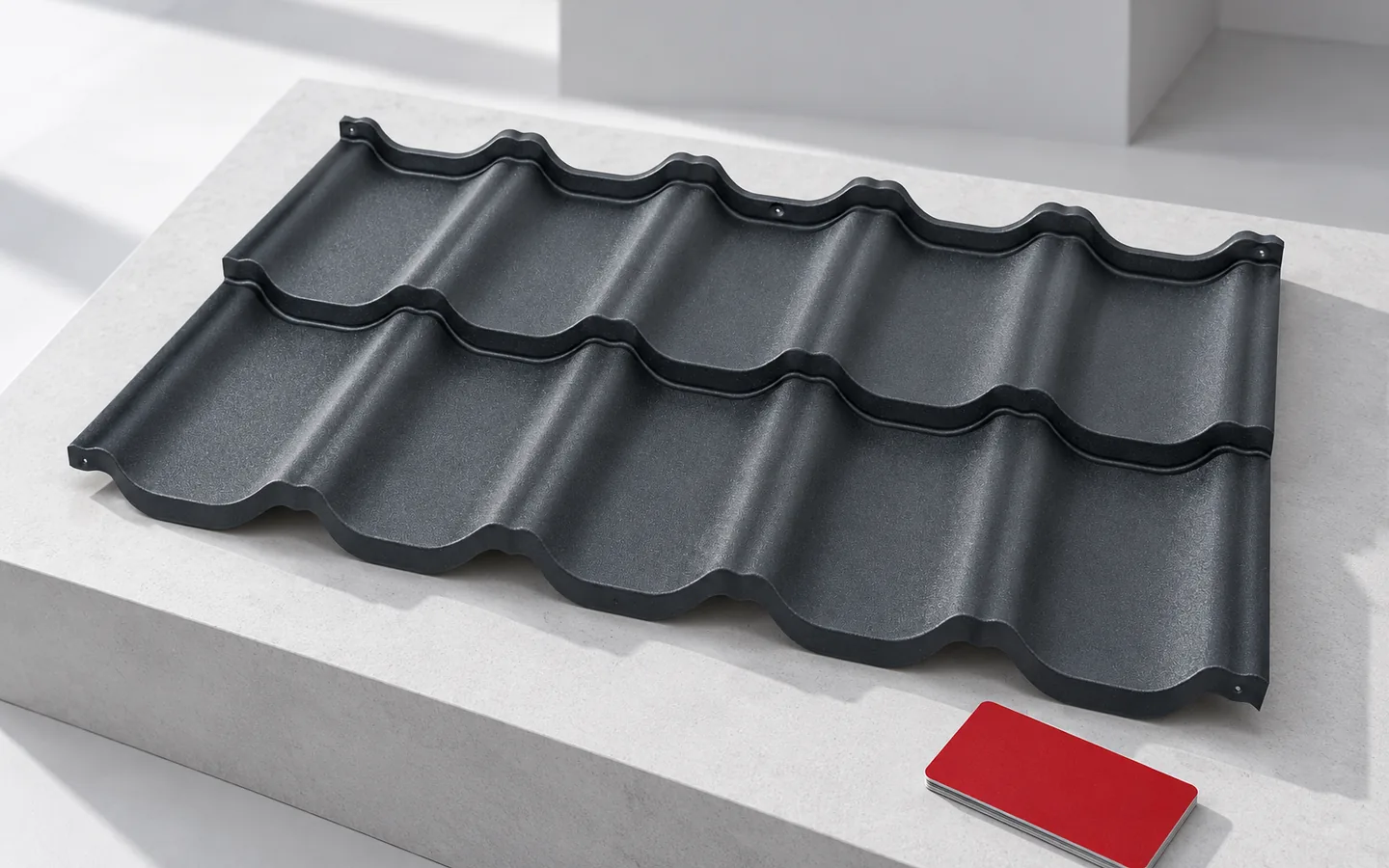
Alongside clearly corrugated patterns, there are also calmer profiles with flat fields. These can harmonise well with a simple building form and a restrained façade. The shape affects how light is reflected and how visible the joints are. However, the effect cannot be judged from a small image alone. The entire roof slope creates a different rhythm than a single piece.
The height of the profiling and the proportions of the module are important both aesthetically and technically. A deeper profile is not automatically better. Its support and method of fixing must be checked. A flat appearance of the covering also does not mean the substrate can be arbitrary. With calm surfaces, unevenness in the substructure can be particularly visible in side light.
What does a repeating format offer?
The modules have fixed dimensions and coverage area. This facilitates storage, transport and handling of the sheets. The installer works with elements of similar size. This is convenient, especially on complex roof slopes. However, the smaller format does not remove the need for roof measurement or a cutting plan at roof valleys and edges.
When calculating the purchase, effective dimensions must be used. Overall dimensions include the overlaps and do not describe the covered area. Two similar modules can have different coverage. Therefore, the price per sheet is not a good comparison criterion. It is worth converting it to a usable square metre and then checking the number of pieces required for a specific cutting layout.
Why is the interlock more important than a fashionable slogan?
The interlock is responsible for how adjacent elements are joined. It can help with positioning and reduce the visibility of the joint. However, it must be installed in accordance with the instructions. Incorrect sequence or uneven support can prevent full engagement. Pressing down a poorly positioned edge with additional screws is not a correct repair.
Before purchase, it is worth viewing a section assembled from several sheets. This allows the joint line and the method of fixing to be assessed. Ask about the permissible roof slope and the details at the eaves. Do not assume that two profiles with a similar appearance can be combined. Differences in the sheet ends can be small in a photo but significant during installation.

What should be checked in the material and coating?
The basis is the thickness of the steel core and the surface protection system. The coating is selected according to the environment and the expected appearance. Matt and gloss can occur in different property classes. The collection name alone does not replace information on corrosion and UV resistance.
It is also worth reading the warranty terms. Technical protection may cover different phenomena than aesthetic protection. Its duration is not an exact forecast of service life. Storage, installation and maintenance requirements matter. A covering with a good coating can be damaged during unloading or cutting. Material quality must go hand in hand with proper handling.
Does the new pattern reduce the cost of the roof?
It can make the work easier, but the cost must be calculated for the entire roof slope. The coverage area, cutting pattern, number of joints and accessories matter. For a simple roof, tile-effect metal roofing cut to size may be advantageous. With many breaks, modules are often more convenient. There is no fixed percentage saving that applies to every building.
To the price of the sheets add flashings, fasteners, layers under the covering and transport. Check the availability of elements for finishing the roof slope. The system is useful when the entire roof can be made from it. A cheap basic module does not solve the cost of custom flashings at a chimney or a long wait for missing accessories.
How to choose a pattern for many years?
Match the scale of the profiling to the size of the roof slope and the character of the building. On a small roof, a very strong pattern may look different than on a large visualisation. View the colour in sun and shade. Gutters, flashings and joinery should form a coherent whole. It is worth exercising restraint in the number of contrasting surfaces.
Also ask about repairs and the possibility of buying additional material. Keeping the model and coating data will facilitate later servicing. Modern tile-effect metal roofing should above all suit the design and be correctly installed. A refined interlock, an even substructure and a durable coating give more than the date the pattern was introduced to the market.
Do not omit ventilation and drainage details, even when the main goal is a minimalist appearance. Hidden edges must still work technically. Aesthetics have a chance to last when supported by a well-resolved structure for the entire roof.
7 branches. Materials closer to your project.