Choosing the covering
Which roof covering suits your house?
The choice of roofing is determined above all by the roof pitch, the structure and shape of the roof, and how the attic will be used — not by appearance or price per square metre alone. Check whether the chosen system holds the required approval for the specific pitch, how the substrate and joints are resolved, and whether the trade name really corresponds to the given profile. When replacing a covering, inspect the roof trusses and allow for loads from snow, wind and any photovoltaic installation. Compare two full quotations for the same project, covering flashings, fixings, transport and labour.
What limits the choice of covering?
Start with the design and roof pitch. Each system has its own requirements for slope, substrate and connections. A tile-effect metal roofing approved for a specific pitch does not confirm the suitability of all other profiles. Likewise, the name T18 alone does not mean that every such sheet can be laid in an identical way.
When replacing the covering, the roof structure must be inspected and its condition checked. The new material may load the roof differently from the old one. Even a lightweight covering requires consideration of snow, wind and possible photovoltaics. Local requirements regarding the form and colour of the roof must also be checked. A good commercial offer does not replace this assessment.
It is worth viewing buildings with the chosen material in natural light beforehand. A small sample indoors shows colour and profile depth differently from a whole roof slope. Also check how the roof connects with the façade and gutters. These proportions will remain with the building far longer than a seasonal trend.
When does cut-to-size tile-effect metal roofing work?
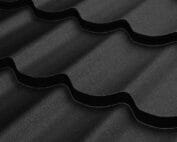
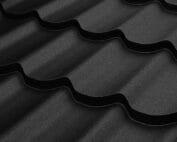
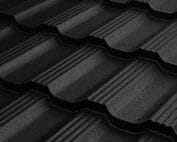
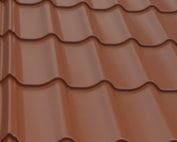
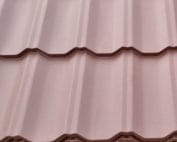
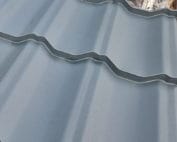
Sheets cut to the length of the slope are a good starting point for a simple gable roof. They reduce the number of transverse joints. They also allow an appearance similar to tiles without their weight. The choice includes various corrugation heights and coatings, so the product category alone does not determine the visual effect.
However, transport and bringing long sheets onto the roof must be planned. They must not be dragged over one another or lifted in a way that causes permanent buckling. With many dormers and corners, the number of cuts increases. Therefore, a cutting plan is needed before deciding, not the assumption that a large sheet will always be cheaper in the overall execution.
What does modular tile-effect metal roofing offer?
Small, repetitive sheets are easier to store and pass onto the roof. They are convenient when dividing work into stages and for complex roof slopes. After damage, a limited section of the covering can be replaced, although access to a specific sheet still depends on the connection method. The module does not remove the need for correct overlaps and fastening.
It is worth viewing a sample of joined sheets. A single piece does not show the seam line or the behaviour of the coating in light. Compare the coverage area, the number of rows and how the fasteners are concealed. Two similar profiles may require different batten spacing. Components from different systems should not be treated as interchangeable.

Is trapezoidal steel sheet suitable for a house?
Yes, if its form suits the building and its parameters match the design. T18 creates a finer rhythm, T35 gives a more pronounced profile. A higher profile can be structurally advantageous, but its suitability is not judged by height alone. Thickness, steel grade, span between supports and method of fixing all matter.
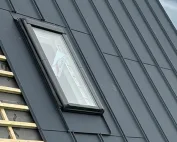
Trapezoidal steel sheet looks good on simple volumes, extensions and buildings with restrained detailing. Its advantage is a clear form and the possibility of ordering long sheets. For a habitable loft, a complete insulation and ventilation system is still required. The sheet alone, even with an anti-condensation layer, does not provide thermal comfort.
When should you consider tiles or shingles?
Ceramic and concrete tiles have their own aesthetic and accessory systems. Their greater weight must be taken into account in the structure. Small elements can be adapted to many roof shapes, but unusual details still require precise work by a roofer. Durability should not be derived from the material name alone.
Bituminous shingles require a suitably prepared, rigid and even substrate. The cost of the deck must be added to the price of the covering. It can be useful for some complex shapes, but requires a system-compliant ventilation and flashing solution. So compare a finished roof with a finished roof, not a pack of shingles with a square metre of sheet metal alone.
How do you compare comfort and subsequent costs?
Rain noise depends on the entire assembly. Insulation, deck, loft lining and structural connections all matter. One should not promise silence based on the thickness of the paint coating alone. Similarly, the loft temperature depends mainly on insulation, airtightness, ventilation and protection of windows from the sun.
Ask for two complete quotes for the same project. Each should include the substrate, flashings, fasteners, gutters, transport and labour. Add the availability of parts and the inspection regime. The best covering is one that meets the roof’s requirements and fits within the budget of the whole investment. A high discount alone does not determine cost-effectiveness.
7 branches. Materials closer to your project.