Costs and planning
What does 100 metres of sheet metal in an order mean and how do you convert the price?
The phrase ‘100 metres of sheet metal’ does not yet specify the quantity of covering. It may mean linear metres of sheets or square metres calculated in two ways. The difference affects the price and the number of runs on the roof. First establish the unit and the width of the specific profile. Then convert full sheets, accessories and delivery into one common scope. A linear metre describes the length of a sheet at its fixed width. A total square metre takes into account the full width of the sheet. An effective square metre results from the coverage width after the specified side lap is made. This is not always the area of the finished roof, because cuts and possible transverse joints remain.
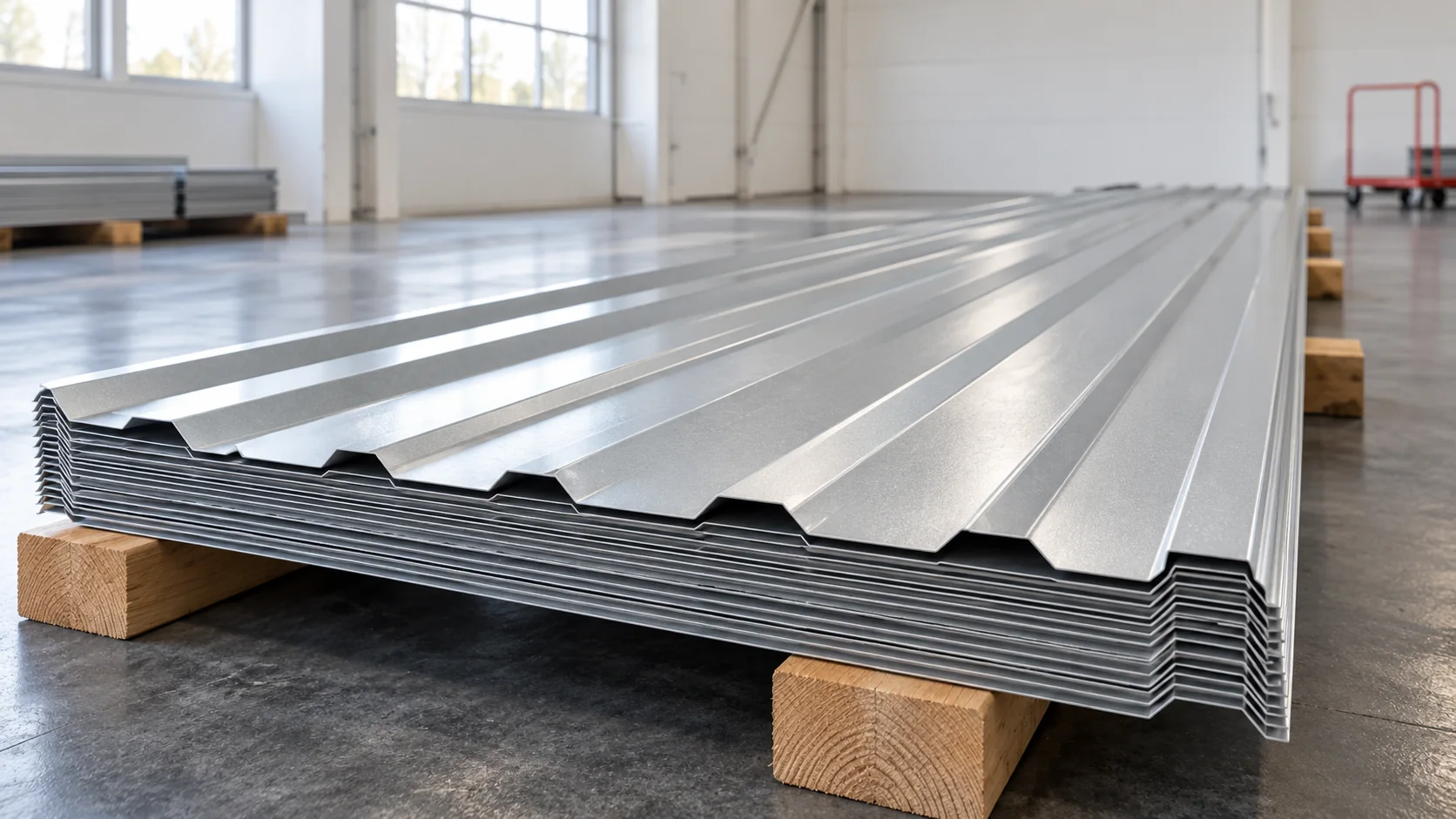
What is the difference between the three units used?
The same delivery can be correctly described by any of these units. The problem starts when we multiply the price from one basis by the quantity from another. The order confirmation should record the lengths, the number of sheets and the settlement method. A bare ‘100 m’ without clarification leaves too much room for misunderstanding.
How do you convert 100 linear metres?
Let us take a specific example of a profile with a cover width of 1.035 m and an overall width of 1.082 m. One hundred linear metres of such sheet gives nominally 103.5 m² of effective cover and 108.2 m² of total surface area. It is still the same material. The dimensions refer to the selected cross-section, not to every sheet marked T35.
At the agreed rate of €8.10 net per linear metre, the cost will be €810.00 net. This corresponds to approximately €7.83 per effective m² or €7.49 per total m². The lower of these figures does not mean a discount. Only the way the price is presented has changed. The rate adopted serves the calculation and is not a current commercial offer.
Why is the sum of lengths not enough?
One hundred linear metres can mean twenty sheets of 5 m each or fifty sheets of 2 m each. The material area will be the same, but the way the roof slope is covered will not. Shorter sections may require transverse joints and additional overlaps. Long sheets, on the other hand, must be delivered, unloaded and carried safely.
Do not choose the format solely by the total number of metres. Determine the laying direction and the length along the slope. If the roof slope requires dividing into strips, the cutting plan should account for the permitted connection detail. The overlap does not have one universal length for all profiles and pitches. It also affects the amount of material that must be added to the theoretical cover area.
How many sheets are needed for a roof with an area of 100 m²?
Let us assume a single rectangular roof slope measuring 10 × 10 m, measured over its surface. For a cover width of 1.035 m, ten strips are needed, because nine gives only 9.315 m. If each strip is 10 m long, the total is 100 linear metres. The purchase therefore covers 103.5 m² of nominal cover, while the roof slope has 100 m².
This calculation demonstrates the rounding principle for the number of strips. It is not a recommendation to order ten-metre sheets for any building. You must check the permissible and available length of the chosen material and whether it can be handled. A different roof shape with the same area may yield a different number of sheets. The finishing of the eaves and ridge also affects the final length.

What should be added to the price of the sheet itself?
The material cost does not automatically include flashings, screws, seals or ventilation components. It is worth calculating each required item from the project. For a new building, you must also determine whether you are ordering just the external covering or also the substructure and other roof layers. These scopes have different prices and different contractor responsibilities.
Check transport and unloading separately. The delivery price to the site does not necessarily include lifting the material onto the roof slope. Also note whether the amounts are net or gross. Compare quotes on the same tax basis. This way, a lower price per metre will not obscure an additional item that changes the final bill for the entire order.
How to place an order without ambiguity?
Provide the profile designation, steel thickness, coating, colour and the side intended for the exterior. Include the set of lengths and the number of pieces. For each rate, state the unit, and for sheets, both widths. If you receive only the total area, also ask for the list of elements. This is what allows you to check compliance with the cutting plan.
Before starting production, compare the data with a measurement of the completed structure. Agree all changes with the contractor. Keep the confirmation as a reference point for delivery and settlement. An exact list of sheets is much more useful than a general order “for one hundred metres”. It allows you to calculate the cost, plan the work and avoid a missing strip at the end of the roof slope.
Questions and answers
Is 100 linear metres equal to 100 m² of roof?
Only in a special case. The result depends on the coverage width, the cutting plan and the overlaps. For a coverage width of 1.035 m, this gives a nominal 103.5 m² before offcuts.
Can the price per linear metre be compared with the price per m²?
Yes. Both prices must be converted using the width of the same profile. Then an identical number and length of sheets must be compared.
7 branches. Materials closer to your project.