Costs and planning
How do you calculate the full cost of covering a 200 m² roof with trapezoidal steel sheet?
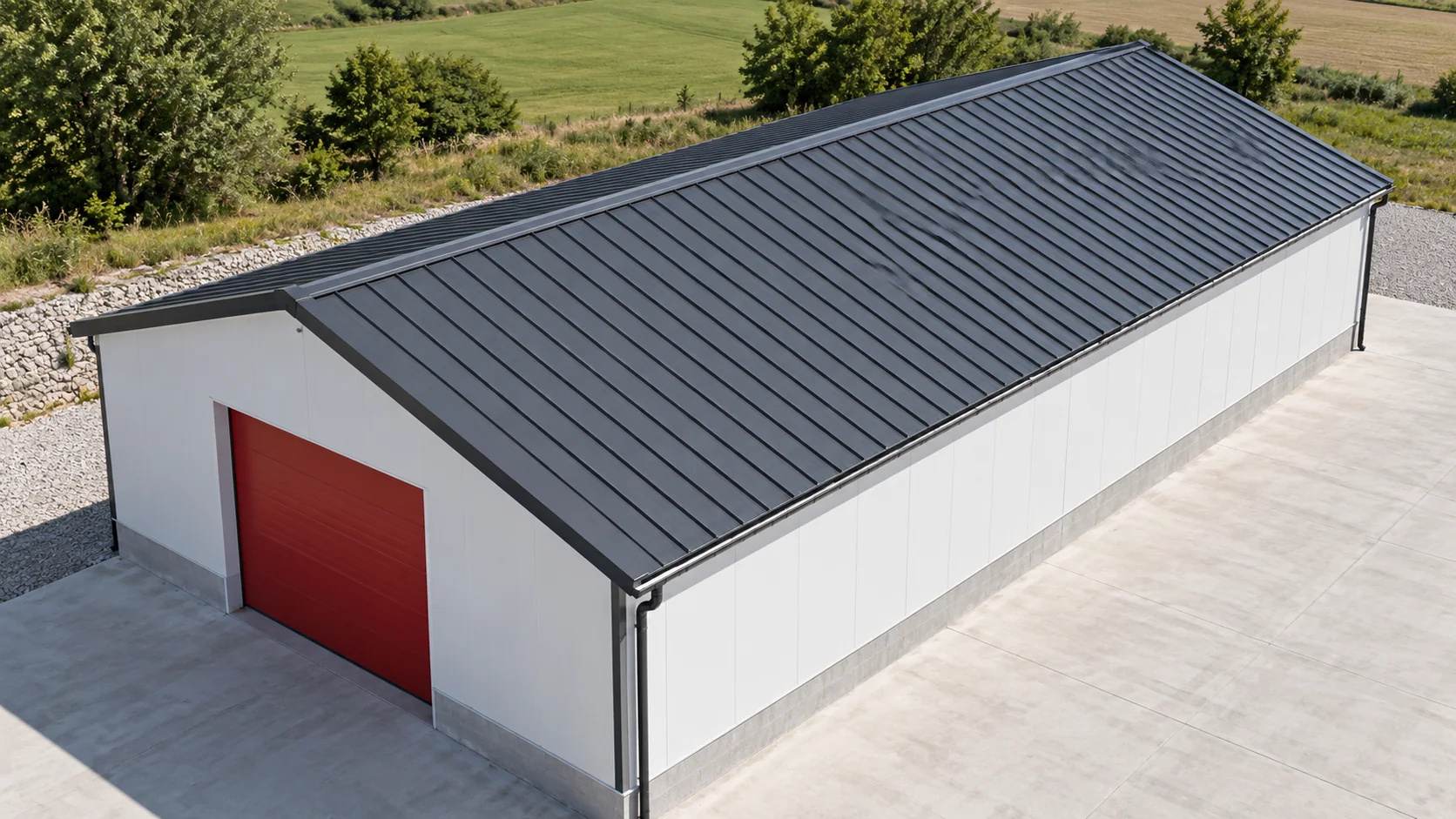
In this sample quote, the roof has two rectangular slopes of 100 m² each. Step by step, we determine the number of steel sheet strips, their billing area and the covering cost including flashings. Delivery and installation are considered separately. All rates are agreed net amounts. This calculation shows what is missing from a price given for the material alone. We calculate the actual area of the two slopes, not the building’s footprint on the ground. Each slope is 20 m wide along the eaves and 5 m long down the slope. One gives 100 m², both together 200 m². We assume a simple gable roof without dormers, roof valleys or chimneys. The dimensions cover the final covering outline.
What does 200 m² mean in this calculation?
These are important assumptions. A roof with the same area but with many changes of direction will have a different cutting layout and more details. The result should not be transferred to the house plan alone. If you only know its width and length, you first need the roof geometry. Eaves overhangs and pitch change the area that needs to be covered.
How many full strips need to be ordered?
We choose an example trapezoidal steel sheet with an effective width of 1.10 m. For a 20 m wide roof slope, eighteen strips are not enough, because they give only 19.8 m. Nineteen strips are needed. With a length of 5 m each, we get 95 linear metres per slope and 190 linear metres for the whole roof.
The nominal effective purchase area is therefore 190 × 1.10 = 209 m². With an overall width of 1.142 m, the total area of the sheets is 216.98 m². Both figures describe the same order in different units. We assumed strips without a transverse joint. Any other lengths resulting from the eaves and ridge detail must be taken into account before production.
How do you calculate the steel sheet cost alone?
For the example, we take €10.76 net per effective m². We multiply this rate by 209 m², which gives €2,248.84 net. We do not multiply it by 216.98 m², as that would use the wrong basis. When the seller quotes a price per gross metre, it is precisely the gross area that must be converted.
In this assumption, the material alone costs around €11.24 net per m² of actual roof surface. This is more than the rate of €10.76 per m² of sheet covering, because we buy full strips. The difference results from the cutting layout. With a different profile width, building width or use of offcuts, the result will be different. The rate serves only to demonstrate how the calculation works.
What do flashings, delivery and installation change?
Assume the following additional net amounts: €620.29 for the processing, connectors and the necessary seals, €196.73 for transport with the agreed handling, and €1,990.47 for installing the covering within the scope described. Together with the sheet metal, this gives €5,056.33 net. Divided by 200 m², this gives approximately €25.28 net per m² of roof.
This is not the price of building an entire roof from scratch. The calculation does not include the structure, insulation, ceiling or any layers and equipment not listed. The scope must be added to the quote item by item. Tax settlement also requires the specific supply or service to be recorded correctly. All amounts above remain an example, not a promise of a quote for every build.

What factors can change the result?
An additional chimney means flashings and work at the penetration. A chimney basket requires its own drainage, cutting and fitting of sheets. A longer roof slope may force the panels to be split or transported differently. The material price is also affected by steel thickness, coating and any anti-condensation layer. These parameters cannot be changed without updating the schedule.
Site access matters. The material must be unloaded safely and brought onto the roof. If the quote does not include the necessary equipment, the cost will appear later. The same applies to the lack of ready support or the need to correct the plane of the structure. Preparing the site and defining a precise scope of work help limit such additional items.
How can you use the example for your own quote?
Replace the slope dimensions with actual data and calculate full panels according to the cover width of the chosen profile. Then enter the rate from the specific quote, consistent with the unit. Add all flashings, accessories and labour. Do not add a single arbitrary percentage for extras if their actual quantity can be calculated.
When comparing quotes, keep the same parameters and the same scope. Ask for the final total and for information on what must be ordered separately. The cutting plan should be approved by the contractor after measuring the structure. Then the cost per square metre becomes a useful result rather than a starting point based on too little data. This allows the budget to be planned before delivery is initiated.
Questions and answers
Is 209 m² of sheet covering always needed for a 200 m² roof?
No. That result applied only to two slopes of 20 × 5 m and a profile with a cover width of 1.10 m. A different shape or sheet width will change the number of panels.
Does the result include the roof structure and insulation?
No. It covers only the described covering, accessories, transport and installation. The other elements of the new roof must be priced separately.
7 branches. Materials closer to your project.