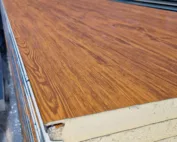
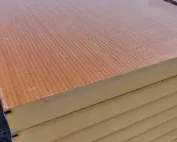
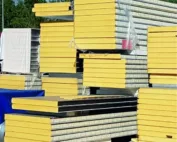
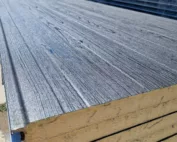
Selection of sandwich panels
Mineral wool or PIR: choosing a panel core for a new building
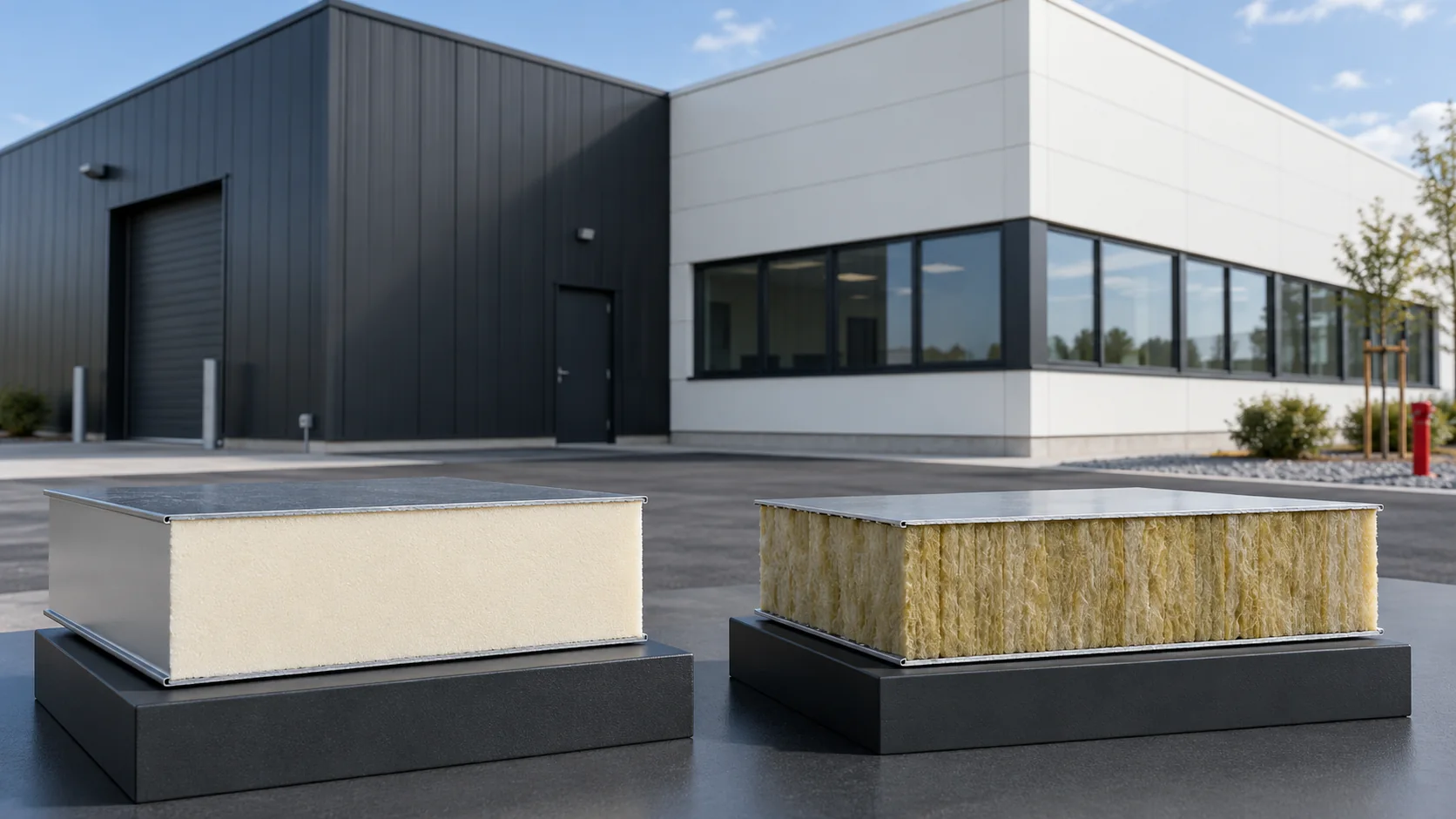
The choice between mineral wool and PIR should follow from the requirements for the wall or roof. A single building may contain zones with different priorities, but combining them requires a design. The core affects the panel’s parameters but does not describe the entire product. Comparison also requires the facings, the joint, the fixing and the conditions of use. For one wall, fire compartmentation may be decisive; for another, limited thickness or mass. Establish these conditions before you compare prices. Reject configurations that do not meet the requirements, and compare the remaining ones as complete envelope solutions.
Start with the requirement that cannot be omitted
The core should not be chosen on the basis of the function ‘hall’ or ‘garage’ alone. Different processes may operate inside, and temperature and humidity will not always be the same. A good basis is a building zone map with openings, internal partitions and roof requirements marked.
Compare the thermal insulation of finished panels
PIR usually achieves a given thermal resistance at a smaller thickness than mineral wool used in panels. The actual selection is based, however, on the declared U-value of the specific product. The joint and the method of determining the value matter, so the core lambda alone does not complete the comparison.
In proven wall configurations, the PIR 100 mm variant has U 0.22 W/(m²·K), and the mineral wool 100 mm variant has U 0.37 W/(m²·K). This is an example of two described configurations, not a universal table. In the design, the influence of openings, thermal bridges and joint tightness must be added.
Separate reaction to fire from resistance
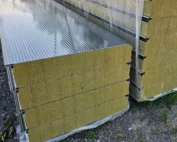
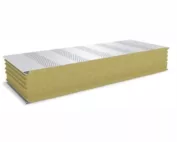
Mineral wool panels can offer the fire reaction classes and fire resistance ranges needed for demanding partitions. PIR must also be assessed on the basis of the documentation for the specific panel. The results of one foam version must not be transferred to every panel bearing that designation.
For walls, the required EI is among the criteria to be checked, and for the roof the appropriate criteria arising from its function. The classification for external fire exposure of the roof describes a different effect than a fire from inside. All these characteristics must be considered together with the fixing, supports and penetrations.
Consider the mass and real installation
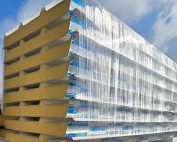
A mineral wool panel is sometimes heavier than a comparable PIR panel, but the result depends on the thickness and the steel sheets. The mass of the specific piece is needed for the lifting plan. A greater length can make handling difficult even for an element with a low mass per unit area.
Match the device, the gripper and the workplace to the actual dimensions. Choosing a lighter core does not relieve you of designing the supports and fixings. The possibility of increasing the span must also follow from the relevant tables, not from a general opinion about the stiffness of one material.

Check moisture, coatings and acoustics
Both types of panel require proper edge closure and tight joints. The resistance of the cladding to cleaning agents or an aggressive environment results primarily from the selected coating. The core will not compensate for a poorly selected metal surface in a damp room.
For acoustics, compare the tested values of the whole panel as well as the openings and flanking paths. The mere presence of mineral wool does not guarantee low reverberation, because the full steel sheet reflects sound. If room attenuation is required, the choice of enclosure must be combined with the design of the joinery, ventilation and absorption.
Consider splitting at the technical section
In a new building, the wall of a technical room may have different requirements from a long warehouse façade. Instead of imposing the same core on the whole building, a mixed arrangement can be compared with a uniform solution. Both must be calculated while maintaining the same functional tasks.
The mixed variant requires agreement on the junction, the support and the installation sequence. Also check the availability of matching coatings so that a similar colour does not mask a significant difference in surface resistance. The aim is a deliberate division of functions, not a set of the cheapest panels in random places. The final choice should indicate why each partition received precisely that configuration.
Combine different cores only within an agreed system
Using mineral wool in one zone and PIR in another may result from a rational division of functions. However, the transition should have confirmed geometric and technical compatibility. Similar width and thickness do not prove that the locks will connect correctly.
Include flashings, additional supports and the continuity of the required properties in the calculation. A uniform system may facilitate execution, but it should not force the abandonment of an important requirement. End the decision with a description of each partition so that a later change of material can be verified.
Questions and answers
Does choosing a PIR core always lower the cost of the enclosure?
Do not assume a fixed price relationship. Compare complete configurations with the required parameters, including accessories, construction and workmanship.
Can cores be compared at identical thickness?
Yes, if you want to see the differences between dimensionally equal panels. For design selection, it is also worth comparing variants that meet the same thermal objective and the other requirements.
7 branches. Materials closer to your project.