PIR insulation
When should you choose PIR boards 120 × 60 cm and when a larger format?
The PIR format affects the number of joints, ease of working and the amount of offcuts. A small board can make it easier to insulate reveals, while a large one can speed up covering a regular surface. However, dimensions must be checked for the specific variant and edge profile. The nominal rectangle area is not always equal to the effective coverage area. Within insulation board families, 1200 × 600 mm and 1200 × 2400 mm are found among others. This does not mean that every type of facing is available in both dimensions. A composite board with gypsum may have a different format, for example 1200 × 2600 mm. Information about the dimension must therefore accompany the full product description.
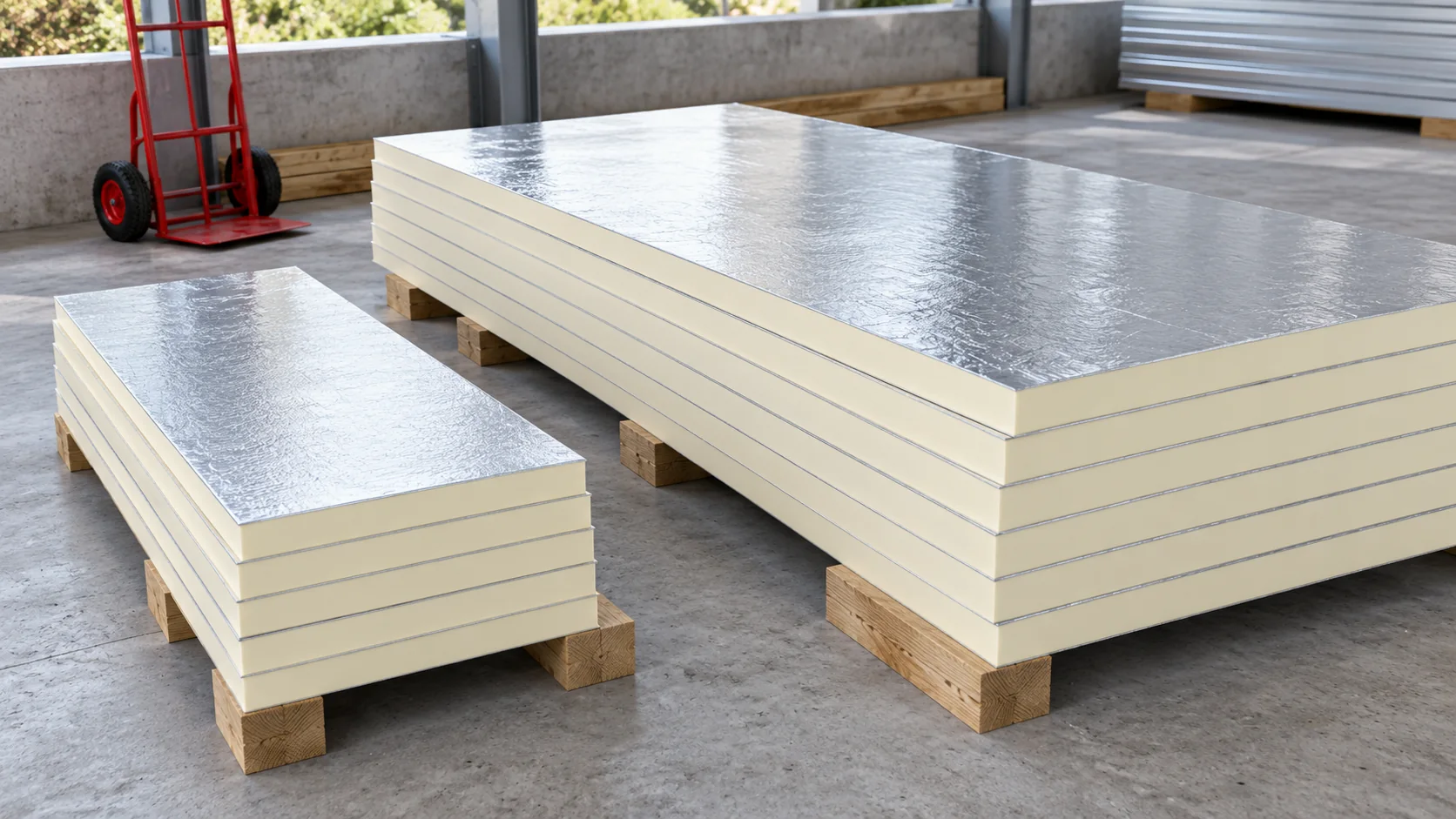
Check the format of the chosen variant
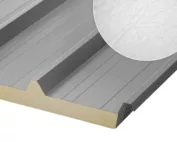
An insulation board should not be confused with a sandwich panel with two metal sheets. The latter has its own modular width, and the length is selected within a different range. Ordering just “120 cm PIR boards” is ambiguous. First specify the application, facings, thickness and edge finish.
Calculate the nominal and coverage area
A 1.20 × 0.60 m rectangle has an area of 0.72 m², while 1.20 × 2.40 m gives 2.88 m². The larger variant therefore has four times the area. With rebated or grooved edges, however, check how the manufacturer defines the dimension. Part of the surface may be involved in the joint with the adjacent board.
For an example of 30 m², dividing solely by nominal areas gives at least 42 small or 11 large boards. These are figures before accounting for cut geometry, overlap and packing. They do not constitute a finished order. A small difference between nominal and effective area can change the number of packs required.
Match the cutting plan to openings and corners
A regular wall without windows favours large formats, but a façade with numerous openings requires a separate cutting plan. The position of the joints should correspond to the system rules, especially at the corners of openings. Do not choose a layout solely to use up every small offcut.
It is worth drawing the first few rows and marking the cuts that can be transferred to another area. The material must retain the correct facing and the edge in the required position. A piece that is damaged or too narrow for correct fixing does not become fully usable just because it mathematically fills the missing area.
Take into account the number of joints and the sealing method
A larger board can reduce the number of joints on a large surface. This can be advantageous when every joint requires additional tape or careful alignment. However, the number of joints is not the only criterion. A large element is harder to fit to an uneven substrate and to move in a confined interior.
Joints must match the function of the layer. In a vapour-control system, airtightness is important, and on the façade, compatibility with the bonding and finishing system is also essential. The groove alone does not guarantee airtightness. A well-planned smaller format can be more practical than a large element that cannot be correctly seated.

Plan the route from storage to the work area
Before choosing large boards, check the width of doors, stairwells and access to the scaffold. A tall format requires adequate space to turn. On the roof, wind action and safe handling are added. Low material weight does not mean that a large sheet will always be convenient for one person.
Storage should protect the boards from damage and weather conditions in accordance with the product requirements. When staging works, it is worth providing a dry place for an opened pack. Damage to the facing during repeated handling can increase the scope of joint repairs and reduce the benefit of a seemingly convenient format.
Order by cutting plan and sales unit
The quotation should state the number of boards, the coverage area and the number of packs. If the seller prices by square metre, establish which area the rate refers to. The same price designation does not always describe an identical scope of material. Thickness can also change the number of pieces per pack.
The allowance is selected according to the geometry and the possibility of using offcuts. There is no single percentage suitable for every wall. In new construction, it is worth coordinating the insulation layout with the openings before the structure is built. Material savings then result from the design, not from excessive saving on cut widths.
Questions and answers
Does a larger PIR board always produce less waste?
No. The dimensions of the surface, the openings and the rules for arranging joints are decisive. In tight or irregular places, a smaller format can be more advantageous.
Does 120 × 60 cm always mean 0.72 m² of coverage?
This is the area of the nominal rectangle. With profiled edges, the effective dimensions and the calculation method for the specific product must be checked.
7 branches. Materials closer to your project.