Fire and acoustics
How doors and roof junctions affect sound insulation in a mineral wool panel wall
Mineral wool in the core does not guarantee a quiet interior. An insulated wall panel with a metal facing limits sound transmission to a certain degree, but doors, gaps and the ceiling can change the result for the whole wall. In a new building, it is worth planning noise protection and reverberation reduction separately. These are different goals and require different data. First establish where the sound comes from: from a machine in the neighbouring hall, from a road outside or from conversations inside the room. The frequency characteristics and duration matter. A wall separating an office from a workshop may require a different analysis than the façade of a warehouse standing next to a street.
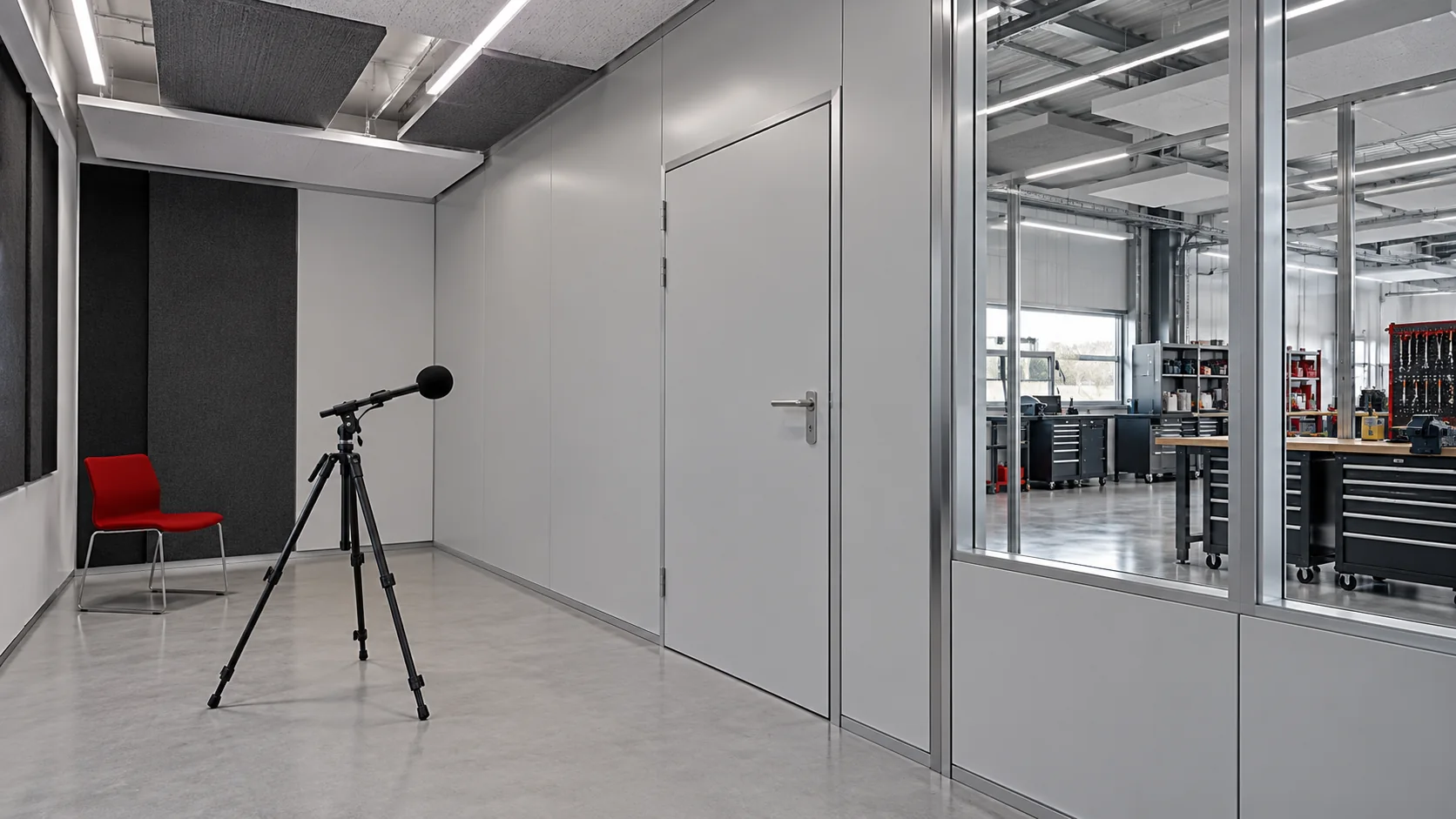
Determine the source and receiver of the noise
Also record the expected comfort level in the protected room. The information ‘attenuation needed’ alone does not allow the partition to be selected. The acoustic design should cover the joinery, ventilation and connections before their dimensions and layout are determined.
Distinguish insulation from absorption
The Rw indicator describes the weighted airborne sound insulation of the tested element. Additional adaptation indicators help relate the result to different noise spectra. Absorption, in turn, describes what proportion of the energy does not return to the room as a reflection.
A closed metal cladding does not behave like exposed porous wool. The panel can therefore limit transmission through the wall while at the same time reflecting sound in the hall. If the aim is shorter reverberation, separate ceilings or absorbers selected for the function of the interior may be needed.
Read the result for the specific panel
In one example family of wall panels with concealed fixing, Rw 31 dB is given. Another family with wool has Rw 27 dB and the indicators RA1 26 dB and RA2 24 dB. These are data for different tested solutions, not a guaranteed range for all mineral panels.
The core thickness alone does not allow the acoustic result to be calculated. The mass and stiffness of the facings and the behaviour of the composite element matter. It is worth checking the scope of the report and how the specimen was mounted. A laboratory parameter is not automatically a result obtained between finished rooms.
See how a weaker section changes the whole
Let us assume a simplified model for a single frequency band: 90% of the surface has an insulation value R of 31 dB, and the remaining 10% has 20 dB. After summing the contributions of transmitted energy, the result for this band is approximately 27.7 dB. This is neither a calculation of the Rw index for the entire wall nor a simple average of values in decibels.
This is a theoretical example without gaps and flanking paths, not a prediction for specific joinery. It does, however, show the importance of a seemingly small weaker element. If doors or ventilation grilles limit the result, replacing the entire wall field with a better panel may bring less benefit than expected.

Start with the gate solution in a noisy workshop
In a facility with a large gate, the share of the full wall may be significant, but when the gate is opened, sound has a direct path to the outside. Selecting a panel with a better Rw will not solve this situation. An analysis of usage patterns, the location of noisy equipment and the duration of individual operations is needed.
If the gate is to remain closed, its seals and actual performance become important. In a new project, a buffer zone separating the workshop from a quiet room can also be considered. Such decisions should be based on an acoustic analysis. They show why assessing the panel alone is only a fragment of planning comfort throughout the building.
Close the paths that bypass the panel
Sound can pass through a gap at the floor, a shared space above the ceiling or a duct connecting rooms. It is also transmitted through structural elements. In a new facility, it is easier to prevent these paths if they are taken into account when arranging walls and services.
The seal must work with structural movement and fire requirements. Accidental rigid filling may crack after the roof deflects. An acoustic solution, in turn, should not compromise the required class of the partition. A shared detail that fulfils both tasks is needed.
Verify the result at room level
For a demanding function, it is worth planning acoustic calculations and, after completion, appropriate measurements. These help assess the entire sound transmission path, not only the material inside the wall. Any corrections can then be directed to the actual weak point.
Establish in advance who is responsible for the doors, seals and ventilation elements. Acoustic requirements should reach each of these trades. The final effect depends on their cooperation, so the promise of quiet should not be based solely on the word “wool” in the panel description.
Questions and answers
Will thicker wool always improve Rw?
There is no such universal relationship for composite panels. The results for specific configurations must be compared, and the other wall elements taken into account.
Will a mineral wool panel reduce echo in a hall?
This cannot be guaranteed for a panel with full metal facings. Reducing reverberation requires an assessment of absorption and often separate internal solutions.
7 branches. Materials closer to your project.