Polystyrene and thermal insulation
What to do when the EPS label and declaration give different information
Other data on the label and in the declaration require clarification before installation. The cause may be a mix-up of products, an older version of the document or an error in the description. Do not choose the more favourable value yourself. Link the pack to the correct declaration, keep the evidence and ask the manufacturer for an unambiguous answer concerning the delivered batch. Start with the full designation of the board, the declaration number and the thickness. Different variants or versions with different properties may be available under a similar name. A data sheet found in a search engine does not have to relate to the delivered pack. The most reliable starting point is the identification visible on its label. Also check the manufacturer, the plant and the batch information, if provided.
Are you comparing the same product?
A change of company name or website layout can make it difficult to find the document. However, it does not automatically mean that the material’s properties have changed. Confirmation is needed as to which document relates to the specific product and the period in which it was manufactured.
Does the difference arise from the units or the notation?
Lambda should be compared in the same units. It must be distinguished from thermal resistance RD, which also depends on board thickness. Two RD values can be correct for different thicknesses of the same EPS. The Uc value, by contrast, describes the building element, so it is not an interchangeable designation for the material’s lambda value.
Pay attention to the inequality sign and the way the class is written. CS(10)100 denotes the level of declared compressive stress at a specified strain in a specific test, not the permissible weight per square metre of floor. Similarly, the symbols relating to water refer to specific test methods. Results obtained by different methods should not be compared as if they described the same thing.
What does a missing stated value mean?
The abbreviation NPD indicates that the property has not been declared. It does not mean a value of zero or confirmation of a very good result. If a given parameter is needed for the planned application, the possibility of using the board must be checked. The absence of a creep declaration does not entitle one to calculate it from CS(10) alone using an arbitrary coefficient.
Not every parameter has to be relevant in every location in a building. A façade board and a board under a loaded floor have different tasks. Therefore the absence of one item does not determine that the whole product is defective. What is decisive is whether the available data allow compliance with the requirements for the planned application to be demonstrated.
Do not add the missing value on the basis of a similar product. The same lambda, colour and thickness do not prove identical water absorption or behaviour under load. A general brochure may also describe a whole group of boards. The information needed should be attributed to a precisely identified variant.
How should the problem be described to the manufacturer?
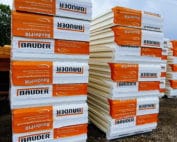
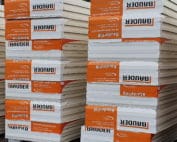
Send a legible photograph of the entire label, the markings on the pack and the section of the document showing the discrepancy. Indicate the parameter and both values. Add the date of purchase and the place of intended use. Such a set allows an answer relating to the material to be given, instead of receiving a general description of the offer.
Ask for a written explanation and the correct document. If the source of the problem is an error in a publication, an unambiguous correction of it is needed. Do not edit the declaration file yourself and do not replace the value on the label. Keep the original materials so that it is clear what the discrepancy consisted of.
Can the material be installed while the matter is being clarified?
If the discrepancy concerns a property needed in the project, pausing installation of that batch avoids covering up uncertain material. This does not have to stop all work. A separate storage place can be designated and activities that do not depend on the resolution can continue. It is important that the team knows which packs remain set aside.
Once the insulation has been built in, record its location and extent. Neither full conformity nor the need for demolition should be assumed straight away. The assessment depends on the clarified properties and the requirements of the building element. If testing or exploratory openings are needed, their scope should follow from the specific doubt.
When can the matter be regarded as clarified?
The answer should make it possible to link the delivery with unambiguous data and to assess conformity with the design. An assurance of good quality alone is not sufficient while two different values still remain. If necessary, the clarification is passed on to the designer or the person responsible for acceptance of the works.
Attach the correct file, the correspondence and photographs of the labels to the project documentation. Update the schedule of materials used if a batch has been replaced. Such a trail remains clear even after completion of construction. It facilitates later assessment of the building element and prevents the mistakenly retrieved document from being used again.
EPS is produced by, among others, Polstyr, Ekobud, Sonarol and Justyr. Clarifications of the documentation should be obtained for the specific product and batch, irrespective of the manufacturer.
7 branches. Materials closer to your project.