Roof and energy
What roof area should be used to compare the price of photovoltaic roofs?
A price per square metre is only useful when it is clear what the metre refers to. Footprint, roof slope, material and active area are different quantities. In an integrated roof, there is also a division into energy-producing elements and passive infill. Without clarifying this basis, two quotes can look similar even though they cover a completely different scope. The measurement must be clarified first, and only then can rates be compared. The footprint shows the area seen from above, while the roof slope is the inclined surface. Its size depends on the geometry, eaves and roof layout. The floor area or outline of the house should therefore not be taken as the exact quantity of covering.
Why is the building footprint not the roof area?
With a complex roof shape, roof valleys, bends and many separate sections are also added.
For a quote, it is best to provide dimensioned drawings and verify them before ordering. In a renovation, measurements of the actual roof may be needed, as it differs from the old documentation. An error at this stage affects both the quantity of material and the layout of the active fields. It cannot always be corrected simply by changing the number of components on site.
How does gross material differ from the finished covering?
A component may have an overall dimension different from the area it actually covers once the joints are made. Overlaps and edge profiling affect the effective coverage. Therefore, the price per metre of material need not correspond to the price per metre of the finished roof surface. The cost estimate should clearly state which basis has been adopted.
In a photovoltaic system, it is also worth separating the area of the active layer itself from the entire roof component. Not every part of it has to generate energy. Simply multiplying the gross dimension by an approximate power indicator may give a wrong result. The final output should result from the number and version of the specific components.
How should active and passive parts be calculated?
Ask for a separate list of both groups and a joint roof plan. Passive fields may occur at edges, at obstacles and in places without an energy justification. They are a necessary part of the covering, not automatically waste. Their cost should be visible, even if the offer presents a single price for the entire roof.
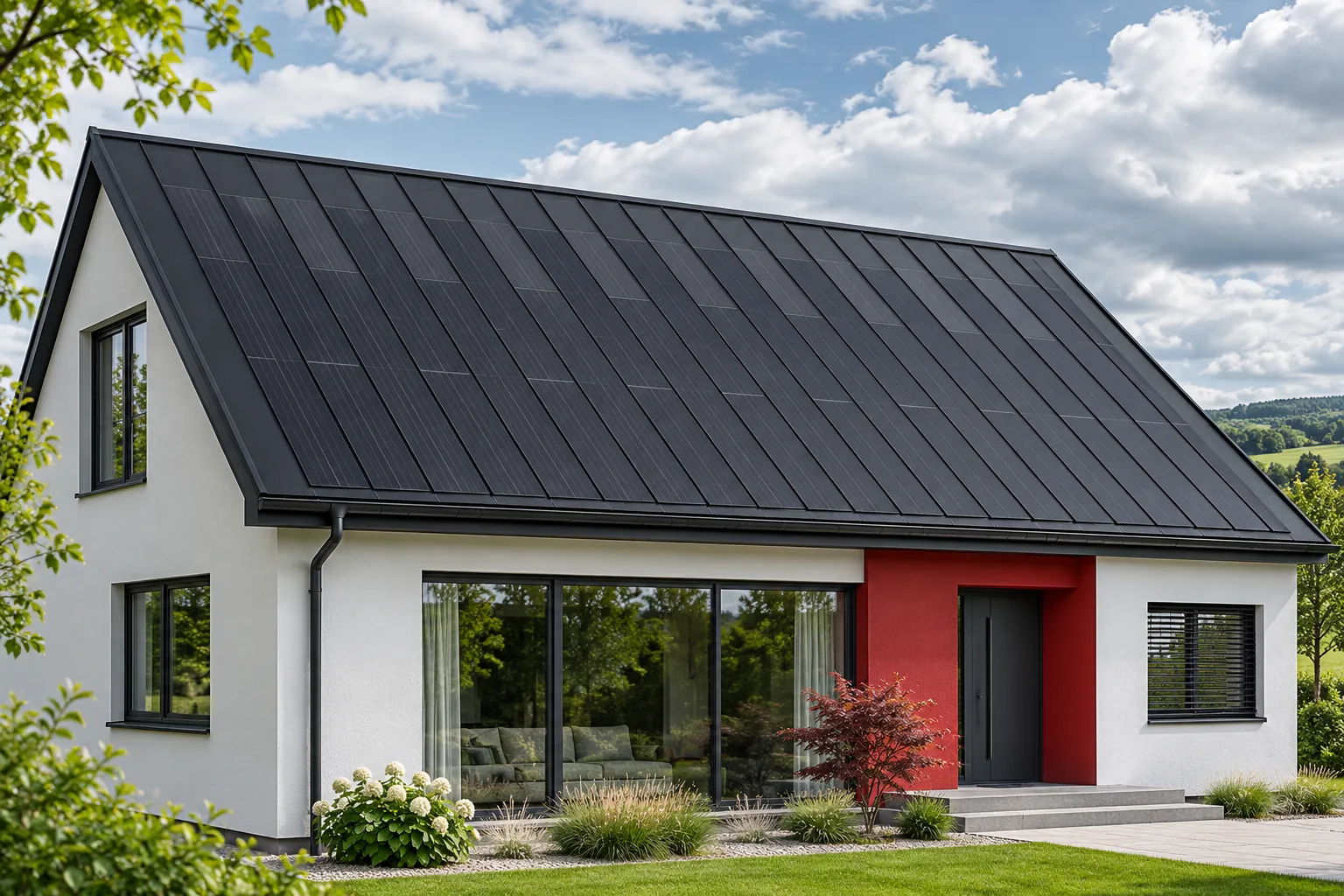
It is precisely the ability to combine active and passive elements that helps maintain the consistent appearance of the steel system. There is no need to maximise output purely for aesthetics. When comparing, however, one should know what proportion of the roof generates energy. Two similar roof surfaces may have different output because the division of functions differs, not necessarily the product quality.
What about waste, cutting and flashings?
Geometry affects material utilisation. A simple roof surface and a roof with numerous bends may have a similar area yet require different amounts of labour and accessories. Not all active elements can be cut freely. The layout must correspond to the system documentation. Therefore, the rate per metre alone does not describe the complete difficulty of execution.
It is worth showing flashings, penetrations and terminations separately or clearly confirming their inclusion in the price. If the quote leaves them for later settlement, the unit price is only a fragment of the cost. There is no need to multiply items unnecessarily, but the client should understand whether they are comparing material on the open roof slope or a complete covering of all details.
Is the price per kilowatt of capacity better?
Such an indicator helps compare the energy part, but it is also not sufficient. An integrated roof serves a building function whose value depends on the scope of coverage. Two systems of similar power may cover a different area and involve different works. The total cost, the coverage area and the power should therefore be compared together, instead of choosing one convenient number.
The assessment is complemented by an energy forecast. Orientation, shading and temperature affect yield, so identical power does not guarantee an identical result. The comparison should relate to the same location and geometry. Then unit indicators help understand the quote instead of masking differences in scope.
What table is worth obtaining from the contractor?
A clear summary is enough: roof slope area, effective coverage, active and passive parts, power, and the scope of flashings and installation. For each value it should be clear whether it is preliminary or confirmed by measurement. In addition, the final price of the entire compared variant is needed. Such a layout makes it easier to ask specific questions.
If the quotes use different bases, ask for a conversion to a common scope. Do not choose the lowest rate until you know what is in the denominator. An integrated roof can be attractive precisely because it combines functions, but these must be calculated honestly. A transparent measurement allows you to see this benefit without misunderstandings about square metres.
Solar roof manufacturers and brands include Wienerberger Wevolt, SunRoof, Dyaqua, Electrotile, LUMA Solar, EDILIANS, SolRoof, BIPVco, ML System and MDM NT (MyRoof).
7 branches. Materials closer to your project.

- SEROCK — Dzierżenin 34 E
- BŁONIE — ul. Sochaczewska 138A
- RADOM — ul. Grobickiego 8
- ŁÓDŹ — Natolin 8
- OLSZTYN — Barczewo, ul. Prosta 9
- WROCŁAW — ul. Jerzmanowska 10C
- GORZÓW WLKP. — ul. Zielona 33/34