Maintenance and durability
Preventing corrosion on a metal roof and spotting when repairs are needed
Before ordering the sheeting, establish the environment the roof will face — the coating should be chosen on that basis, not on colour alone. Check which protective layers the sheet has and whether their intended use suits conditions by the sea, at an industrial site or inside a farm building. During installation, watch the edges, swarf and fixings, since corrosion most often starts there. A single rusty spot does not necessarily mean the steel is damaged, so before any repair it is worth identifying the source and extent of the change.
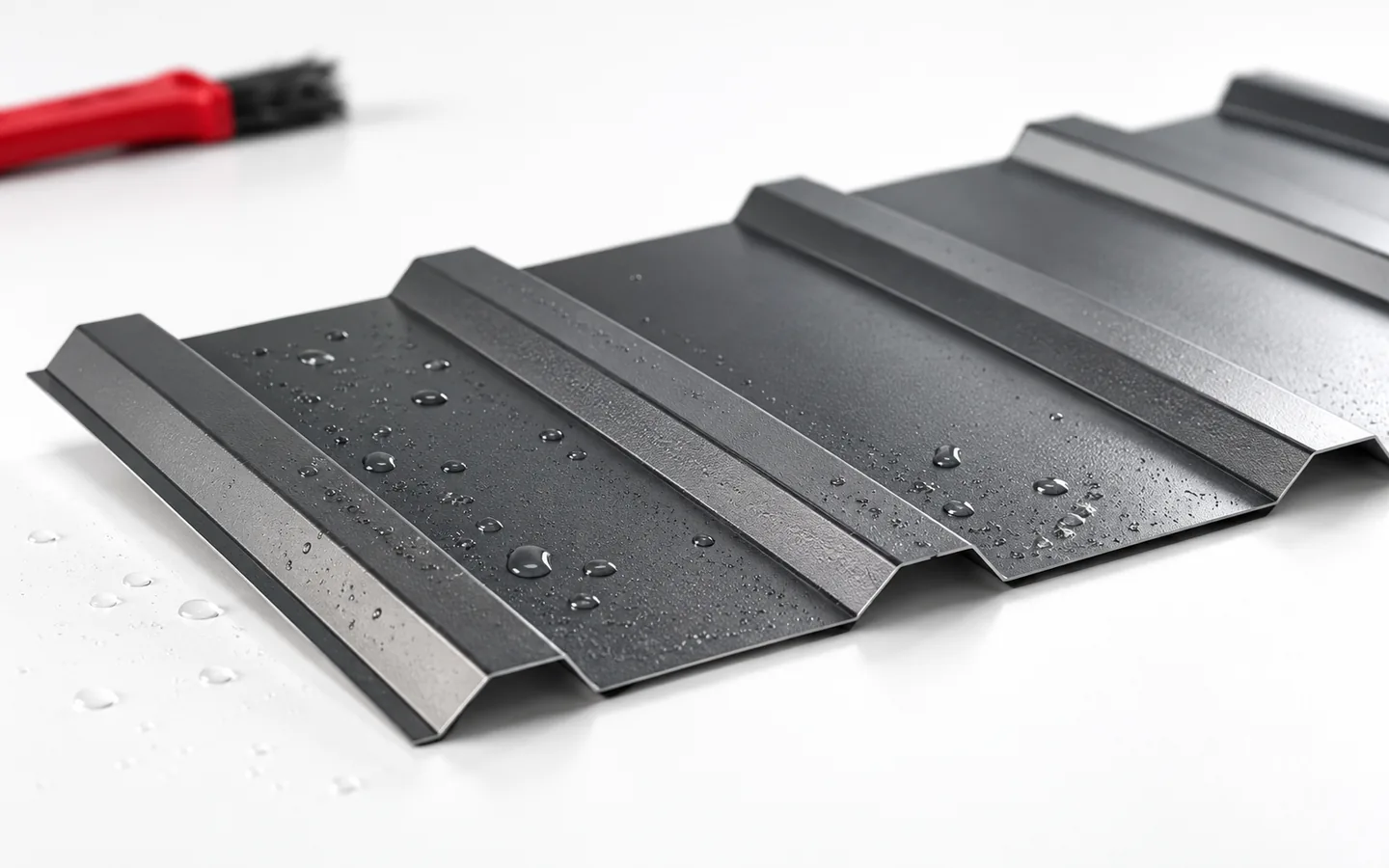
What layers protect steel on a roof?
The steel core is protected by metallic layers and, depending on the variant, an organic coating. Their tasks complement each other. The paint provides colour and protects the surface, while the metallic layer contributes to corrosion protection. Quality should not be judged solely by the thickness of the coloured layer. Its composition, adhesion and intended use are important.
Conditions by the sea, near industry or inside an agricultural building can differ. Selection should take into account both sides of the sheet and the possibility of cleaning. A coating suitable for an ordinary residential roof need not be appropriate in a permanently damp or aggressive environment. The documentation and application limitations must be checked before the material is ordered.
Why does corrosion often start during installation?
Cutting with a tool that strongly heats the sheet can damage the edge protection. Hot sparks leave fine marks also away from the cutting point. Drilling chips can adhere to the coating and corrode on its surface. Rusty spots then form which need not immediately indicate rusting through of the steel sheet.
Damage is also caused by sliding sheets over one another and walking with dirty footwear. A clean workplace and proper handling are therefore important. Fasteners must be compatible with the material and the environment. An unsuitable screw or a damaged seal can create a spot of permanent dampness. A good coating does not eliminate the consequences of incorrect fastening.
Where should moisture and contamination be checked?
Roof valleys, areas around chimneys and the lower parts of the roof slope require particular attention. Leaves and deposits can hold moisture at the surface. Areas under equipment, where rain washes away dirt less effectively, must also be checked. Industrial contaminants and dust may require a different cleaning rhythm than ordinary dust on an exposed roof.
It is worth inspecting the underside where it is accessible. Condensation, leakage or humid air from the interior can damage the layers from below. The drying of the anti-condensation mat is particularly important. If it remains permanently wet, the cause must be determined. It should not be treated as a way to allow unlimited water accumulation under the sheet.

How to clean a roof without damaging the coating?
The method should correspond to the product instructions. Usually it begins with the removal of loose dirt and gentle washing with an approved agent. Abrasive materials or random solvents should not be used. A strong jet directed under the lap can introduce water into places that are not prepared for such exposure.
Work must be carried out from safe access, not by walking freely on a wet roof slope. If contamination does not come off, it is better to establish its type than to increase the aggressiveness of the agent. Some stains may come from adjacent materials or equipment. Removing the mark without repairing the source will make the problem quickly return in the same place.
When is a touch-up enough, and when is a larger repair needed?
Minor surface damage can be repaired in accordance with the coating system. Substrate preparation, material compatibility and the extent of the area requiring protection are important. All edges should not be painted with a thick layer without instruction. Such a coating may look different and will not always resolve the cause of the damage.
Extensive corrosion, blisters or loss of adhesion require professional assessment. It must be established whether only the outer layer is damaged or also the steel. Painting a weakened sheet does not restore its load-bearing capacity. In the case of local perforation or serious damage to a joint, replacement of the element may be more justified. The decision should result from the condition of the material, not solely from the appearance of the stain.
How to plan protection for the years ahead?
Establish an inspection rhythm matched to the surroundings and the coating documentation. Keep data on the material, photos and information on repairs carried out. When installing new equipment, check metal compatibility and the sealing method. Water running off some adjacent materials may affect the surface below. The whole system is important, not only direct contact.
The most effective approach is a quick response to minor damage and removal of the cause of moisture retention. It is not worth waiting until a leak appears. The durability of the sheet metal results from the combination of the correct coating, careful installation and maintenance. None of these parts should be omitted simply because the roof is covered by a multi-year guarantee.
7 branches. Materials closer to your project.