Maintenance and durability
How to prepare a metal roof for painting
Painting a metal roof makes sense only when the covering is technically sound, not when it is meant to replace a repair. Before choosing a renovation system, assess the continuity of the sheeting and the stability of its fixing, identify corrosion and check the adhesion of the old coating. Flashings, fasteners and the layers beneath the sheeting also need assessment, because a leaking detail will remain the cause of the leak. Establish which areas need cleaning, preparation or replacement, and compare this with the purchase documentation for the material. Where the old finish is unknown, an adhesion test on a small area settles more than general assumptions.
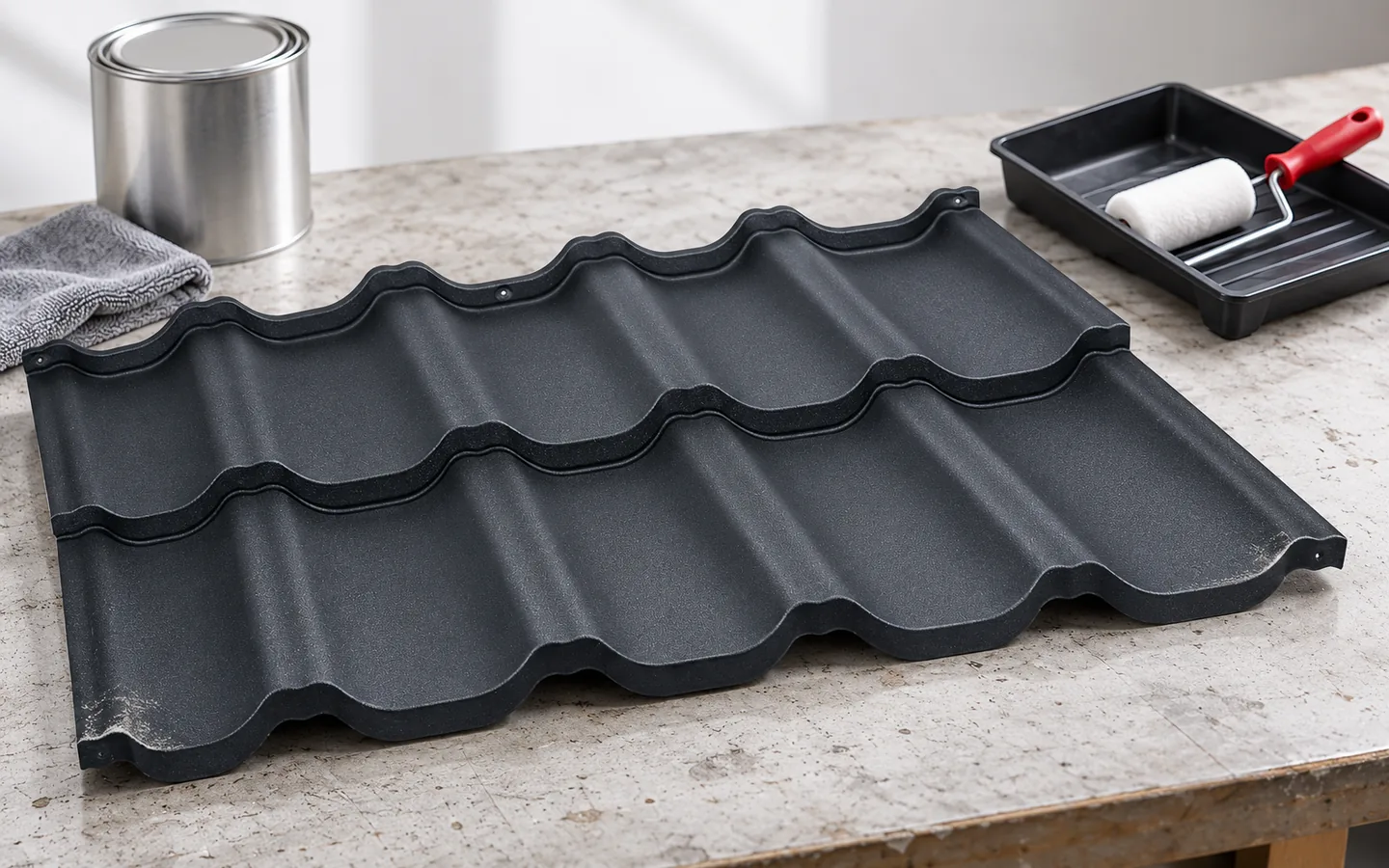
Is the covering suitable for renovation?
First, check whether the sheet metal is still continuous and securely fixed. Corrosion spots, delamination and dents must be assessed separately. Surface damage to the coating is not the same as loss of the steel core. Perforated coverings will not be repaired by applying paint alone.
It is also worth assessing the flashings, fasteners and layers beneath the sheet metal. If the roof leaks through a poorly executed detail, painting will not remove the cause. Technical repairs are carried out first. Otherwise, the freshly renovated surface may soon have to be dismantled when the valley or chimney is corrected.
The result of the inspection should separate areas for cleaning, preparation and replacement. Photos with descriptions of the damage help. For a large area, a trial renovation of a small section allows checking whether the planned preparation method gives the expected adhesion and appearance.
How to determine the type of existing coating?
It is best to locate the purchase documents and the material designation. Different coatings require different renovation systems. The term “metal paint” is too general. Compatibility with the substrate, the primer coat, surface preparation and application conditions matter. The required information is contained in the documentation of the selected set.
If the old type of finish is unknown, this should be reported to the paint supplier or contractor. The adhesion test then becomes particularly important. It is not worth assuming that every new paint will bond well with every old coating. A good appearance immediately after drying does not yet confirm durability.
Also check whether the renovation affects the valid warranty of the covering. The conditions may require specific procedures. The repair documentation should include the products used and the date of the work. This will make it easier to touch up the coating later without accidentally mixing systems.
How to clean and prepare the substrate?
Leaves, deposits, greasy dirt and loose fragments of finish are removed. The cleaning method must match the condition of the surface. Water must not be forced under the laps. After washing, the substrate must reach the conditions required for further work. Moisture trapped under a new layer can impair the result.
Corrosion spots are prepared in accordance with the requirements of the renovation system. Healthy coating around the damage must not be destroyed unnecessarily. Dust and processing residues must be removed thoroughly. If a primer is necessary, its type and thickness are determined by the instructions, not by an arbitrary choice of an available can.
It is worth protecting gutters, windows and elements not covered by the work. Residues of cleaning agents and paint should not accidentally reach the façade. Organising the workplace matters as much for quality as the painting itself. A roof is not a convenient equivalent of a flat workbench.

What weather conditions are suitable?
Not only the air temperature matters, but also that of the substrate and the humidity. Metal in the sun can be much hotter than the surroundings. A surface that is too hot makes it difficult to spread and dry some systems correctly. Cold or dew, in turn, can impair adhesion. The range specified in the paint instructions must be observed.
The forecast for the entire required drying time must be taken into account. No rain at the moment of starting is not enough. Wind is also important, particularly when spraying. It can carry material onto windows, cars and adjacent surfaces. The application method is chosen according to the conditions and the product documentation.
Work is not planned at the expense of safety at height. A wet or freshly painted roof can be very slippery. Proper safeguards and organised access are necessary. If the weather prevents correct work, it is better to change the date than to try to rescue the result with an extra coat of paint.
How should a renovated surface be assessed?
After completion, the evenness of coverage, hard-to-reach places and the condition of details are checked. Particular attention is required at the edges of the profiling, around fastenings and on previously repaired surfaces. No uncovered points of corrosion should remain. A uniform colour viewed from the street alone is not a full assessment of quality.
Keep the system data sheet, batch numbers and information on substrate preparation. It is worth setting a date for the first inspection. During use, deposits should be removed and it should be checked whether damage reappears in the same places. A return of the problem may indicate an unresolved cause of moisture or a faulty connection.
Painting makes sense as a planned renovation of a technically sound roof. The right order is diagnosis, repair, preparation and only then the new coating. Saving on the first stages usually shortens the durability of the result. With heavily worn metal, it is worth comparing such a cost with replacing the material before making a decision.
7 branches. Materials closer to your project.