Facades and sandwich panels
How to choose roofing for an industrial hall or factory building
Start by considering what the hall is used for, since this sets the direction for choosing a covering. In an unheated building, trapezoidal sheet may be sufficient, whereas a heated one calls for sandwich panels or a build-up with structural sheet and PIR insulation. The price per metre alone should not decide. Support spacing, airtightness, acoustics and planned roof installations all count. A warehouse without heating, a workshop and a facility with a cold store each need a different covering, because temperature, water vapour, the nature of the work and aggressive substances matter.
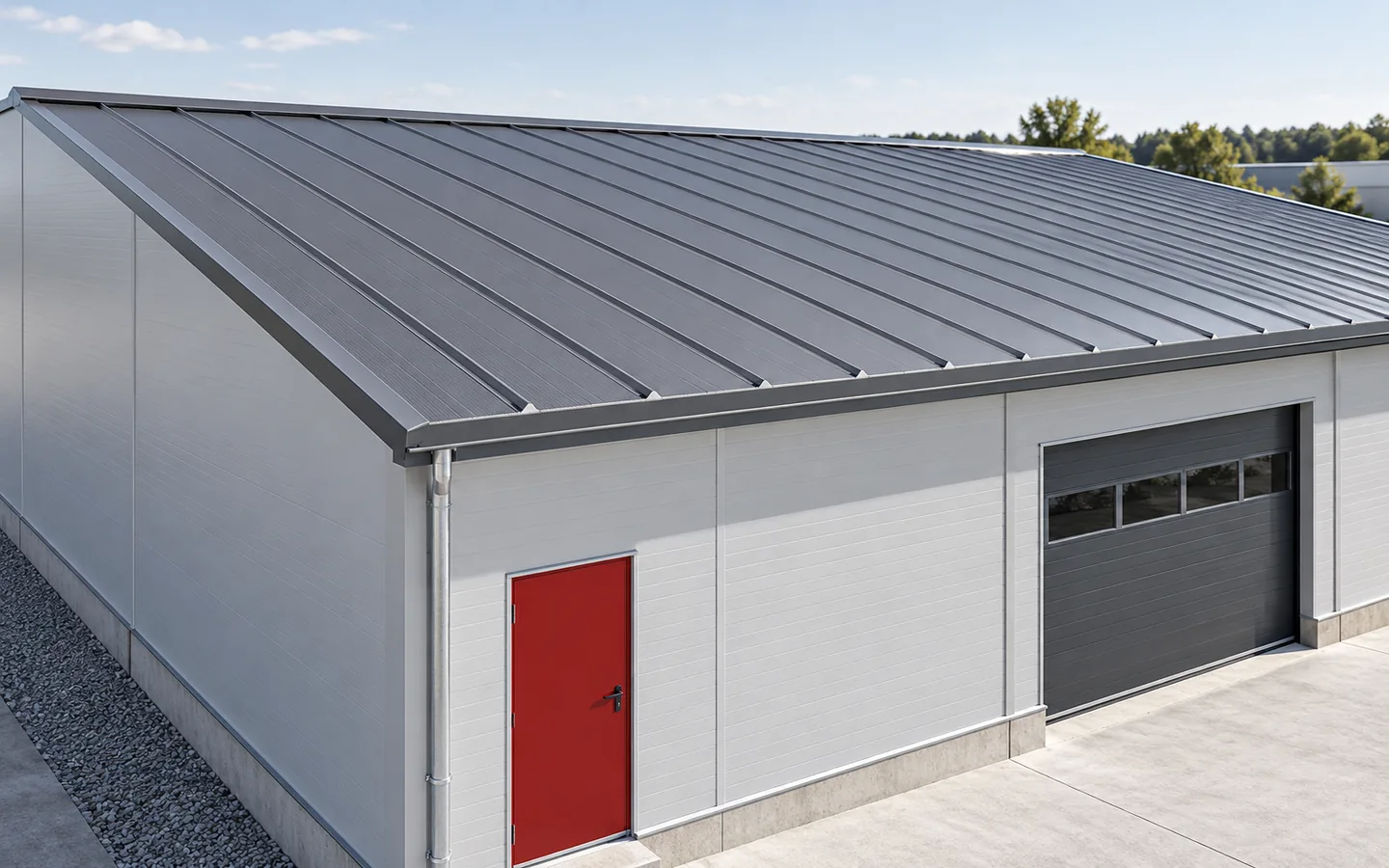
First determine how the hall will be used
An unheated warehouse, a workshop and a facility with a cold store place different demands. Temperature, the amount of water vapour, the type of work and the presence of aggressive substances all matter. The roof must be matched to the internal and external conditions. A coating suitable for an ordinary warehouse need not be sufficient above a technical process.
Also determine whether the hall will be heated in the future. Subsequent roof insulation may require rebuilding the layer build-up and solving the condensation problem. Preliminary decisions should cover skylights, fans, installations and service access. Every penetration through the roof surface means a detail that affects tightness and the organisation of works.
For noisy facilities it is worth defining the acoustic requirements separately. Good thermal insulation does not mean good noise attenuation. Different parameters describe sound transmission through the roof and different ones describe sound absorption inside the hall. This distinction helps avoid choosing a core at random.
When is trapezoidal steel sheet alone sufficient?
Trapezoidal steel sheet is often used in canopies and unheated facilities. The T18 and T35 profiles differ in geometry and stiffness, but the name alone is not enough to determine load-bearing capacity. The steel thickness, the support arrangement and the table for the given product must be known. A higher trapezoidal profile does not entitle you to increase the purlin spacing arbitrarily.
Condensation of water vapour on the cold sheet must be anticipated. A coating or fleece that limits dripping can retain some of the condensate, but it requires conditions for drying out. It does not replace insulation or ventilation. In an open canopy, the effect of wind from beneath the covering must also be checked. A partially sheltered building behaves differently from a closed hall.
What does a roof sandwich panel offer?
The panel combines an outer facing, an insulating core and an inner facing. It allows the roof to be closed quickly if the structure is prepared and compliant with the design. A PIR core makes it possible to achieve good thermal parameters at a relatively small thickness. The mineral wool variant may be needed for other fire or acoustic requirements.
Suitability is determined by the complete classification of the specific panel. Reaction to fire is not the same as the fire resistance of the roof. The minimum slope, longitudinal joints and the method of fixing must also be checked. A wall panel does not become a roof panel just because it has the same core. The facing profile, the locks and the conditions for water drainage are different.

When to choose a roof with separate layers?
In such a system, the structural steel sheet transfers loads to the supports. Above it are layers associated with vapour tightness, thermal insulation and waterproofing. PIR boards can reduce the insulation height. However, their type must match the method of fixing and the selected membrane or roofing felt.
The advantage is the ability to adapt individual layers to the requirements of the building. However, the number of details and execution stages increases. The fixing of the waterproofing, drains, parapets and service penetrations must be resolved. A PIR board with a thin facing alone is not a standalone covering. Nor should its strength at ten percent deformation be equated with the permissible in-service load.
What needs to be calculated before ordering?
The designer checks snow, wind, permanent loads and planned equipment. Edge and corner zones are important, where fixing may require different spacing. Load tables are read for the correct span arrangement, support widths and facing thicknesses. It is not enough to select the largest stated span from the table.
Photovoltaics, ventilation units and service walkways are not irrelevant to the roof. Point loads need a designed transfer to the structure. Snow clearing and access to equipment should be assessed similarly. If expansion is planned, it is worth describing it in the assumptions. Later addition of installations on a finished roof can be costly.
How to compare quotes for a complete roof?
Compare solutions with the same purpose and comparable parameters. Include material, accessories, transport, crane or lift, and installation. For a layered roof, add separate waterproofing and its details. For a sandwich panel, check flashings, seals and the scope of substructure preparation.
It is also worth calculating access for repairs and the costs of later inspections. A cheap roof area with difficult-to-service drainage can generate expenses for years. The final quote should contain a specific layer build-up and installation requirements. This allows comparison of two roofs capable of fulfilling the same task, not two random material prices.
7 branches. Materials closer to your project.