Insulation and ventilation
How metal roofing fits into an energy-efficient house
A metal roof can be a suitable covering for an energy-efficient house, but it does not by itself determine the building’s thermal performance. Rather than judging a product by its lambda value, check whether the design ensures continuity of insulation and airtightness across the whole assembly, especially at junctions at the eaves, walls, chimneys and windows. PIR boards above the rafters can reduce layer thickness, but they require proper support and fixing. Choose a board intended for the specific application, not a thin insulating facing. Leave the final layer build-up to the designer, who will select insulation thickness to suit the building’s requirements.
What really limits heat loss through the roof?
The external covering protects against precipitation and weather exposure. Heat flow is limited primarily by the insulation and by the correct construction of the entire building envelope. The steel sheet itself is thin and does not perform an insulating function. Therefore, the energy efficiency of a house cannot be judged by the appearance or the mass of its covering.
Connections at the eaves, walls, chimneys and windows are important. Even good insulation across most of the roof slope will not remedy a gap in the corner. Air leakage can introduce moist air into the roof interior. The design should therefore cover the continuity of the relevant layers and their connection to the rest of the building.
What role can PIR play?
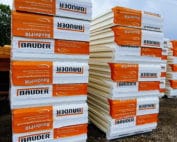
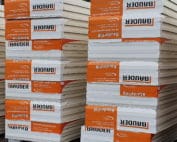
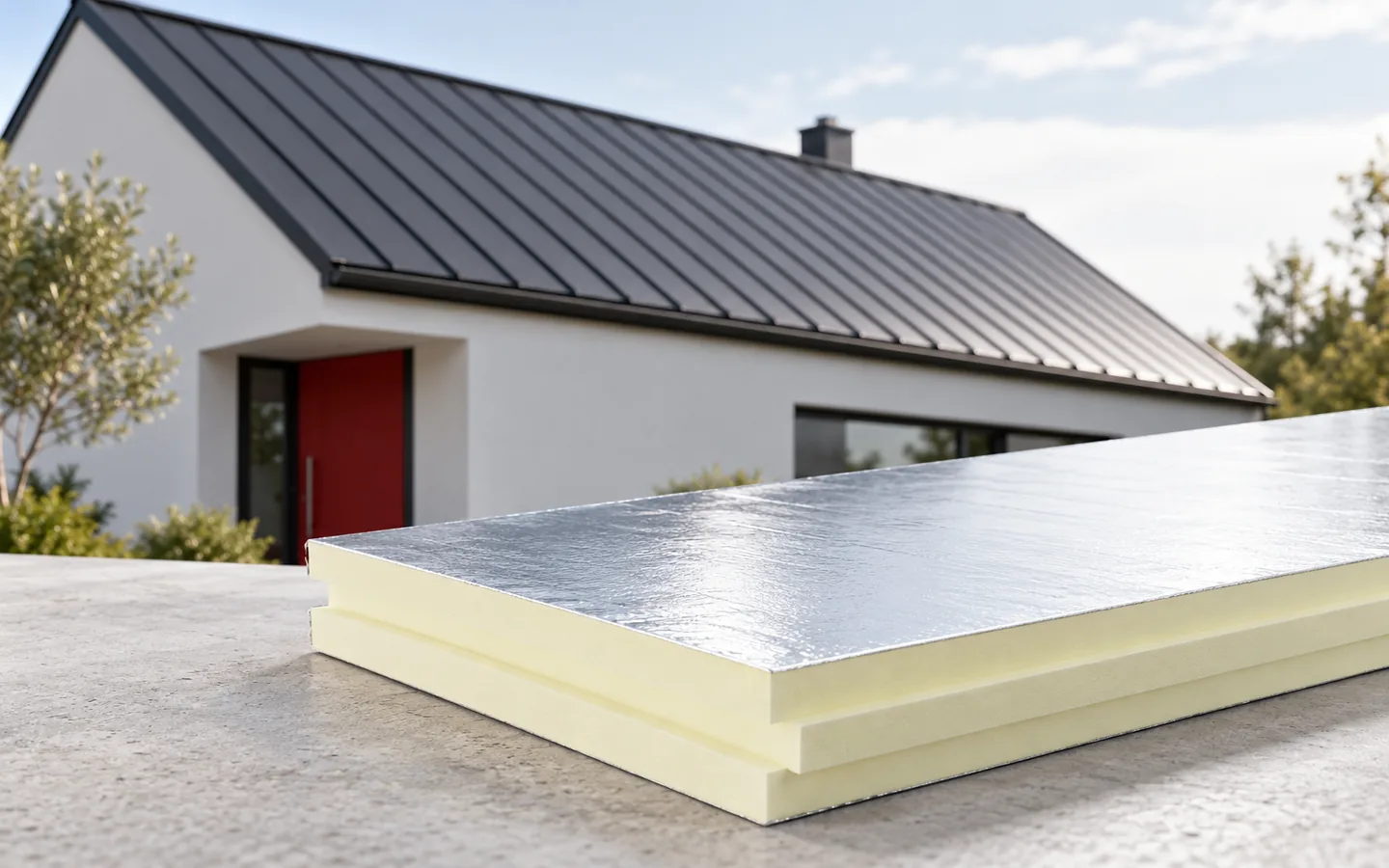
PIR boards allow a high thermal resistance to be achieved at a relatively small thickness. This is useful where attic height is limited or when insulating from the outside. A continuous layer above the rafters can reduce the effect of thermal bridges created by the timber. Another advantage is the possibility of leaving the visible roof structure elements exposed inside.
However, a board intended for the given application must be selected. An insulating PIR board with a thin facing is not a roof sandwich panel and does not constitute a standalone covering. It requires proper support, fixing and protection. Its low water absorption does not replace waterproofing, and the aluminium facing does not automatically seal all joints.
What do lambda, R and U mean?
Lambda describes the thermal conductivity of a material. A lower value allows the same resistance to be achieved with a thinner layer. The R value depends on thickness and lambda. For example, 100 mm of insulation with a lambda of 0.022 gives a calculated value of approximately 4.55 m²K/W. This is a comparison of the material alone, not a result for a completed roof.
The U-value relates to the entire building envelope. It takes into account its layers and, in a correct assessment, also the relevant corrections and the influence of thermal bridges. The parameters of a single board should not simply be attributed to the roof. The insulation thickness is selected according to the design and the requirements of the building. The passive house standard results from an assessment of the whole, not from the use of a single product.

Will PIR always be the best choice?
PIR has an advantage where limiting thickness is important. This does not mean an advantage in every property. Mineral wool may better meet certain fire and acoustic requirements. Selected XPS grades are intended for conditions of high humidity and loads. EPS can be an economical solution in a suitable configuration.
Compare materials at a similar thermal resistance and for the same application. Do not set a thick insulation with low lambda against an accidentally thin layer of another product. Fire reaction, stresses, moisture and compatibility with the other layers must also be taken into account. PIR should not be described as a non-combustible material.
How should insulation be connected with roof covering ventilation?
In a ventilated roof, the air under the steel sheet has a designated path from the eaves to the outlet. This space should not be equated with a leak in the layer on the interior side. The building’s airtightness and the ventilation under the covering serve different functions. Both may be needed in the same correctly designed roof.
Particular attention is required where the channel is interrupted by windows and chimneys. The solution approved for the system must be maintained, without accidentally blocking the space with insulation. Fasteners passing through the PIR layer are selected for the loads and the roof assembly. A long screw chosen solely on the basis of the board thickness is not a complete fixing design.
What should be checked before closing the layers?
Assess the tightness of the joints, the continuity of the insulation and the condition of the materials after installation. Duct penetrations should have prepared seals. It is worth documenting details that will disappear under the covering. If an airtightness test of the building is planned, its timing should be coordinated with the possibility of making corrections.
A metal roof offers many aesthetic and structural possibilities. However, it works towards energy efficiency together with the entire layer assembly. The best result comes from matching the covering, insulation and workmanship at the design stage. Later addition of material in random places usually costs more and makes it harder to maintain the continuity of the building envelope.
It is also worth assessing the protection of the attic against summer overheating. The colour of the metal sheet is only one factor. Windows, shading, room ventilation and the entire assembly of building components matter. Replacing the roof slope with a lighter colour alone does not solve every temperature problem.
7 branches. Materials closer to your project.