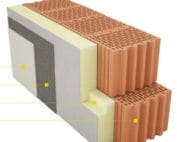
PIR insulation
How do you convert the thickness of EPS to PIR for the same wall?
PIR can provide a similar thermal resistance in a thinner layer than a selected EPS, but there is no single conversion factor for all boards. You need to compare the lambda of specific types and their application. Only then can you assess how much space can be recovered and how the change will affect the render, reveals and other wall layers. Lambda describes heat conduction through a material. The lower it is, the greater the resistance of a layer of the same thickness. In a simple calculation, the resistance R is d divided by lambda, where d is given in metres. U, on the other hand, relates to the entire building element and requires the other layers and the calculation conditions to be taken into account.
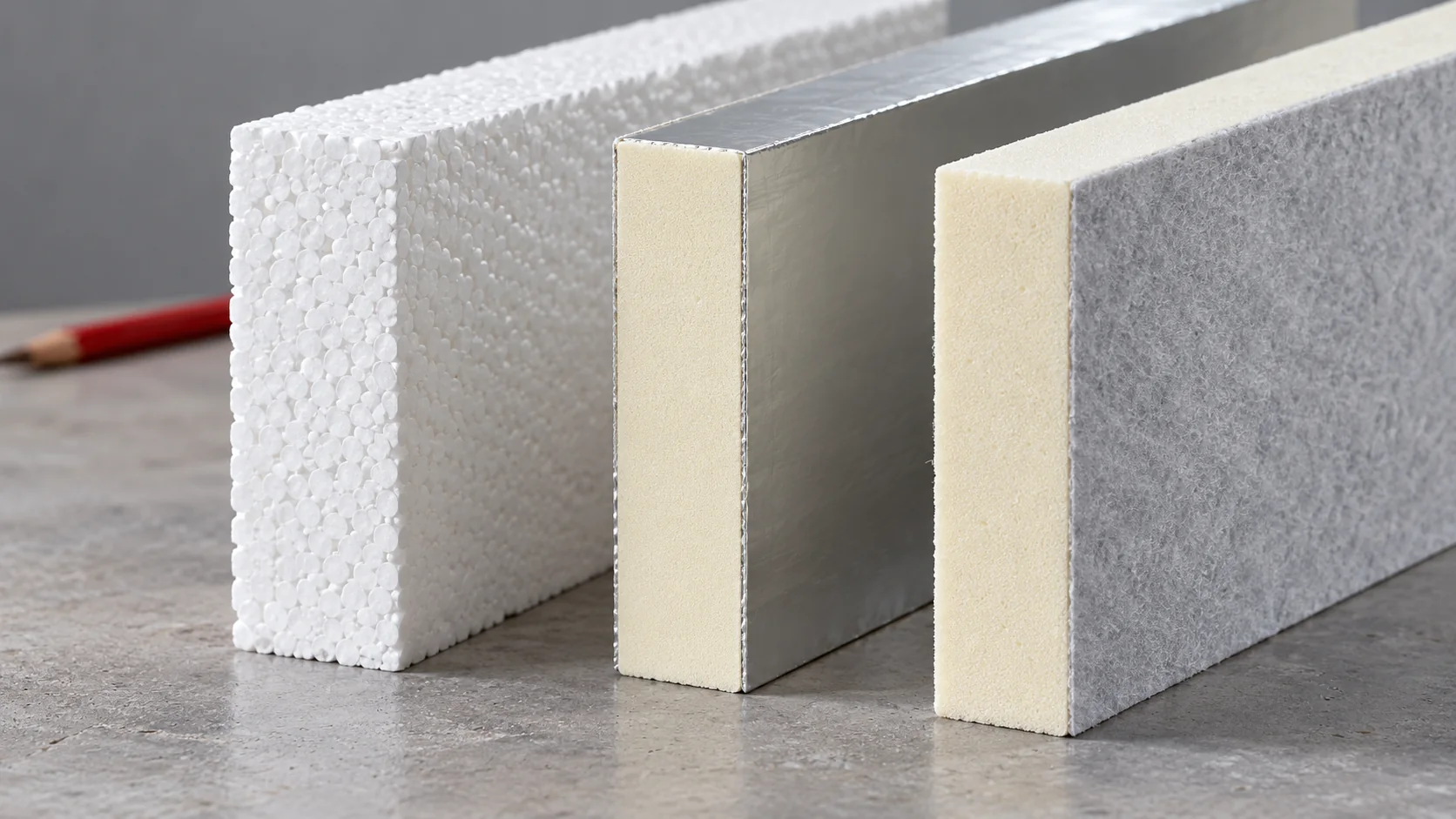
Compare the same physical quantity
So do not compare the lambda of EPS with the U-value of a sandwich panel. Likewise, the resistance of PIR alone is not the result of a finished wall. When comparing a change of insulation, the masonry and other layers can be left unchanged, and then a similar insulation R can be selected. This is a good starting point for analysing variants, though not a complete design.
Carry out the conversion using specific data
For a theoretical calculation, assume EPS with a lambda of 0.040 W/(m·K) and a thickness of 160 mm. Its resistance is 0.160/0.040, i.e. 4.00 m²K/W. The same mathematical result is given by 88 mm PIR at a lambda of 0.022 W/(m·K). The difference in thickness between the two layers is 72 mm.
If the PIR board under plaster considered has a lambda of 0.025 W/(m·K), 100 mm is needed for the same resistance. The difference relative to the assumed EPS will then be 60 mm. These are calculated comparative thicknesses. At purchase, the available variant is selected and its declared properties are checked; a result of 88 mm does not mean that every system offers such a dimension.
See why the cladding changes the choice
A board with aluminium foil may have different thermal and diffusion parameters than a board with a facing for bonding façade insulation. The name PIR alone does not identify the product. Changing the type of surface affects the selection of layers and the way the wall dries out. It cannot be treated as a purely geometric exchange of thickness.
Under plaster, the compatibility of the entire system is key: substrate, adhesive, insulation, fixing and reinforced layer. For internal installation, continuity of vapour and air control is also required. Calculating the resistance helps to select candidates, but the final decision must be related to the actual place of application.
Calculate the effect for the entire building element
Assume that the other wall layers together with the surface resistances have an R of 1.25 m²K/W. After adding insulation with a resistance of 4.00, the total resistance is 5.25, and the simplified U is approximately 0.190 W/(m²K). With equal insulation resistance, the result of this model is the same regardless of its name.
In a real wall, differences can arise at junctions and fixings. A change in thickness affects reveals, sills and the geometry of the plinth. The appropriate corrections must also be taken into account. It should not be promised that two buildings will have identical energy consumption simply because the central fields of their walls have a similar calculated resistance.

Assess centimetres where they are needed
A thinner layer can be valuable where there is a narrow passage, a limited reveal depth or a junction between the façade and an adjacent element. In new construction, however, the geometry of the detail can sometimes still be changed before the structure is built. Compare both solutions before deciding that the smallest thickness is the most important criterion.
For a wall 13.5 m long, reducing the internal build-up by 72 mm gives 0.972 m², i.e. approximately 0.97 m² of floor-plan area. This is a geometric example relating to one straight wall. It does not include additional framing or cladding. With external insulation, the space saving relates to a different zone and does not automatically increase the interior of the house.
Compare the finished construction, not the foam alone
Add to the cost of the variant the accessories, finishing and labour needed to close the layers correctly. Also check the fire requirements, moisture resistance and load conditions at the given location. These properties do not follow from the equation d/λ. A material with a lower lambda does not thereby become a substitute for every insulation.
When comparing variants, it is worth recording R, the total thickness of the build-up and the solution for the most difficult detail. If all three elements are known, the comparison becomes useful for the design. On this basis the technology can be selected, and then the available thicknesses and the exact scope of the order can be matched.
Questions and answers
Can PIR that is twice as thin always replace a layer of EPS?
No. The conversion factor depends on the lambda of both types. Their thermal resistances must be compared and their suitability for the same application confirmed.
Is it permissible to change the insulation without changing the façade design?
This possibility should not be assumed. A change may require verification of the system, fixings, details, fire protection and moisture conditions.
7 branches. Materials closer to your project.