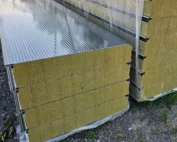
PIR insulation
One 120 mm PIR board or two 60 mm boards? How to check a proposed substitution
The merchant has 60 mm PIR boards in stock, while the design specifies a single 120 mm layer. Two thinner boards occupy the same depth. To assess the thermal effect, look up the resistance for both thicknesses and add the resistances of the layers laid one over the other. If the manufacturer quotes different conductivities for different thicknesses, the sum can differ from the value for a single thicker board. The designer should also check design conductivity, fixing arrangements and joint positions in the proposed build-up before accepting the substitution.
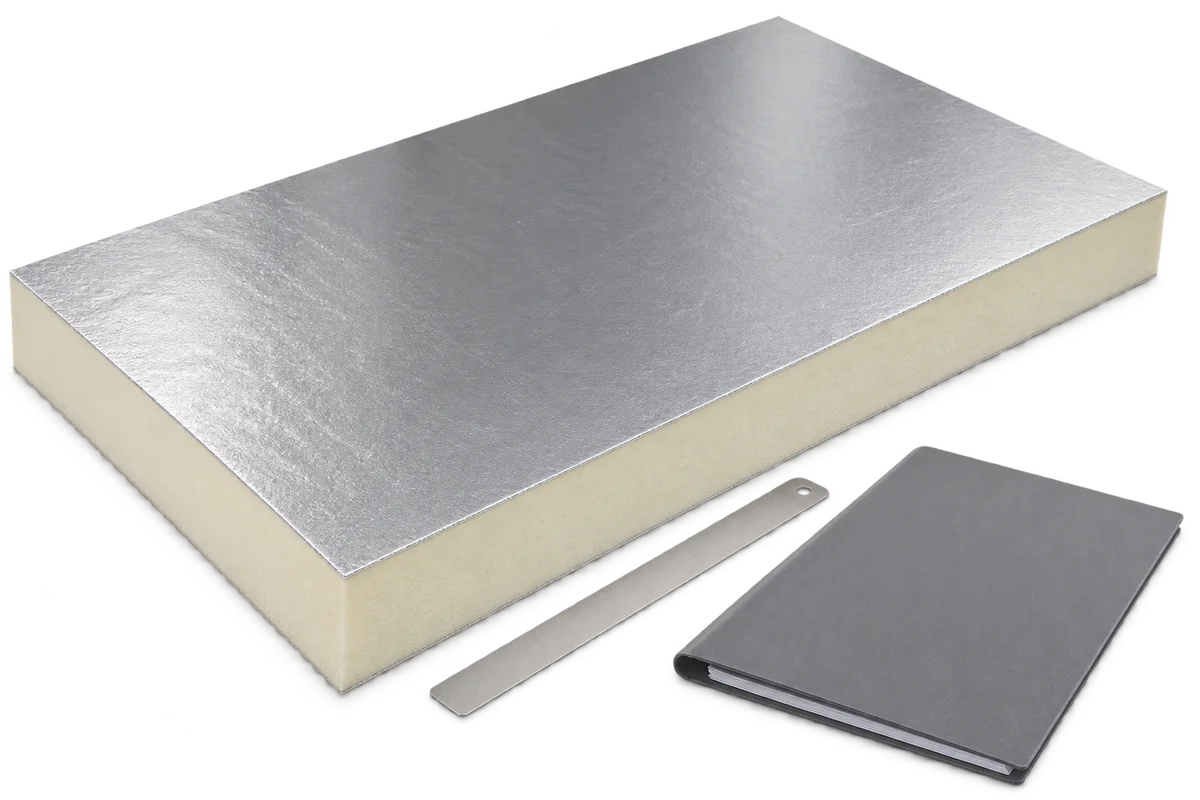
What exactly has the merchant offered?
Ask for the references of both board options, including facing and edge profile. The 60 mm row must cover the product that will actually arrive on site. Several versions may share a single range name.
How do you add the resistances of two layers?
Assume two homogeneous layers are in full contact and heat passes through them in sequence. In this model their combined resistance equals R1 + R2. The conductivities of the two boards are not added together.
For a comparison of declared values, enter the offered 60 mm board’s RD twice and compare the sum with the 120 mm board’s RD. Use the values declared for the boards in their respective rows. Table rounding can produce small differences from thickness divided by conductivity.
When can equal thickness give a different result?
For illustration, assume 0.024 W/(m·K) for a 60 mm board and 0.022 W/(m·K) for a 120 mm board. Two layers at 0.060 / 0.024 each give a combined 5.00 m²·K/W. One layer at 0.120 / 0.022 gives about 5.45 m²·K/W. Both options occupy 12 cm.
If both thicknesses have the same conductivity, the homogeneous-layer calculation gives the same result. The example therefore establishes no universal preference between the options. Replace the illustrative figures with those on the supplied sheets and keep their document references.
Which conductivity belongs in the design check?
Declared conductivity describes a specified product under reference conditions. Calculating the building element requires the conductivity adopted for the intended service conditions. Establish which value the designer used for the original 120 mm board.
For the two-layer check, supply the documents for both layers and show their positions in the section. Where a conversion is needed, its basis can be checked against the procedures in ISO 10456. The designer identifies the applicable service conditions.
How do you assess joints and fixings?
Draw the board joints in each layer. Consult the system instructions to see whether and how the joints should be staggered. The ideal R1 + R2 calculation has no separate term for staggering, so it gives no additional resistance credit for that detail.
Submit the support and fixing arrangement for both layers for review. Record resistance of the insulation in m²·K/W separately from the U-value of the finished roof in W/(m²·K). Anyone signing off can then see what each figure represents.
How do you approve and measure the substitution?
Convert the area to the number of layers. Covering a net area of 40 m² with two complete layers takes 80 m² of boards before cutting waste and pack rounding. Use this quantity to compare the substitution cost with the original order.
Before the material is released, record the agreed thicknesses, board references, outcome of the element check and joint layout. Include a photograph of the first layer before it is covered in the handover file. It will show where the concealed joints run.
7 branches. Materials closer to your project.