Choosing a covering
Clay tiles or tile-effect metal roofing for a new house?
Tile-effect metal roofing and clay tiles are best compared before the structure is approved. They differ in weight, format and the way they are worked on the roof. The price of the basic material shows only part of the expense. The choice should also be decided by the shape of the roof slopes, the details, the desired appearance and the conditions for later servicing of the covering. Steel tile-effect metal roofing is considerably lighter than many clay coverings. For example, with a tile-effect metal roofing weight of 4.7 kg/m², a covering of 160 m² weighs around 752 kg. Plain tiles weighing 1.6 kg each at a consumption of 36 pieces per m² give 57.6 kg/m², that is 9216 kg over such an area. This is a comparison of two specific examples, without battens, insulation and accessories.
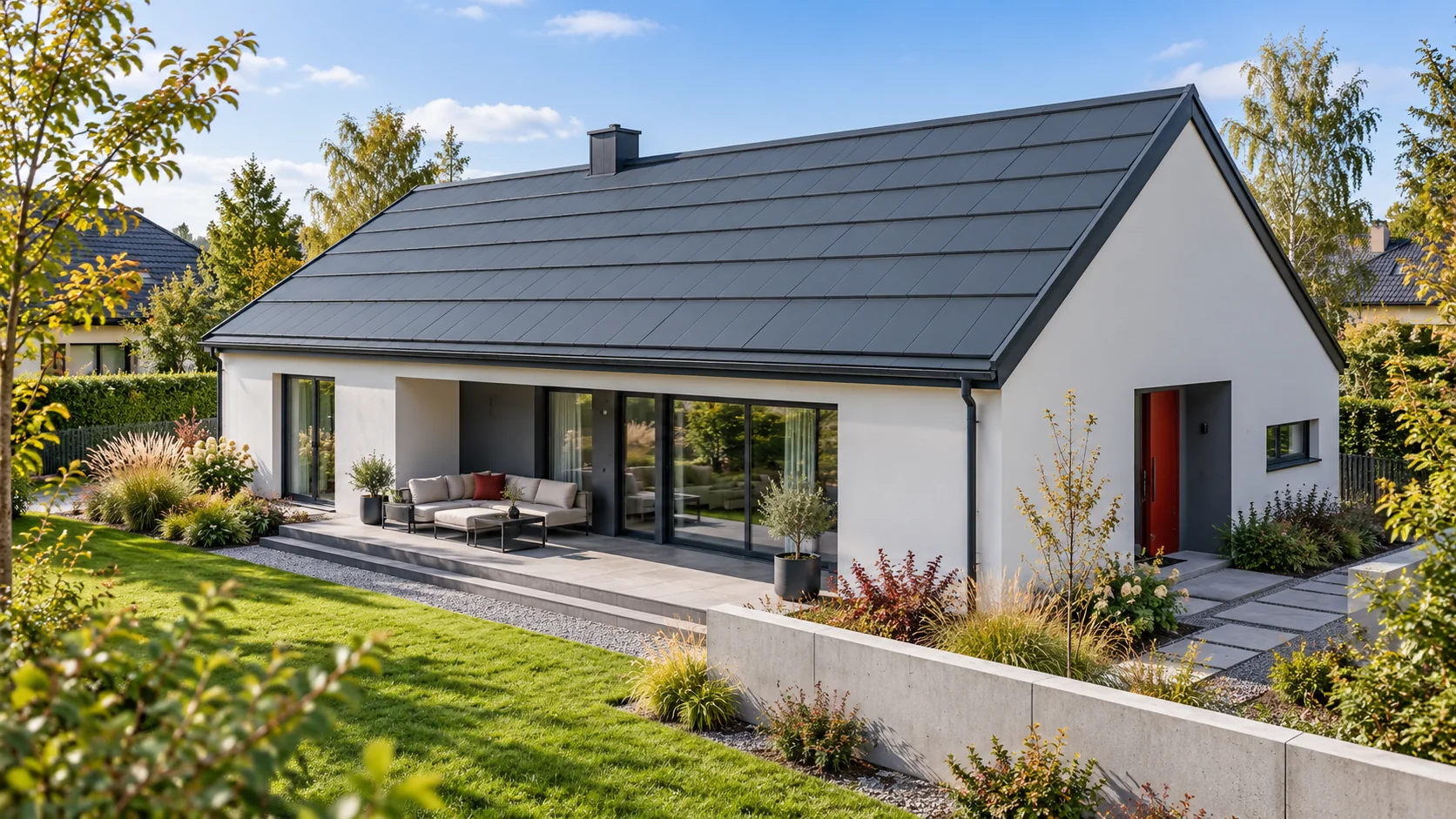
How does the weight of the covering affect a new building?
It does not follow from this that every ceramic roof needs identical reinforcement. The designer takes into account the entire structure, loads and support arrangement. In a new house, it is worth finalising the choice of covering before ordering the roof truss. A later change of material to a heavier one requires verification, not just an additional transport surcharge.
What changes with the shape and division of the roof slopes?
Large rectangular roof areas favour the efficient laying of longer sheet metal panels. With numerous roof valleys, dormers and slopes, the importance of cutting plans increases. Modular tile-effect metal roofing allows work with smaller elements, but still requires cutting and has its own joining rules. It does not automatically result in zero waste.
Ceramic tiles are small elements that also have to be adjusted at edges and openings. Edge tiles, ventilation tiles, ridge tiles and other accessories are added. Before comparing, establish whether both variants are permitted at the given pitch and with the selected underlay. If one requires additional work, it must be added to the cost estimate.
How to compare costs without apparent savings?
Ask for two cost estimates based on the same roof drawing. Separate the basic covering, accessories, substructure, underlay, transport and labour. Compare insulation and interior finishing over the same scope. Otherwise, the cheaper offer may simply include fewer works.
Suppose two roofing options cost €7174.95 and €9026.55 excluding VAT. The difference is €1851.60. If the first quotation omits flashings and roof access equipment costing €740.64 before VAT, the difference on the same scope falls to €1110.96. These figures illustrate why the final totals and itemised specifications matter.
Will a heavier material alone ensure quiet and warmth?
The weight of the covering matters for the roof’s behaviour, but the comfort of the attic depends on the entire assembly. Beneath the metal sheet, the insulation, sealing layers, cavities and ceiling lining work together. Their arrangement affects the transmission of sound and heat. A bedroom cannot be reliably assessed just by tapping a loose sheet and a single tile.
If the loft is to be habitable, establish the acoustic and thermal requirements at the design stage. Also consider window position, ventilation and summer solar gain. Heavier roofing does not replace continuous insulation. Conversely, a lighter material does not determine noise inside. What matters is the build-up of layers and the quality of the joints.

How should durability and warranty conditions be understood?
Durability cannot honestly be reduced to a single number of years for all ceramics or all sheet metal. For sheet metal, the steel, metallic protection, organic coating, environment and edge treatment all matter. For ceramics, the properties of the specific tile and its condition after installation are assessed. In both roofs, flashings, fasteners and the layers beneath the covering also play a role.
Check what the warranty covers: appearance, perforation, frost resistance or other specified characteristics. Different scopes are not directly comparable. The required inspections and exclusions also matter. A long warranty on one material is not a promise that the entire roof will not need checking or replacement of a small component during that time.
Which variant better suits your project?
Tile-effect metal roofing makes sense when low weight, efficient handling of the sheets and a specific visual effect are important. Ceramics are worth considering when their format and character suit the building, and the structure and budget allow for the heavier covering. Neither choice will fix a poorly designed roof valley, chimney or ventilation.
Before deciding, look at a larger sample, not just a single colour. Establish access for later inspections and the possibility of replacing a damaged section. Also check the team’s experience with the chosen system. The most sensible option is the one whose parameters, details and full cost are known before work begins. The material itself is only the beginning of that decision.
Questions and answers
Does tile-effect metal roofing always give you a cheaper roof?
No. The outcome is also determined by the cutting plan, coating, accessories, structure and labour. The price of a single square metre of covering is not enough for comparison.
Can you freely change ceramics to sheet metal in a new house?
The change must be agreed with the designer. Even a lighter covering may require different battens, fastening, underlay and detailing.
7 branches. Materials closer to your project.