EPS and thermal insulation
Assessing the durability of EPS concealed in a building element
The durability of EPS depends on the material, correct application and the conditions prevailing within the building element. When assessing old insulation, you need to check more than the age of the building. Moisture, loads and the condition of the protective layers and joints all matter. Render in good condition does not always describe the insulation beneath it. Conversely, a need to refurbish the façade does not automatically mean that the EPS has deteriorated. EPS can retain the required properties over a long service life if it works in suitable conditions. Tests on samples taken from a building in use showed that the thermal and mechanical properties had been maintained after many years. Such a result confirms the potential for durable use, but it is not a guarantee for every building. A single replacement interval should not be assigned to all boards.
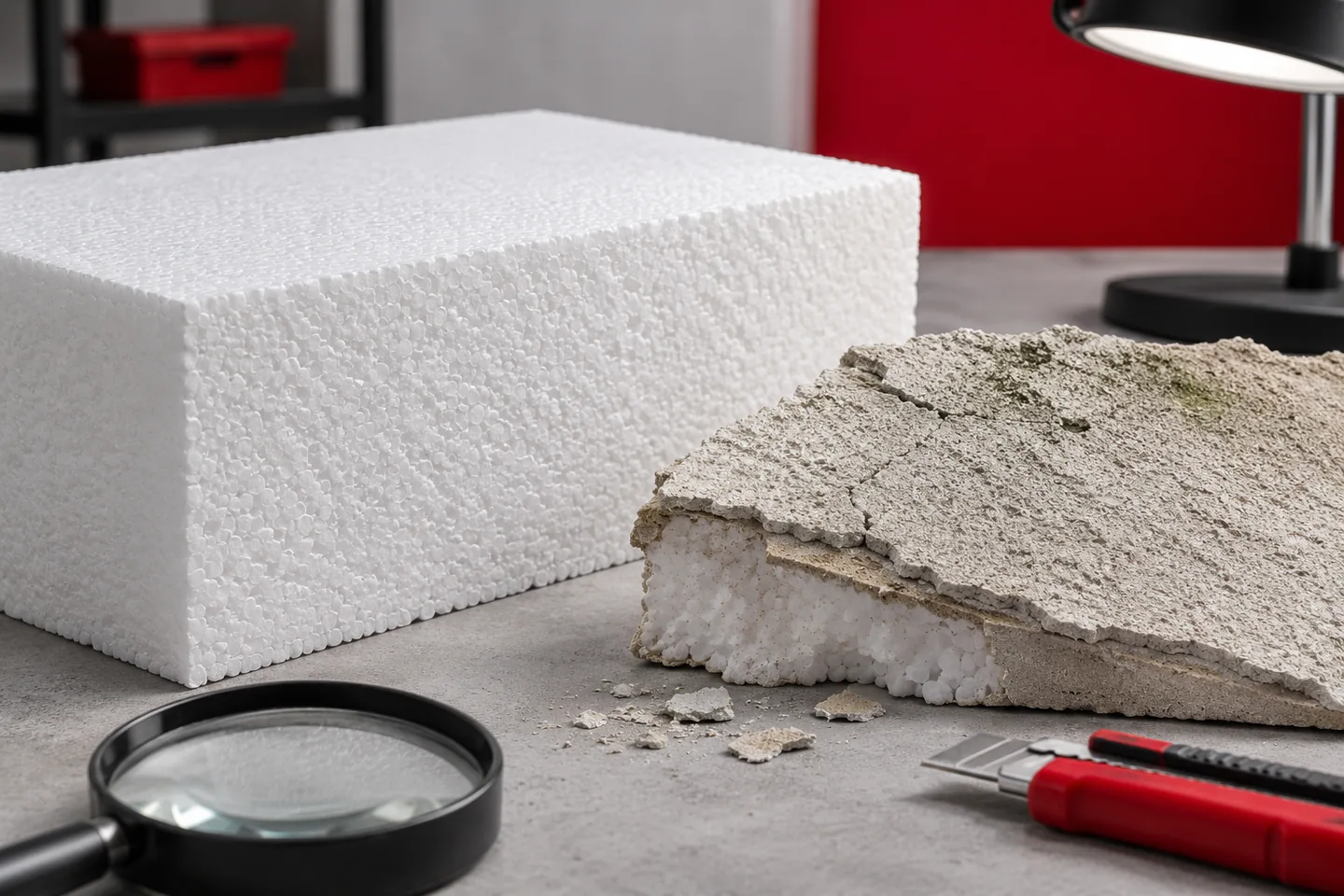
Does the age of the polystyrene determine its condition?
The history of the specific building component matters: leaks, renovations, overloading and the manner of execution. The assumed period in the environmental analysis also does not replace a technical assessment of the building. The material may be sound despite an older installation date, or damaged much earlier by unsuitable conditions.
How can the condition of the EPS be distinguished from the condition of the entire thermal insulation?
On a façade, the complete set of layers is at work: substrate, adhesive, insulation, fixings, reinforcing layer and finish. Wear or damage to one of them does not automatically describe the others. Soiling of the render may require surface treatments. Detachment of a larger area, however, requires identifying where the loss of bond occurs.
The situation is similar on the roof. A leaking covering can worsen the insulation conditions, even though the boards themselves were not defective at installation. In the floor, cracking of the covering may result from movement of the screed, the substrate or the load. When assessing, it is not worth starting from the assumption that polystyrene alone is responsible for every symptom.
Which conditions can impair the performance of the insulation?
EPS should be protected against factors incompatible with its intended use. High temperature, contact with unsuitable chemicals and mechanical damage are significant. Exposed material is also exposed to UV. Once installed, protection is provided by the intended layers and details, which must be kept in good condition.
Water requires separate attention. A board with reduced water absorption does not replace waterproofing. A leak can cause dampening of materials, accumulation of water at joints and problems in adjacent layers. First the source of ingress is removed, and then the condition of the building element is assessed. The mere drying of a visible stain does not conclude the diagnosis.
Behaviour over time also counts under load. Insulation that is too compliant can deform under constant pressure. That is why the CS(10) parameter is not sufficient to assess many years of floor performance. Design conditions, appropriate material data and information on the actual furnishings and changes of use are needed.
What symptoms should prompt an inspection?
On the façade, look for cracks, bulges, open joints and signs of persistent damp. Inspect especially window sills, parapets, plinths and service penetrations. These are places where a local leak can affect a larger part of the system. In the floor, new depressions and changes in level are significant.
It is worth comparing the observation with photographs from earlier years. A single image does not always show whether the damage is progressing. Do not make random holes just to see the colour of the EPS. Exploratory openings should have a defined purpose, and after the investigation they require proper restoration of the layers and their airtightness.
What can a thermal imaging survey or an exploratory opening reveal?
Thermography helps to identify areas with a different temperature distribution. However, the image is influenced by the measurement conditions, solar radiation, moisture and the geometry of the building. A thermogram alone does not determine the lambda of a concealed board, nor does it prove its distribution. The result must be compared with the construction of the building element and other observations.
A targeted inspection opening allows the thickness, surface condition, joints and method of fixing to be assessed. Where material parameters are needed, appropriate tests on samples are selected. Their scope depends on the problem: moisture raises a different question from deformation beneath a floor finish. It is not necessary to carry out the full set of tests without a clear reason.
How do you decide whether to leave it in place or replace it?
The decision should follow from an assessment of the entire system and the extent of the damage. Sometimes repairing the flashing or the outer layer is enough. In other cases, local or more extensive replacement of the insulation is needed. Before adding another layer of thermal insulation, the load-bearing capacity and condition of the existing assembly must be checked.
Keep the records of inspections and the documentation of repairs. Eliminate the causes of leaks and damage before they are covered by new finishes. Durability does not result solely from the properties of the board stated in the declaration. In everyday use it is also sustained by the proper functioning of those layers that protect the EPS and provide it with the design operating conditions.
EPS insulation is produced by, among others, Austrotherm, Termo Organika, Polstyr and Ekobud. When assessing an existing building element, what counts is the parameters of the product used and the actual condition of the entire system.
7 branches. Materials closer to your project.