PIR insulation
Kingspan Therma TR27 quotations: comparing technical properties and costs
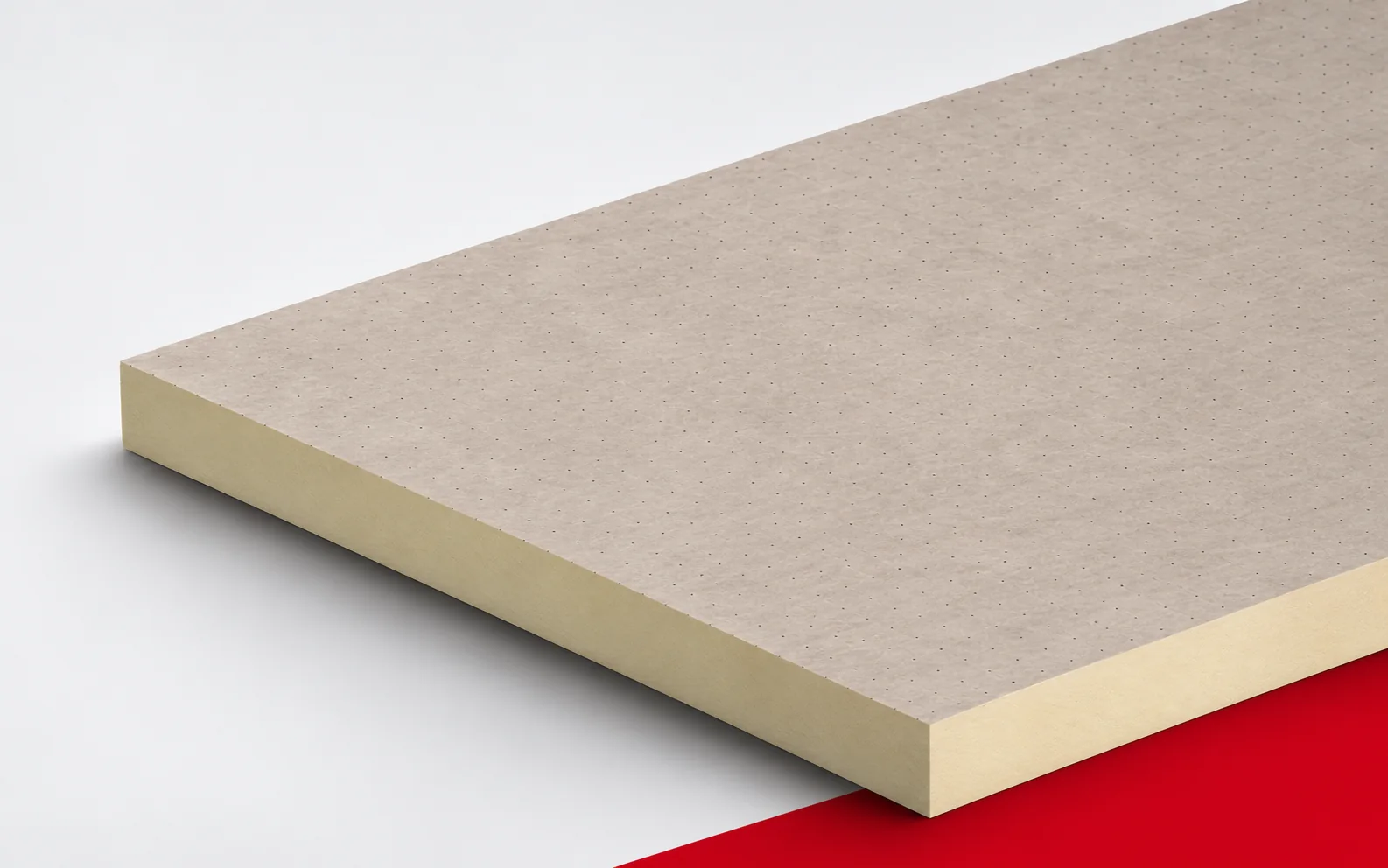
When buying Kingspan Therma TR27 boards, the price per square metre alone does not decide the choice, because offers differ in scope. PIR boards with matched thermal resistance must therefore be compared on the same scope of works; otherwise a lower figure may mean less work. TR27 is a PIR board with glass fibre facings on both sides; the catalogue describes flat roof and terrace build-ups with mechanical fastening, bonding or ballasting in accordance with the system documentation. In your enquiry, describe how TR27 is combined with the first layer of the chosen covering, so that every tenderer prices the same application variant.
A precise request for quotation
A brief sales description is not enough to establish interchangeability, because a board with a fleece facing does not correspond to every variant of PIR in any bonded arrangement. The comparison is intended to show whether the offer uses the properties of the facing without disregarding the requirements of the roof assembly. Agree with the tenderers on the type of substrate, the membrane variant and the documentation of the layer bond, so that they price a comparable task.
A comparable thermal result
The lambda value of TR27 depends on thickness, so a single value does not cover all variants. For 100 mm the catalogue states 0.027 W/(m·K) and RD 3.70 m²K/W, and for 120 mm 0.026 and 4.60. When assessing equivalents, include TR27 boards in both thicknesses with their declared lambda values.
After changing the TR27 thickness, read off the lambda value and the declared thermal resistance again, so that the price difference does not result from different thermal assumptions. Applying a single lambda value to both variants would distort the difference in their resistance. Enter RD 3.70 for 100 mm and 4.60 m²K/W for 120 mm in the quotation table; only then can the price be linked to the parameters.
What increases the scope of works
Therma TR27 has a standard format of 1200 × 600 mm, and the catalogue provides for square edges or rebated edges. For an order, the specific geometry and covering must be confirmed. When calculating quantities, take into account the joint of the 1200 × 600 mm boards near the corner and the end of the roof flashing.
Match the TR27 edge to the layout of the field and the support of the elements at the perimeter, and calculate the material allowance from the actual cutting plan. The pack area can be misleading, because offcuts may lose the factory side profile intended for the planned joint. Before determining the number of packs, lay out the last rows before cutting the elements at the perimeter of the roof slope. The quotation for the polyurethane insulation should cover this detail: check the edge variant, the covering area and how the new cut edges are closed.
Product parameters and delivery conditions
Service access to equipment above TR27 requires an assessment of local compressive stress, including when a cheaper alternative is proposed. The Therma TR27 declaration covers a minimum of 120 kPa at 10% deformation and reaction to fire class E. Checking the loads and fire requirements of the entire roof remains a separate task.
Assess the compressive stress in the service zone together with the protection and support of the TR27 layer before a lower price becomes an argument for an equal result. A similar name or facing is not enough, because 120 kPa at 10% deformation does not permit every point load. The supplier should provide data for designing the support and protection in a location used differently from the middle of the field. Before accepting the savings, compare the service traffic area, the support area and the classification conditions of the entire covering in both solutions.
Completeness of the offered solution
Before accepting the price for bonding onto Therma TR27, confirm the waterproofing system and the conditions for preparing its substrate. The glass fleece facing of the board works with the layers of a specific system. It is not a universal surface for every adhesive, so the offer should state what will be fixed to it.
The offer for a bonded system with TR27 should specify the requirements for surface preparation and the use of the correct board and waterproofing system. Approval of a specific bond does not entitle the use of any compound with a similar name. Instead of a general item “polyurethane foam”, establish the cost of auxiliary materials, cleaning and inspection of the substrate condition. Also agree the application conditions, the method of checking the bond and the responsibility for its execution.
Calculation of the entire building element
Compare the TR27 price at the agreed thermal resistance and covering scope, with fixing, auxiliary layers and detailing included in the calculation. Compare the “polyurethane insulation” line item using the full scope of works. Analyse the TR27 quotation for the bonded solution and for the alternative method of fixing the covering.
Compare the cost of the TR27 system at the same thermal resistance and scope of the completed roof, so that the purchase price is related to the finished works. A different fixing method changes material consumption and surface preparation, so the difference between quotations may result from the scope. When approving the order, check the board thickness, the type of joint, the auxiliary layers and the flashings included by the contractor, and record each excluded item as a separate cost.
Two TR27 quotations for the same thickness may cover a different scope of covering work: one the preparation and adhesion, the other only the supply of boards. These are not equivalent amounts, so the insulation material, auxiliary layers and labour must be separated. With a different thickness, there is also the need to check the correct RD and the effects of changing the build-up height.
7 branches. Materials closer to your project.