PIR insulation
BauderPIR FA beneath roof equipment: supports and protective layers
BauderPIR FA under roof-mounted equipment requires an assessment of the entire load-transfer path. The price of the insulation does not automatically include the design of the support, the load-distribution layer or the protection of the waterproofing. Comparable quotations must relate to the same equipment, forces, actual bearing area and duration of load action. The CS value from the compression test is not the permissible permanent pressure on the finished roof. Below, we separate these parameters and show a simple calculation of the average pressure. We also identify the cost-estimate items for supports, penetrations and the service route that must be agreed with the designer before choosing the cheaper variant.
The subject of the purchase must be unambiguous
The enquiry to the supplier should include the force transmitted by the support and the actual contact area, so that the scope is unambiguous. Insulation performance is combined here with the permissible deformation under load, and the connections are explained by the designer of the support and roof loads before quotations are compared by final amount.
The correct product and the scope of its data
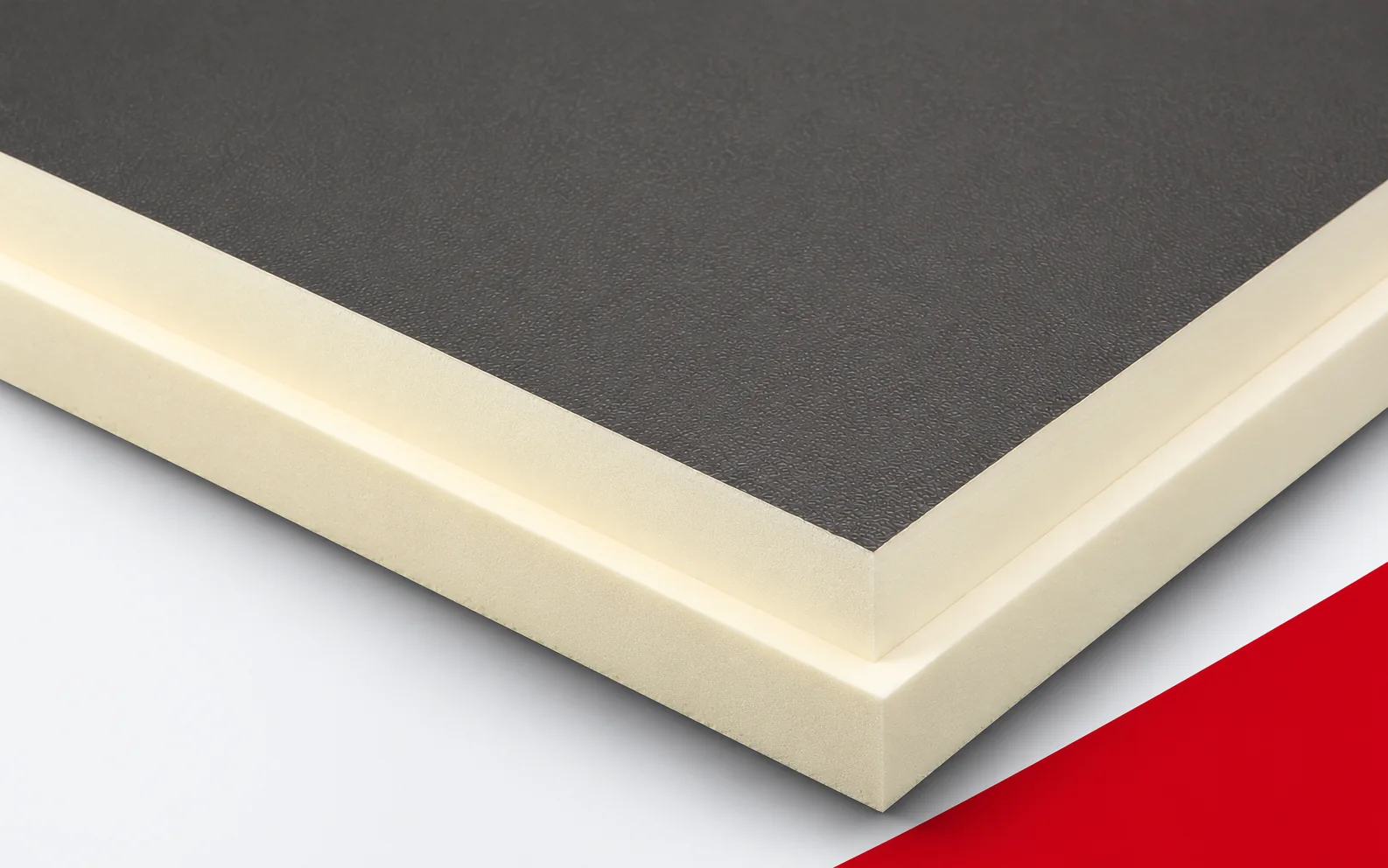
The parameters of BauderPIR FA are λD 0.022 W/(m·K), CS(10/Y)120 and reaction-to-fire class E. The Polish data sheet of September 2026 states separately 24 kPa for long-term load at 2% deformation — this is not the same as the test result at 10%. The design of the support must therefore refer to the conditions in the documentation and to all layers of the system; CS on its own is not a load-bearing calculation for the finished roof. In the order, the full name BauderPIR FA is needed, because generic “polyurethane boards” are not sufficient. The core in BauderPIR FA is PIR foam, and the properties of the complete board also include the facings; installation here means factory-made boards in a defined layer build-up.
A uniform basis of calculation
For a force of 2.50 kN and an actual contact area of 0.050 m², the average pressure is 50.0 kPa. It is not enough to relate this to the 120 from the CS parameter, because the Polish data sheet states separately 24 kPa for long-term load and 2% deformation. The distribution of the force throughout the detail must be examined; this is an example, not a design or an approval of the support. Forces from the equipment to the structure must be transmitted in accordance with the design, and the nominal outline of the base plate does not mean contact over the entire surface.
The enquiry for the equipment base should specify whether the price includes its design and calculation, and should also define separately the protection of the covering and the execution of the penetrations. A quotation limited to the element visible above the roof may omit the work beneath it, so that the amounts compared do not relate to the same function. The cost of the support must be assigned to a specific item of equipment and to the adopted layer build-up.
For the same support, combine the short-term compressive assessment with the assessment of creep deformation over time. The cost estimate documentation should state the assumed forces, the actual contact area and the load-distributing layers. The support drawing then explains what the estimate covers and which protective solutions must be supplied together with the boards.
What changes the cost of the solution
Increasing the actual load-distribution area may mean a different scope of works than a separate support solution transferring the load in accordance with the design. For BauderPIR FA, the consequences of both decisions must be set out for the contact area of the roof equipment foot. In the comparison, the figure of 120 kPa must not be taken as a ready permissible support load, because then the prices relate to different assumptions. Differences in the cross-section are confirmed by the designer of the support and roof loads; only once these are clarified does it make sense to choose the financially more favourable item, and the final scope is organised by the set of documents concerning supports, penetrations and the service route linked to the selected solution.
Labour hidden in the joint
The aluminium facing of BauderPIR FA lies beneath the subsequent roof layers; it does not itself protect the waterproofing from the equipment foot. Price separately the required protective layers, the adaptation of the insulation and the sealing of penetrations. Acceptance of the support should cover both the structural calculation documentation and the conformity of the executed detail with the drawing.
Transport, stock and preparation
Before ordering, agree who will prepare the base, execute the support and protect the covering while the equipment is being installed. A change to the base or the contact area requires a reassessment of the loads and an update of the scope of works. The interval between laying the insulation and closing the covering may mean an additional cost for protection.
Conditions for accepting the final quote
At acceptance, check the board model and the execution of the support against the approved cross-section. A proposed substitution requires returning to the forces, the areas over which they are transferred and the permissible deformation over time. In the record, include the protection of the waterproofing, the penetrations and service access, so that the amount settled corresponds to the entire solution.
7 branches. Materials closer to your project.