Choice of covering
Stone-coated or painted steel roof tiles: what does the finish change?
The choice between a granular-coated metal roof tile and a coated finish depends on the desired appearance and verified documentation, not on a slogan about a better covering. It is worth checking whether the sample matches the effect on a large roof area, and comparing the coating build-up and installation requirements. The granular finish gives a mineral texture and diffuses light, but does not replace insulation or snow guards. A coated finish allows various gloss levels and profiles. The decision should be based on a complete system for the same roof geometry.
How do granules differ from a matt coating?
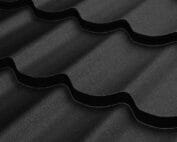
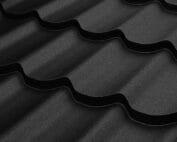
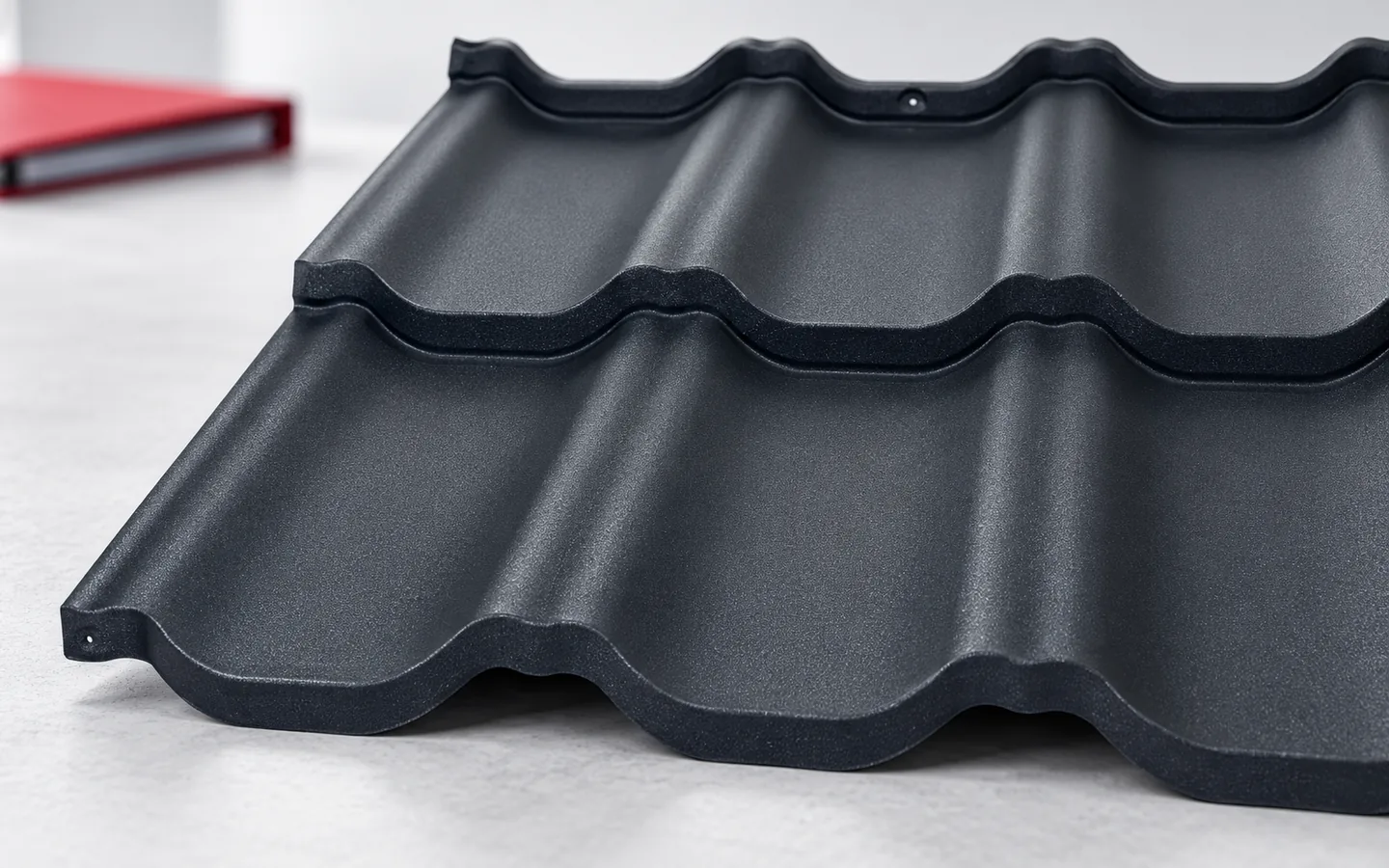
In granular-coated tile-effect metal roofing, the steel core has corrosion protection, bonding layers and an external aggregate layer. The detailed build-up depends on the product. The surface resembles a mineral material and diffuses light. It is not the same effect as a matt finish obtained with an organic coating. When assessing samples, it is worth looking at them up close and from a distance similar to the view of the roof from the street.
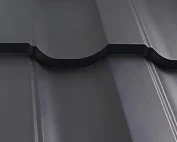
Coated tile-effect metal roofing is also available in various textures and degrees of gloss. Its parameters depend on the protective system, not only on the colour. Steel thickness, the type of metallic protection and the environmental application still matter. The presence of aggregate does not allow this information to be omitted or every product with granules to be considered more durable than every coated sheet.
How does the appearance of the finished roof change?
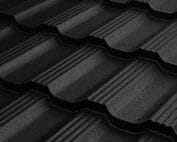
Granules can emphasise a pattern reminiscent of shingles, slate or traditional tiles. Fine grains create a non-uniform surface. When choosing, the shade of the façade, joinery and gutters must be taken into account. A small sample in a shop does not fully show the effect on a large roof area. It is worth viewing a real installation with a similar pitch.
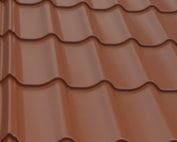
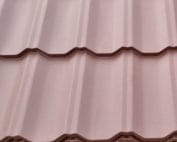
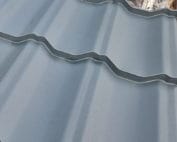
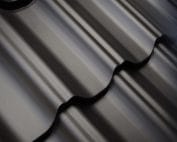
Modular tile-effect metal roofing with a coating offers a wide choice of profiles without the need for aggregate. Clear edges can suit a restrained form, and a gentle profile a traditional house. There is no need to attribute exclusivity for a particular style to one finish. The availability of matching flashings is also important. An accidental gloss on a barge board can disturb a carefully chosen roof appearance.
Do granules provide quietness and better insulation?
An additional layer on the sheet can influence the sound of raindrops. However, it cannot promise silence in every house. What is heard in the attic is determined by the entire roof: support, insulation, gaps and the lining on the inside. Acoustic data should relate to the tested assembly. The result of one product is not transferred to the entire group of coverings.
Granules are not a thermal insulation layer of the thickness needed to insulate an attic. The same applies to matt paint. Heat is retained by correctly designed insulation, for example made of mineral wool or PIR boards. Where space is limited, PIR can provide the required resistance at a smaller thickness. Mineral wool, in turn, has other advantages in terms of fire and acoustics. The choice of covering does not settle this comparison.

How should snow and installation rules be treated?
A rough surface can influence the behaviour of snow, but it does not replace the design of snow guards. Above an entrance, a walkway or a lower roof, the need for suitable barriers must be assessed. Lying snow still loads the structure. It cannot be assumed that a particular texture will always prevent the sudden sliding of the entire layer.
Products with a granular finish are sometimes fixed differently from popular coated modules. The instructions specify the position of fasteners, overlaps and batten spacing. The installer should know the chosen system, not just the general principles of sheet metal roofing. Mixing modules and accessories from different families can result in leaks. Equally important is correct cutting and the method of repairing damaged finish.
Does maintenance look the same?
Every covering requires the removal of dirt and a check of water drainage. The cleaning method must be matched to the surface. A brush or jet suitable for one coating may damage the layer of another product. On a roof with a granular finish, particular care must be taken to avoid mechanically wearing away the granules. Adhesive and random granules should not be selected independently for repairing defects.
With coated tile-effect metal roofing, small damage is repaired using the solution recommended for the coating. In both cases, it is worth keeping documentation and a small stock of material from the same delivery. The stock should be stored correctly. After years, an identical shade or profile may be more difficult to obtain. The length of the warranty alone does not mean there are no maintenance obligations.
How can the price of both solutions be compared fairly?
The price should relate to the m² of effective coverage. If the product is sold by the piece, the coverage area of the module is calculated first. Then the waste resulting from cutting is added. Separate items are flashings, ventilation, fasteners, transport and labour. On a complex roof, the cost of dedicated corner and end pieces may be significant.
Compare two complete sets for the same roof slope geometry. Ask for a description of the coating, the warranty conditions and the scope of service. If your main priority is a matt finish and a regular pattern, a popular modular tile-effect metal roofing may meet expectations without a granular finish. If a mineral texture is key, look at the variant with granules. The choice should be determined by the visible effect and proven documentation, not by a slogan about better coverage alone.
7 branches. Materials closer to your project.