Installation and details
Which modern construction methods are worth considering?
Modern construction is not about choosing the newest products, but about matching the degree of prefabrication to the specific project. Before deciding, check access, transport and the ability to store large elements. A solution that is quick on a large site may be troublesome on a cramped plot. A sandwich panel requires the correct arrangement of supports and connections, and the core type is selected for the expected parameters. The core name alone does not guarantee the safety of the entire wall. What counts is the classification of the specific partition and how it is made.
Why are more and more elements prepared in advance?
Prefabrication allows part of the work to be moved from the construction site to controlled production conditions. It applies to structures, building envelopes and finishing elements. Repeatable dimensions make it easier to plan installation and deliveries. However, the benefit depends on the accuracy of earlier arrangements. A measurement error can be repeated throughout the entire ordered batch.
Not every construction project requires maximum prefabrication. Access, transport and storage capacity are important. A large ready-made element needs space for unloading and suitable equipment. Therefore, modernity also consists in matching the degree of preparation to the specific project. A solution that is fast on a large site may be problematic on a cramped plot.
What role do sandwich panels play?
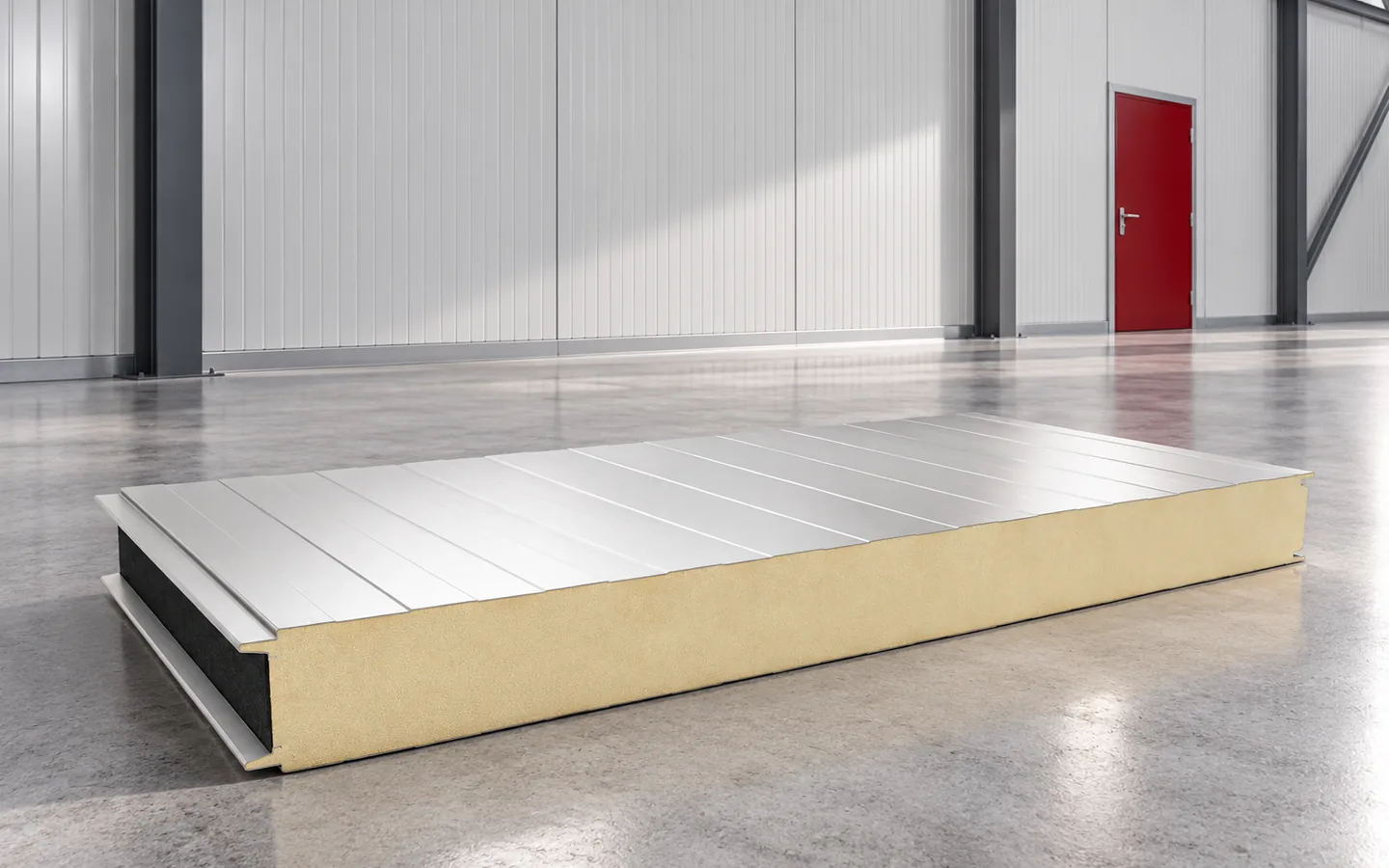
A sandwich panel combines metal facings with a core. It can form a wall or a roof, in accordance with the intended use of the given profile. It allows the building to be enclosed efficiently, but requires a proper arrangement of supports and connections. A wall panel is not an arbitrary substitute for a roof panel. They differ in geometry, water drainage and operating conditions.
The type of core is selected according to the expected parameters. PIR helps to reduce the thickness needed to achieve a given level of insulation. Mineral wool may meet other fire and acoustic requirements. A conclusion about the safety of the entire wall should not be drawn from the name of the core alone. The classification of the specific building envelope and the way it is constructed are what matter.
Where are structural steel sheets used?
High trapezoidal profiles can serve as the load-bearing substrate for a roof. Further layers, such as insulation and waterproofing, are laid on them. Their selection takes into account spans, loads, deflections and fixing. Load-bearing profiled steel sheet is not merely a thicker version of decorative cladding. It has a defined function in the structural design.
Such a solution facilitates the creation of large surfaces, but requires control of openings and installation loads. Service penetrations cannot be cut arbitrarily, nor can heavy packs be stored in random locations. Cooperation between the designer and the contractor is as important here as the product itself. A well-developed plan helps to avoid later reinforcements.

Why is insulation compared differently than before?
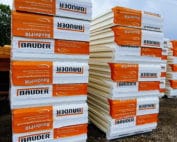
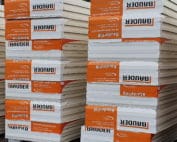
Thickness alone does not indicate how effective a layer will be. Thermal conductivity, joints and thermal bridges must be taken into account. PIR insulation can be advantageous where space is limited. At a similar thermal resistance, its layer is often thinner than a layer of material with higher lambda. This is a spatial advantage that can be calculated for specific products.
However, moisture, fire and loads must not be overlooked. XPS, EPS and mineral wool have variants designed for different conditions. Comparing them solely with the cheapest or weakest variant gives a misleading picture. A good design matches the material to its location in the building. It does not try to replace all products with one universal board.
What does digital documentation provide?
The model and precise drawings make it easier to coordinate structure, services and building envelope. Clashes between a duct and a support can be detected in advance, or the position of a roof penetration can be determined. The documentation also helps prepare a cutting plan and bill of materials. Its value depends, however, on the data being up to date. A nice visualisation does not confirm correct calculations.
Changes made on site should be incorporated into the as-built documentation. This ensures that later maintenance knows where the fasteners and concealed layers are located. This is particularly important for photovoltaics and building extensions. The digital record does not have to be complicated. Even organised drawings, photos and a material list can prevent many misunderstandings.
How should promises of new technologies be assessed?
Ask about a measurable benefit for your building. It could be shorter installation, a thinner building envelope or easier repair. Check whether the cost includes the necessary accessories and equipment. Some solutions save time on site but require greater precision in preparation. It is worth including both stages in the comparison.
The availability of documentation and parts is important. The system is meant to serve for years, including after a change of contractor. A modern building should be maintainable and repairable. Therefore, parameters, a proven detail and a clear way of use are a better basis for selection than a fashionable slogan. Such an assessment allows you to take advantage of new possibilities without unnecessary experiments.
Finally, check who is responsible for connecting the individual systems. Most errors often occur at their interfaces. A good wall material and a good roof still need a correct common detail at the eaves and parapet.
7 branches. Materials closer to your project.