Costs of new construction
How much does a square metre of sandwich panel cost and what are you really buying?
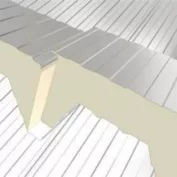
The price per square metre of a sandwich panel describes a specific product and a method of calculation. It does not yet tell you how much you will pay for the complete set of components or for the finished wall. To assess an offer, you need to combine the rate with dimensions, quality and scope of delivery. A simple calculation allows you to compare the cost per unit, per order and for the enclosure after installation. Ask whether the calculation is based on cover width, overall width or another rule stated in the offer. The cover width defines the module repeated after correct connection of the elements. The part forming the joint does not provide a separate strip of finished wall. Do not count it again as usable area.
First establish which metre is being priced
Also check the length adopted for invoicing, the method of rounding quantities and the minimum order value. The offer may relate to whole available pieces, even though the project requires shorter sections. A clear billing unit allows the price of the product itself to be separated from the effects of its format for a specific construction project.
Record this rule next to the price in the spreadsheet, so that a later change of supplier does not unnoticedly change the basis of the calculation.
How do you convert the rate into the price of a single unit?
Let us assume a panel with a billing module of 1.15 m and a length of 3.2 m. Its area is 3.68 m². At an agreed net price of €34.02/m², one piece costs €125.19. Twelve such elements give 44.16 m² and €1,502.28 net. This is an arithmetic example, not a current market quotation.
If you need a section 2.9 m long, do not automatically assume that you pay only for that length. The seller must confirm the possibility of cutting and the basis of billing. The remainder has value for the construction project only when there is a use for it that complies with the design. Keeping it in storage alone does not reduce the cost of the completed partition.
Which product features must be compared together?
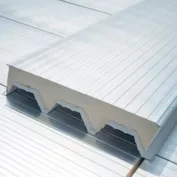
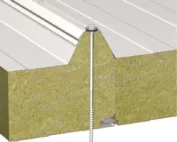
Put the core type, thickness, both facings, profiling, coating and colour into one table. Add the fixing method and documented parameters. Do not compare a wall panel with a roof panel solely by thickness. The lock arrangement and the shape of the outer steel sheet result from a different mode of action and water drainage.
The name of the core is not sufficient to assess load-bearing capacity or fire classification. The U-value for a given panel is not the lambda of its insulation material. If the cheaper item has a different specification, the designer should check whether it can be used. The saving exists only with a solution that meets the requirements of the building and its location.

Why can a higher rate result in a lower total?
Let us assume two possible cutting layouts for the same finished surface of 160 m². Variant A requires purchasing 180 m² at an agreed €32.17, that is €5,790.60. Variant B needs 168 m² at €34.95, that is €5,871.60. At the material stage alone, the difference is only €81.00, despite a clearly different unit price.
If the additional cutting and details cost the assumed €312.46 in A and €106.47 in B, the totals rise to €6,103.06 and €5,978.07. In this model, B is cheaper by €124.99. All amounts are net assumptions. Other identical costs have been omitted; in a real comparison, both the quantities and the full scope must be confirmed.
Which items are not visible in the panel price?
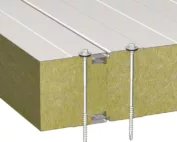
Flashings, fasteners, sealants, transport, unloading and installation may occur separately. Accessories are billed in various units: linear metres, pieces or packs. Their rates must not be added together as if each meant złoty per square metre. First calculate the required quantities and the value of each item.
In a small order, the organisation cost can be significant per metre. The building height, the length of the elements and access to the workplace, on the other hand, affect the equipment. Compare two separate totals: the purchase of the panels and the execution of the agreed cladding. This makes it clear what the choice of material changes and what results from the site conditions.
How do you write a comparable price enquiry?
Give all bidders an identical list of dimensions, the number of pieces and the technical requirements. Ask them to state the unit, the net or gross price and any exclusions. If the batch has a reduced commercial grade, describe the permitted defects and the elements intended for rejection. A cheap metre of panel that is unusable in the project still burdens the budget.
The deadline and the validity of the quote should be unambiguous. If the colour, claddings or lengths change, update the calculation instead of carrying over the old rate. Base the final choice on the same finished area and specification, and keep the material price per metre alongside. Both indicators answer different investor questions.
Questions and answers
Does the price per metre mean the price of the whole panel?
No. The price per piece is calculated from the agreed billing area and the rate. The width, length and the rules for selling whole elements must be confirmed.
Can net and gross offers be compared?
Only once they have been brought to the same basis. In every total, the scope of materials, labour and additional services must also be kept identical.
7 branches. Materials closer to your project.