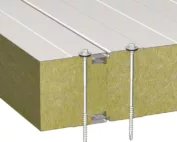
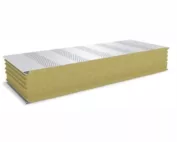
Installing sandwich panels
How many sandwich panel fixings does your support layout require?
It is worth replacing the question of the number of screws per metre with the question of the number of fixings in each field of the wall or roof. Loads are not distributed evenly everywhere, and different fasteners have different tasks. In a new building, the schedule is produced from the support plan, wind zones and the specific panel. Only then can the average purchase quantity be calculated. A square metre of panel, a linear metre of its length and a metre of flashing are different units. If the question does not specify the basis, a numerical answer can be misleading. Equally important is the distinction between structural fixing screws and fasteners for thin finishing elements.

First establish what a metre means
In the schedule, list main fastenings, system-approved stitching and flashings separately. Several proper connections to the support cannot be replaced by a larger number of small sheet screws. Each item should have a specified type, scope of application and unit of settlement.
Read the diagram from the design
For each panel, indicate the supports on which it is to be fixed. Then assign the number and arrangement of fasteners required for that location. The plan should account for corner zones, edges and areas of higher wind suction.
The choice depends on the facings, core, joint and substrate. In a concealed system, a strip or pressure-distributing element may also be important. The support spacing affects the force transmitted by each connection, so the number of fasteners is not selected independently of the structure.
Calculate an example, not an installation instruction
Assume, solely to show the calculation, that the approved design specifies 18 panels, with 3 support lines per panel and 2 fixings on each of these lines. This gives 18 × 3 × 2 = 108 main fasteners. This is not the recommended number for any wall.
Assume further that the design requires one additional fastener on each of the 3 supports for the 6 edge panels. This adds 18 pieces, bringing the total to 126. The example shows how to account for zones; it does not justify the adopted scheme without calculations and verification of the specific solution.
Add flashings according to their actual layout
Base flashings, corners, reveals and roof flashings have their own fixing rules. Their length, division into sections and method of forming laps are needed. The number of screws depends on the detail and the substrate, not just on the total linear metres of sheet.
Check whether the offer includes all required types of fasteners. A screw of similar length may have a different tip or washer. A well-prepared list reduces the risk that a missing type will be replaced on site with the first available item without checking its suitability.

Settle the revised opening before the final order
If the gate was enlarged during the project, the number of panels and supports around it may change. The earlier screw schedule then becomes outdated, even if the total wall area has decreased only slightly. Shorter sections may require a separate arrangement of connections.
The list should therefore have a defined version consistent with the elevation drawing. Supplementing the order based on a percentage of the area alone will not show what type of fastener is needed at the new frame. Also check the substrate material: the lintel may differ from typical rails. This keeps the schedule a construction tool, not just a sum of pieces in the cost estimate.
Show purchase reserve separately
The reserve serves work organisation and covers justified losses; it does not replace designed connections. If for the example of 126 pieces you purchase only a 5% reserve, you get 132.3 pieces and, after rounding, 133. The actual order quantity may also result from the packaging.
This should not lead to the conclusion that a five-percent reserve is the norm for every project. Determine it in line with work organisation and the availability of replenishment. For small accessories concealed in joints, a few missing pieces can stop the installation of an entire field.
Check execution before closing the joints
The number of elements is only one criterion. Their position, type, anchoring and correct pressure must be checked. A larger number of incorrectly seated fasteners does not give an equivalent connection. The panel should not be deformed in order to pull it to the curve of the support.
In systems with concealed fixing, the check is carried out before covering with the next panel. It is worth documenting deviations and how incorrect holes were remedied. The final as-built schedule should correspond to the actual arrangement, especially if holes or panel lengths were changed.
Questions and answers
Is the average number of screws per m² useful for the cost estimate?
Yes, as the result of a verified layout and an indicator for initial comparison. However, it should not serve as a standalone instruction for the arrangement of fasteners.
Is one screw always added at the corner?
No. The extent of the change results from the loads and the load-bearing capacity of the connections. The addition in the example is purely a calculation assumption, not a universal rule.
7 branches. Materials closer to your project.