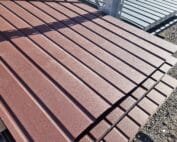
Trapezoidal steel sheets
Why must sheet thickness be selected together with the profile and supports?
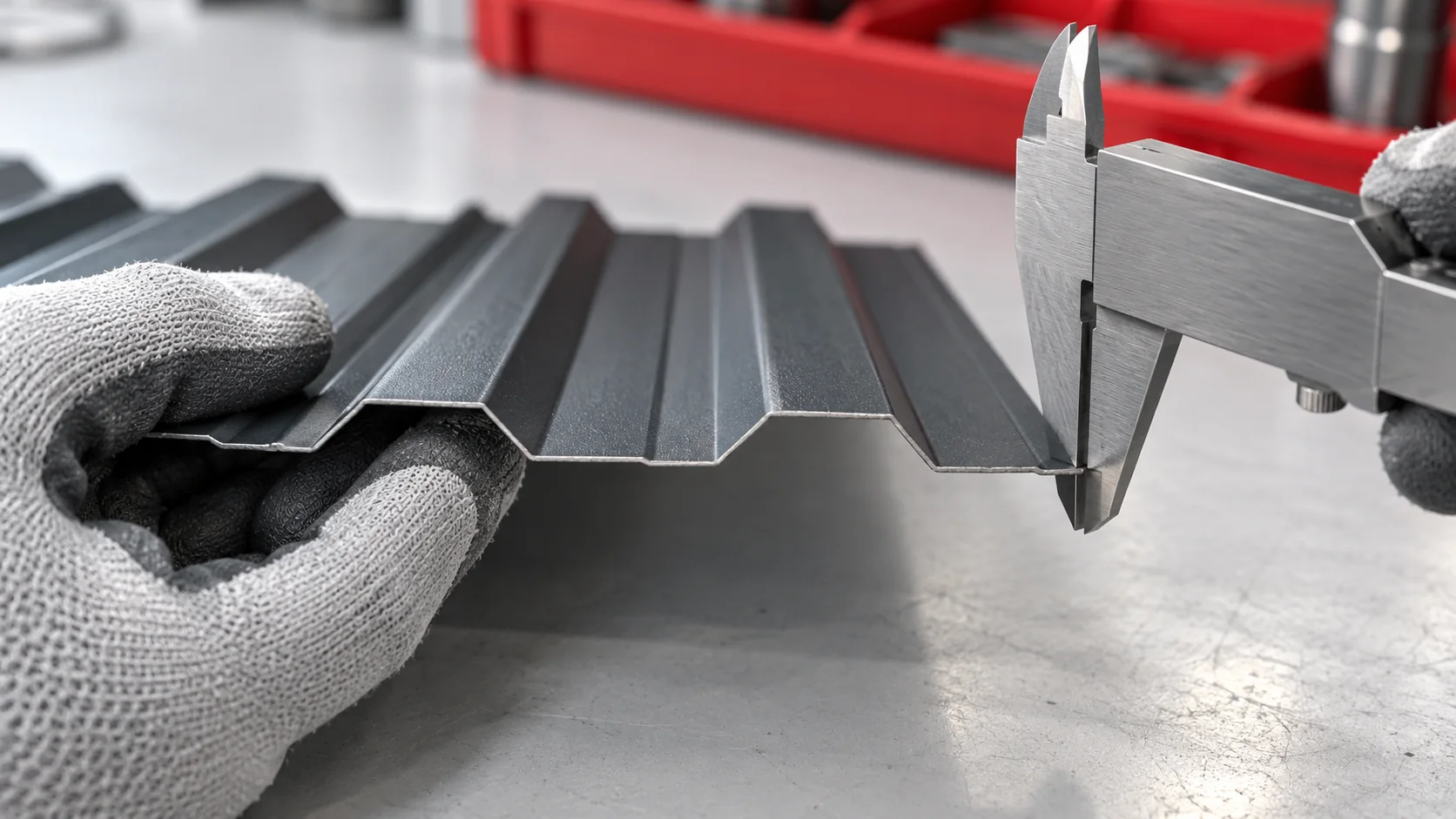
There is no single sheet thickness suitable for every roof. The sheet works together with the ribs, supports and fasteners. The choice of 0.5 or 0.7 mm should follow from the load and the specific section. Thicker material can improve the properties of the system, but it will not fix faulty construction or incorrectly selected fasteners. It must be established whether the stated value describes the nominal steel thickness and according to which rules it has been declared. Protective coatings are separate layers. Measuring the total thickness of the finished sheet does not automatically separate them from the core. Therefore, simply applying a calliper does not replace identifying the material.
What does the thickness stated in the offer mean?
In selected families of cladding sheets, for example 0.5, 0.6 and 0.7 mm are found. Availability depends on the profile, colour and coating. This does not mean that every thickness is suitable for the same support spacing. The profile, thickness and steel grade should be recorded together in the design and in the order. Only this set allows the correct data to be consulted.
Why does a millimetre alone not describe load-bearing capacity?
A flat sheet and a sheet formed into a deep trapezoid behave differently, despite the same thickness. The height, width and arrangement of the section walls matter. The steel grade also counts. Comparing only two thickness numbers omits a large part of the information about the performance of the covering.
It should not be assumed that increasing the thickness by a given percentage gives the same percentage increase in permissible support spacing. Various conditions may determine the result: strength, deflection, behaviour at the support or the connection. A table or a calculation for exactly this variant is needed for verification. Data for a similarly named profile can lead to an incorrect choice.
Which loads must be taken into account?
Snow and wind, among other things, act on the roof. Their values depend on the location and the geometry of the building. At edges and corners, conditions may differ from the middle of the roof slope. Near a higher part of the building, local snow accumulation must also be assessed. An open canopy is not the same in terms of load as a tightly closed hall.
The roof layers and planned installations are added to the design. If a device requires forces to be transferred to the structure, it cannot be supported solely on thin covering. Thicker sheet is not permission for arbitrary walking on the roof slope. The manner of movement and the safety measures for the works must correspond to the given roof and the installation stage.

What does the spacing and width of supports change?
The same sheet can perform in a single-span or multi-span system. The number of supports, their spacing and the bearing width affect the result. It must also be checked whether the actual substructure corresponds to the assumptions in the table. It is not enough that the purlins are “more or less” in the same positions.
The bearing plane is important. Curved or unstable elements can force deformation of the covering. Fastenings are checked separately with regard to the substrate and the forces acting on them. In practice, the choice between thicker steel sheet and changing the supporting structure should be based on a comparison of two complete variants. Buying a stronger sheet alone does not determine which system will be correct and cheaper.
How does thickness affect the weight and handling of the sheet?
For one example profile, T18, the weight of the 0.5 mm version is 4.43 kg/m² of effective coverage, and of the 0.7 mm version 6.20 kg/m². One hundred square metres of such material weighs approximately 443 and 620 kg respectively. The difference is 177 kg. The values relate to this cross-section and the specified configuration, not to all trapezoidal steel sheets.
Greater weight affects unloading and handling of the elements. A long sheet still requires adequate support during lifting. A small thickness does not mean, in turn, that the material can be bent freely. Before ordering, establish the lengths that can be handled on site. The production dimension and the convenient installation format are not always identical.
How to decide before installing the roof?
Provide the designer with the selected cross-section, thickness and support conditions. The verification should cover the properties of the sheet as well as the fastenings. Then compare the cost of the entire system with any alternative. In the quote, keep the same coating and scope of accessories so that the difference does not result from an accidental change in the quality of protection.
Once selected, do not change the thickness independently at the ordering stage. If another variant is available, its suitability must be confirmed. On delivery, compare the markings with the confirmed specification. A well-chosen thickness is the result of an agreed design. It does not have to be the largest in the catalogue, but it must match the actual task of the sheet on your roof.
Questions and answers
Is 0.5 mm sufficient for a garage roof?
It may be sufficient in a specific solution, but this requires verification of the profile, loads, supports and fastenings. The building name alone does not provide the answer.
Does a thicker coating replace thicker steel?
No. The coating mainly serves protective and aesthetic purposes. It should not be treated as a substitute for the mechanical parameters of the steel core.
7 branches. Materials closer to your project.