Purchasing for the project
Buying panels for a project in Wrocław: how to compare regional suppliers
Purchasing sandwich panels in Lower Silesia should be based on the build’s requirements and the real cost of the finished cladding. A nearby point of sale can make it easier to view the material, but the choice is also determined by matching lengths, available accessories and transport. Comparing several complete quotes gives more than just a claim about a large warehouse. A heated workshop near Wrocław needs different panels from a seasonal storage shelter. Note the interior temperature, planned openings and project requirements. Add the address and access conditions. A short distance on the map does not describe the width of the entrance gate, the turning radius or the load-bearing capacity of the yard.
Start with the location and the build programme
In a region with varied terrain, loads must be related to the specific location. Do not transfer the support spacing from a building in a neighbouring town. Present the same specification to the supplier as to the designer and contractor, so that everyone assesses one cladding variant.
Write down what has to fit together
The purchasing list should distinguish between wall and roof panels, thicknesses, facings, coatings and installation direction. Give the length and number of pieces for each item. Include flashings for corners, plinths, openings and eaves. The total square metreage alone leaves the supplier too much room for different interpretations.
If the plan covers several stages, note the required compatibility of the next batch. The same RAL colour does not guarantee an identical gloss or texture. A similar joint profile also does not prove that the products can be correctly joined together. Such matters are checked against the documentation for the specific system.
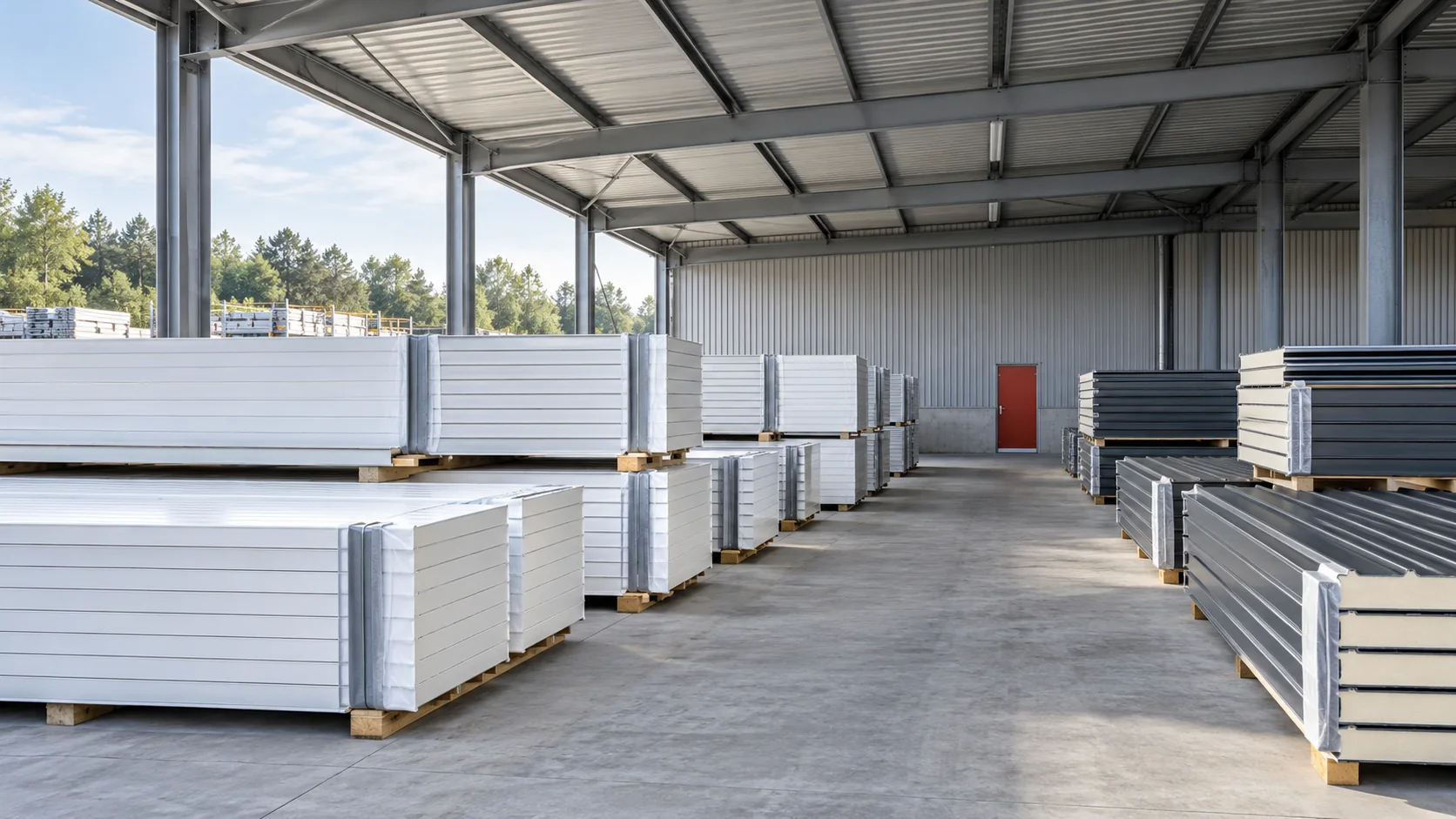
In the enquiry, state whether unloading from the side of the vehicle is possible and how much space the support for long packs will take up. This information allows the feasibility of delivery to be assessed. It is not replaced by a general statement that the plot is on a public road.
When does viewing the material on site help?
When buying a non-standard batch, it is worth inspecting representative panels from different places in the pack. Check the surface in side light, the ends, the edges and the way they are marked. The inspection allows the appearance to be assessed, but does not replace documents concerning load-bearing capacity, thermal insulation and fire classification.
For second-grade items, a description of the reason for the downgrade in commercial grade is needed. A scratch on the concealed side and damage to the joint have different consequences. Record which pieces and which defects you accept. If the building requires a uniform front façade, show the supplier its drawing and the planned direction of light.

Calculate transport for specific lengths
For the assumed 280 m² of walls, offer A at €32.87/m² gives €9,203.60. Let us add the assumed €208.30 for transport and €138.87 for unloading: a total of €9,550.77. Offer B at €31.71/m² gives €8,878.80, but with transport of €555.48 and unloading of €162.01 the total is €9,596.29. These are purely example net amounts.
This difference shows the point of comparing the whole, not the advantage of a specific supplier. Even greater importance may attach to matching lengths to the cutting plan. If more unusable offcuts remain from the cheaper batch, the cost per metre of the completed wall rises despite the lower purchase price.
How can you check the quality of technical support?
Ask what documents are available for the specified panel and whether the offer includes all selected accessories. With an unusual opening or a long dark façade, the route to resolving a technical problem matters. A promise that the material is suitable for everything does not replace checking the specific configuration.
A well-prepared enquiry makes it easier to obtain a useful answer. Attach a sketch with axes, the position of openings and the interior temperature. Clearly separate the question of availability from the question of suitability. A panel may be waiting in the warehouse and yet not fit the purlin spacing or the wall requirements.
Compare confirmed items, not declarations
In the comparison, note the net price, quantity, transport cost, unloading, flashings and the scope of documentation. Check the validity period of the quote and the possibility of reserving a specific batch. Where the material requires production, include the time for agreements, not just the expected loading date.
Do not judge a point of sale by the slogan “largest” or “cheapest” if it is not known exactly what the comparison covers. For your build, what counts is a consistent complete set and a feasible date. Before payment, make sure that the final length schedule matches the latest version of the design and the agreed installation plan.
Questions and answers
Will a local purchase always be cheaper?
No. A shorter journey may help, but the total price also depends on quantity, lengths, accessories and unloading. Compare the complete set at the same level of detail.
Does a photo of the package confirm the quality of all the panels?
No. For a batch in varying condition, a description of the individual elements and the opportunity to assess them are needed. A photograph does not confirm technical parameters or the compatibility of the seams.
7 branches. Materials closer to your project.