Choosing the covering
How does roof shape help you choose modular or made-to-measure tile-effect metal roofing?
The format of tile-effect metal roofing should be matched to the roof geometry and the organisation of works. A long sheet can be convenient on a rectangular slope. Smaller modules give greater freedom with hips and difficult access. No format guarantees the lowest price or zero waste. The answer is given by the layout of elements on the actual dimensions of the structure. A made-to-measure sheet is produced to a specified length within the limits of the given system. Its width and the rhythm of the profiles remain fixed. This does not mean that any rectangle can be ordered without taking cut locations into account. With a longer strip, the termination at the eaves and ridge must also be determined.
What does a made-to-measure sheet mean, and what does a module mean?
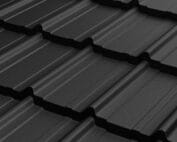
The module has a repeatable, smaller format. An example flat covering uses a module length of 320 mm and a cover width of 1210 mm. This is a specific geometry, not a standard for all tile-effect metal roofing. Small elements are laid according to the rules of the given joint. The number of pieces required is not determined solely by dividing the roof area by the module area.
When does a simple slope favour long sheets?
On a rectangular roof, parallel strips can be planned from the eaves to the top edge. If the permissible length and logistics allow it, the number of transverse joints is reduced. This makes installation easier to organise. However, it does not exempt you from checking the diagonals, the support and the line of the first sheet.
The benefit disappears when a long strip later has to be divided because of a chimney, transport or limited lifting space. Before ordering, check the delivery route and the space next to the building. The sheet should not be bent during carrying. The format is therefore matched to the entire path of the material: from the vehicle to the place on the roof slope.
What do modules offer at roof valleys and dormers?
Smaller elements are easier to arrange on short and variable sections. On a roof with many hips and valleys, the need to handle large, heavily cut sheets can be reduced. The final saving depends, however, on the shape of the roof slope and on whether the remaining pieces actually fit in other places.
Do not rotate offcuts arbitrarily just to use every piece. The direction of flow, the arrangement of the seams or the appearance of the coating may not match. A well-prepared cutting plan shows which pieces will be reused. The rest must be honestly counted as waste. The module makes organisation easier, but it does not remove the rules governing how the covering works.
How accurate must the measurement be?
With made-to-measure sheets, a length error can affect the entire ordered strip. A sheet that is too short requires a different solution, and one that is too long may require work on site. The measurement should take into account the actual structure, the overhang at the eaves and the detail at the top edge. Dimensions from the design must be confirmed before production.
Modules do not exempt you from accurate measurement. You need the rafter lengths, widths, diagonals and the positions of openings. The batten spacing must match the geometry of the covering. Changing the selected module after the battens have been installed may result in additional work. The format and the substructure should therefore be fixed in a single sequence before the team begins installation.

How do you compare two cutting plans?
Take the same roof drawing and prepare two schedules. In the first, record the number and lengths of the sheets. In the second, the number of modules, including full pieces and packs. For both, add flashings, fasteners, transport and labour. If the coatings differ in their parameters, the comparison of formats is no longer meaningful.
Assume, for the purpose of assessing the scope only, that the sheet variant requires the purchase of 174 m² of billable area and the modular variant 181 m². This does not yet decide in favour of the first. The rates must relate to the same surface basis, and the costs of handling and installation may differ. What matters is the final cost of a correctly executed covering, not the waste percentage alone.
What should you agree with the team before making the final choice?
Discuss how the material is transported onto the roof, where it is set down and the order of laying. With smaller modules, efficient handling of many elements is required. With large sheets, safe support during carrying is what counts. For both solutions, the right tools and cutting rules must be selected so as not to damage the coating.
Also ask about the future replacement of a section of the covering and about a small reserve of material. Access to a damaged spot depends on the joint layout, so a small format does not always mean a simple replacement of a single piece without touching the neighbouring ones. Choose the variant whose advantages suit the specific roof. The popularity of modules or sheets alone is not a technical argument.
Questions and answers
Is tile-effect metal roofing in modular form suitable only for complicated roofs?
No. It can also be used on simple roof slopes if it suits the design. The purchase quantity, the installation method and the cost of the whole variant must be compared.
Is a sheet cut to size always the length of the entire roof slope?
No. System, transport and design constraints may require a division. The transverse joint must then be made according to the rules of the selected covering.
7 branches. Materials closer to your project.