Costs and planning
What determines the cost of a tile-effect metal roof?
The price of tile-effect metal roofing depends on the material, coating, format and the quantity needed for a specific roof. Two rates per metre may refer to different areas. With modules, pricing is per piece. Before you compare quotes, convert them to the same unit and add the elements without which a complete covering cannot be made. A quote may show a total square metre, an effective square metre or the price of one module. The effective area describes the coverage after the elements are joined. The total area also includes the parts that go into the laps. You should not multiply the price per total square metre by the roof slope area without checking the layout.
Which metre are you actually paying for?
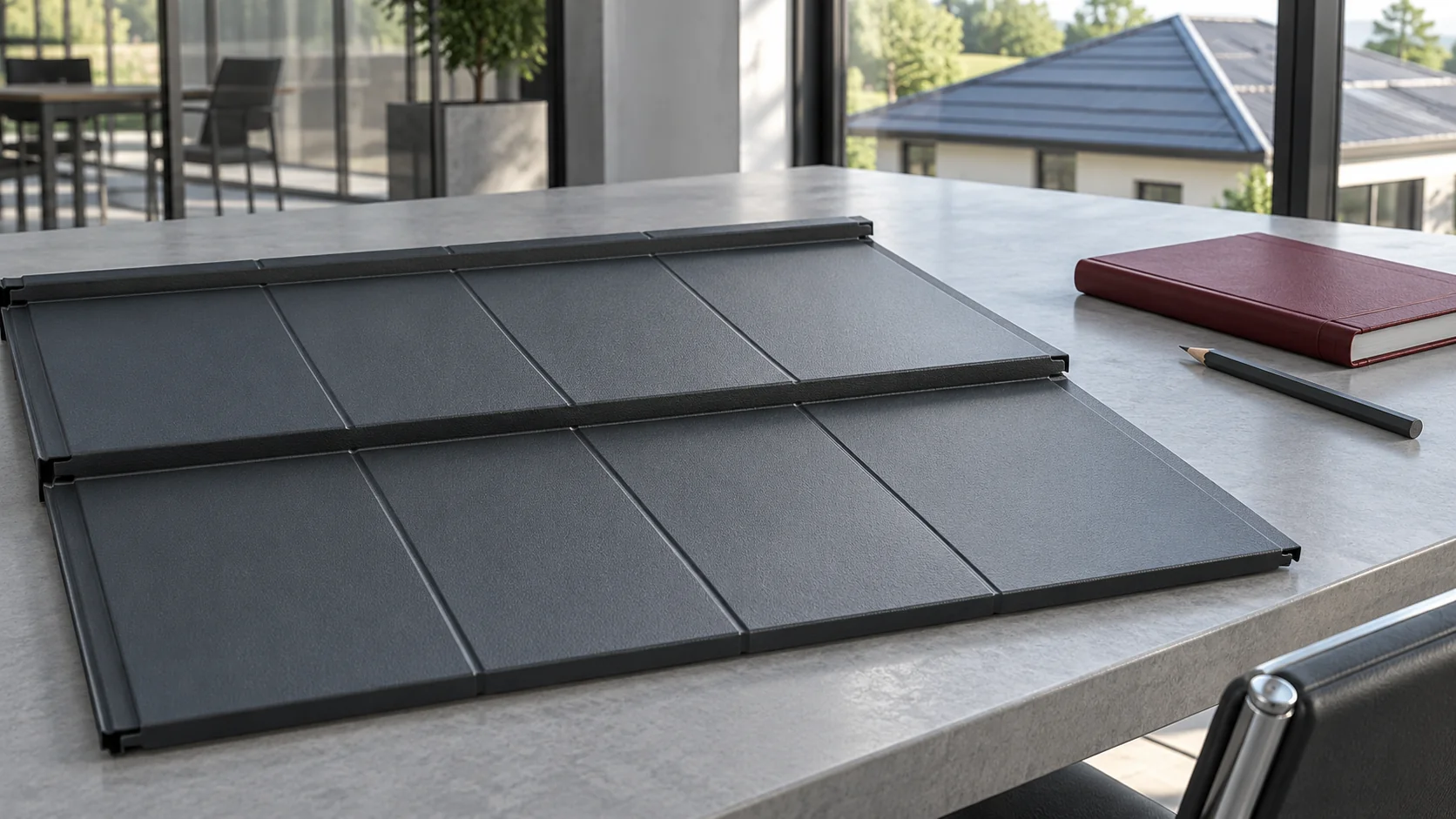
A flat module in this example has a declared cover area of 0.387 m². At an assumed €4.48 per module excluding VAT, its nominal cover costs €11.58/m² before VAT. The cost per square metre of finished roof is still unknown because cuts along slopes and edges leave some of the material unused.
What changes with the type of steel and coating?
Different materials may hide under a similar colour. What matters is the thickness and grade of the steel, the metallic protection and the type of external coating. Its parameters are selected for the environment and the expected appearance. A roof in a heavily polluted area or under demanding conditions should not be chosen solely on the cheapest colour option.
Compare exact variants. The term “mat” alone does not describe the entire protection. A thicker paint layer is also not the only quality criterion. Its composition, adhesion, resistance and conditions of application matter. If you change the coating during the quote, ask for the entire set of flashings and accessories to be updated so that the appearance remains consistent.
How does the format affect the quantity purchased?
On a simple slope, long sheets can reduce the number of transverse joints. On a roof with many slopes, what matters is the ability to use offcuts sensibly. Small modules make it easier to work with the format, but not every piece can be rotated and installed elsewhere. The profile direction and the joint edge still apply.
Do not assume a single waste percentage for all roofs. The calculation should follow from the arrangement of the elements. Also check the rules for rounding up to full pieces or packs. It is worth asking for two cutting plans if the choice between sheet and module remains open. Then you compare the actual purchase quantity, not a general promise of smaller losses.
How do you calculate an example with modules?
Suppose the cutting plan calls for 520 modules covering 0.387 m² each. Their combined nominal cover is 201.24 m². At €4.48 per module, the material costs €2329.60 excluding VAT. If the roof area is 190 m², the covering alone costs about €12.26/m² of finished roof before VAT.
The difference between €11.58 and €12.26 per square metre comes from the number of modules required at slopes and edges. The supplier’s price has stayed the same. The example uses a particular layout, so its quantities do not apply to every 190 m² roof. All prices are illustrative.

Which items should be added to the budget?
The covering also requires flashings, ridge elements, fasteners, seals and ventilation accessories. Calculate the initial covering, substructure, roof access and safety measures specified in the design separately. Check transport, unloading and the method of delivering material onto the roof slope. Compare labour quotes for the same scope.
Allow a further €879.51 for accessories, €208.30 for transport and handling, and €2129.34 for installing the covering. Including the modules, the example totals €5546.75, or about €29.19/m² of roof, all excluding VAT. Add the structure, insulation and internal finishes separately.
Where can savings be found without random substitutions?
First check the roof shape, the number of difficult details and the cutting layout. At the design stage, a simpler form can reduce work on roof valleys and flashings. Later, savings are harder because some decisions have already been made. It is also worth agreeing one complete delivery on a date that suits the crew’s work.
Do not remove items from the quote just because they are not visible in a photo of the finished roof. Fasteners, initial covering and ventilation have specific functions. If the budget requires a change, compare a complete alternative variant with confirmed parameters. Only then recalculate the final cost. This approach shows the saving that can actually be achieved on site.
Questions and answers
Is the price per piece harder to compare than the price per metre?
Simply divide it by the module’s declared coverage. Then you need to take into account the number of pieces resulting from the cutting layout, not just the geometric area of the roof slope.
Should the installation cost include all flashings?
The scope must be stated. The quote may bill flashings separately. For comparison you need the same list of works and information on which materials the contractor provides.
7 branches. Materials closer to your project.